
The Dawn of Unhackable Connections: Unveiling Quantum Networking Technology
An exploration into how quantum mechanics is revolutionizing communication, promising unparalleled security and computational power.
Quantum networking is a groundbreaking field that harnesses the peculiar principles of quantum mechanics to transmit and process information. Unlike classical networks that rely on bits representing either 0 or 1, quantum networks utilize quantum bits, or qubits. These qubits can exist in multiple states simultaneously (superposition) and can be intricately linked (entangled), enabling capabilities far beyond the reach of today's internet. This technology promises to revolutionize areas such as secure communication, computational power, and sensing.
Key Insights into Quantum Networking
- Revolutionized Security: Quantum networks offer inherently secure communication due to the no-cloning theorem, making eavesdropping attempts detectable and data transmission virtually unhackable.
- Enhanced Computational Power: By connecting multiple quantum processors, these networks can create powerful distributed quantum computing clusters capable of solving problems intractable for classical supercomputers.
- Next-Generation Sensing: Networks of entangled quantum sensors can achieve unprecedented precision in measurements, opening new avenues for scientific discovery and technological advancement.
The Quantum Realm: Fundamental Principles at Play
Quantum networking operates on principles that are fundamentally different from classical physics. Understanding these concepts is key to appreciating the transformative potential of this technology.

A conceptual illustration of interconnected nodes in a quantum network.
Qubits: The Heart of Quantum Information
The basic unit of quantum information is the qubit. Unlike classical bits, which can only be a 0 or a 1, a qubit can represent a 0, a 1, or a combination of both through a phenomenon called superposition. This allows qubits to carry significantly more information than classical bits. Qubits are often encoded in the quantum states of particles, most commonly photons (particles of light).
Superposition: Existing in Multiple States
Superposition is a core principle of quantum mechanics. It dictates that a quantum system, like a qubit, can exist in multiple states simultaneously until it is measured. Upon measurement, the qubit "collapses" into one definite state (either 0 or 1). This property is crucial for the enhanced information capacity and computational capabilities of quantum systems.
Entanglement: "Spooky Action at a Distance"
Entanglement is perhaps one of the most counterintuitive aspects of quantum mechanics. When two or more qubits are entangled, their fates are intertwined, regardless of the physical distance separating them. If you measure the state of one entangled qubit, you instantly know the state of the other(s), a phenomenon Albert Einstein famously called "spooky action at a distance." Entanglement is a vital resource for quantum communication protocols, distributed quantum computing, and quantum sensing.
The No-Cloning Theorem: A Foundation for Security
The no-cloning theorem is a fundamental principle stating that it is impossible to create an identical copy of an arbitrary unknown quantum state. This has profound implications for security: any attempt to intercept and measure (and thus copy) a qubit transmitting information will inevitably disturb its state. This disturbance can be detected by the communicating parties, alerting them to the presence of an eavesdropper. This forms the basis of Quantum Key Distribution (QKD).
Building Blocks of a Quantum Network
Constructing a functional quantum network requires a suite of specialized hardware and sophisticated protocols, distinct from those used in classical networking.
Transmission Media: Carrying Quantum Signals
Fiber-Optic Cables
Much of the current research and early-stage quantum network deployments leverage existing telecommunications fiber-optic infrastructure. Photons, encoded with quantum information, can travel through these fibers. However, photon loss and decoherence (loss of quantum properties) over distance are significant challenges.
Free-Space and Satellite Links
For long-distance and global-scale quantum communication, free-space optical links, including satellite-based quantum communication, are being explored. Satellites can overcome the distance limitations of terrestrial fiber by transmitting entangled photons through the vacuum of space, where signal loss is much lower. China's Micius satellite, for example, has successfully demonstrated entanglement distribution over record-breaking distances.
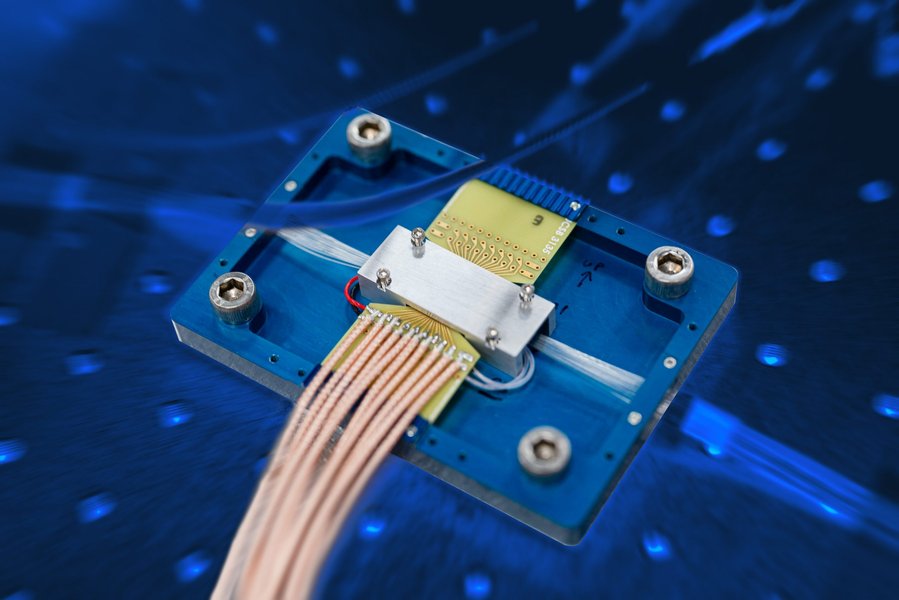
An example of specialized hardware: Cisco's Quantum Network Entanglement Chip, designed for quantum communication.
Quantum Processors and Memory Nodes
Quantum processors are devices capable of performing quantum computations on qubits. In a quantum network, these serve as end-nodes that can generate, manipulate, and measure quantum states. Quantum memory nodes are essential for storing quantum states temporarily, which is crucial for synchronizing operations across the network and for building quantum repeaters.
Quantum Repeaters: Extending the Reach
Due to the fragility of quantum states and the no-cloning theorem, classical signal amplifiers cannot be used in quantum networks. Instead, quantum repeaters are required to extend communication distances. These devices work by a process called entanglement swapping: they establish shorter entangled links and then connect them to create a longer entangled connection without directly measuring (and thus destroying) the quantum information being transmitted. The development of efficient and scalable quantum repeaters is a critical area of research.
Network Architecture and Integration
Quantum networks are envisioned to develop in stages, from simple point-to-point connections to complex, multi-user networks. They are not intended to replace the classical internet entirely but rather to coexist with it, providing specialized quantum capabilities. This necessitates hybrid architectures and interfaces that can bridge classical and quantum systems. Specialized optical switches and routers will also be needed to direct quantum traffic.
Visualizing Quantum Network Concepts
To better understand the interconnectedness of concepts in quantum networking, the following mindmap illustrates the key principles, components, applications, and challenges.
This mindmap highlights how foundational quantum principles enable the development of specialized components, which in turn support a range of powerful applications, all while researchers work to overcome significant technological challenges.
Quantum vs. Classical Networking: A Comparative Look
The following radar chart offers a comparative perspective on various aspects of classical networking versus the current state and future potential of quantum networking. The scores are illustrative, representing qualitative assessments rather than precise quantitative data, scaled from a minimum of 30 to a maximum of 100 for visual clarity.
This chart visually contrasts how classical networks excel in maturity and scalability currently, while quantum networks promise superior security and data density, though facing challenges in cost, current scalability, and long-distance transmission without advanced repeaters.
Operational Aspects and Protocols
Quantum networks function by generating and distributing quantum states, primarily entangled qubits, between nodes. One of the most developed applications is Quantum Key Distribution (QKD). In QKD, two parties can establish a shared, secret cryptographic key. The security of this key is guaranteed by the laws of quantum mechanics: any attempt to eavesdrop on the key exchange will inevitably disturb the quantum states, alerting the legitimate users. Quantum error correction codes are also crucial, as quantum states are very fragile and susceptible to noise and loss. These codes help protect the integrity of quantum information during transmission and processing.
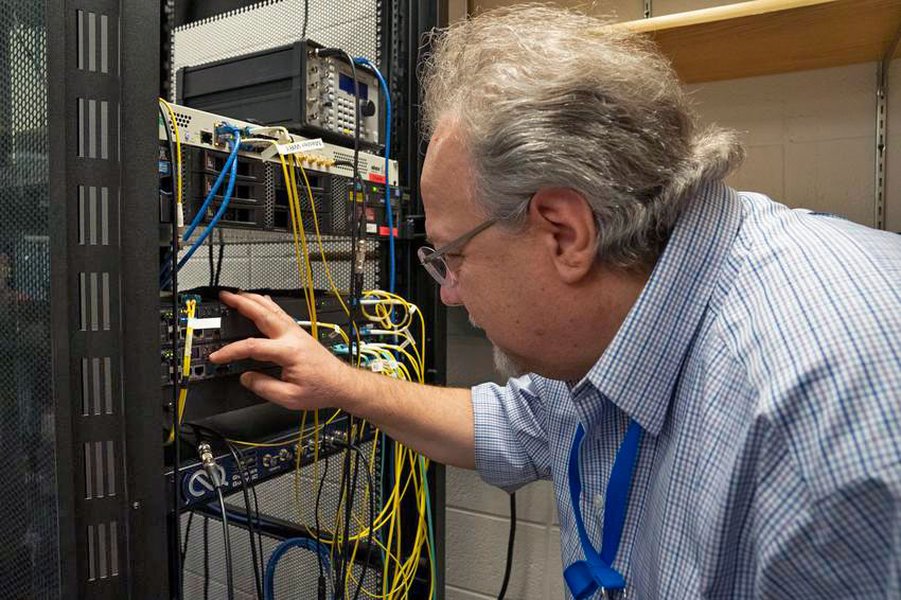
An experimental setup for quantum communication research, showcasing the intricate hardware involved.
Key Applications of Quantum Networking
The unique capabilities of quantum networks pave the way for revolutionary applications:
- Ultra-Secure Communication: QKD enables the creation of cryptographic keys that are theoretically unhackable, providing unprecedented levels of security for data transmission.
- Distributed Quantum Computing: By linking multiple smaller quantum computers, a quantum network can form a more powerful quantum computing cluster. This allows for tackling complex problems that are beyond the capacity of any single quantum computer.
- Enhanced Quantum Sensing: Networks of entangled quantum sensors can achieve far greater sensitivity and resolution than classical sensors. This has applications in fields like metrology, navigation, medical imaging, and fundamental physics research (e.g., detecting gravitational waves).
- Secure Access to Quantum Computers: Quantum networks can provide secure access to remote quantum computing resources, allowing users to run quantum algorithms without needing their own quantum computer.
- Precise Clock Synchronization: Entangled particles can be used to synchronize clocks with extreme precision, which is beneficial for financial networks, navigation systems, and scientific experiments.
This video, "Quantum Internet Explained," provides an accessible overview of the concepts behind quantum communication and its potential impact.
Comparing Classical and Quantum Networks
To clearly delineate the distinctions, the table below summarizes key differences between classical and quantum networking technologies.
| Feature | Classical Networking | Quantum Networking |
|---|---|---|
| Basic Unit of Information | Bit (represents 0 or 1) | Qubit (can be 0, 1, or a superposition of both) |
| Underlying Principles | Classical Physics (electrical/optical signals) | Quantum Mechanics (superposition, entanglement, no-cloning) |
| Information Copying | Easily copied and amplified | Cannot be perfectly cloned (No-Cloning Theorem); amplification is complex |
| Security Basis | Algorithmic (computational difficulty) | Physics-based (laws of quantum mechanics) |
| Signal Boosting/Extension | Amplifiers and repeaters | Quantum Repeaters (rely on entanglement swapping) |
| Primary Applications | General data transfer, internet services | Ultra-secure communication (QKD), distributed quantum computing, advanced sensing |
| Maturity | Highly mature and widely deployed | Emerging, largely experimental with some early commercial applications (e.g., QKD) |
| Data Transmission | Transmits classical information | Transmits quantum states (qubits) or uses quantum phenomena for classical tasks (like key distribution) |
Current State of Development and Future Challenges
Quantum networking is still in its nascent stages, though progress is accelerating rapidly. Several experimental networks and testbeds exist worldwide. For example, city-scale quantum networks have been demonstrated in locations like Bristol, UK, and Boston, USA, often utilizing existing fiber optic cables. China has made significant investments, establishing an extensive integrated quantum communication network spanning thousands of kilometers using both fiber and satellite links. The U.S. Department of Energy and various European initiatives are also heavily funding research and development in this area.
Despite this progress, significant challenges remain:
- Scalability: Building large-scale, multi-user quantum networks is a complex engineering feat.
- Distance Limitations: Qubit loss and decoherence in optical fibers limit direct transmission distances. Efficient quantum repeaters are crucial for overcoming this.
- Qubit Coherence: Maintaining the delicate quantum states of qubits for long enough periods to perform useful operations is difficult and often requires specialized, controlled environments (e.g., cryogenic temperatures for some qubit types).
- Error Correction: Developing robust quantum error correction codes that can function effectively in real-world network conditions is essential.
- Integration: Seamlessly integrating quantum networks with existing classical internet infrastructure presents technical and standardization hurdles.
- Cost and Complexity: Current quantum networking components are often expensive and require specialized expertise to operate.
Researchers anticipate that the first widespread applications will likely be in niche areas requiring ultra-high security, such as government and financial sectors, followed by broader applications as the technology matures over the next decade or two.
Frequently Asked Questions (FAQ)
What is the main advantage of quantum networking over classical networking?
Will the quantum internet replace the classical internet?
How do quantum networks achieve such high levels of security?
What are quantum repeaters, and why are they essential for long-distance quantum communication?
Conclusion
Quantum networking technology stands at the forefront of a new communication paradigm. By leveraging the fundamental principles of quantum mechanics, it offers the potential for unbreachable security, vastly increased computational power through distributed systems, and unprecedented sensing capabilities. While still in its developmental stages with significant technical challenges to overcome, the rapid pace of innovation and global investment signal a future where quantum networks will play a crucial role alongside classical networks, unlocking new possibilities across science, industry, and society. The journey towards a fully-fledged quantum internet is complex, but the transformative implications make it a compelling frontier of modern technology.
Recommended Further Exploration
- How does Quantum Key Distribution (QKD) work in detail?
- What are the latest breakthroughs in quantum repeater technology?
- Explore the differences between various types of qubits used in quantum networking.
- What are the leading global initiatives and projects in quantum network development?
References
 aws.amazon.com
Last updated May 21, 2025