
Unlock the Power of Order: Your Comprehensive Guide to Queue Data Structures
Master the First-In, First-Out principle and its applications with this step-by-step tutorial.
Essential Insights into Queues
- FIFO Principle: Queues operate on a "First-In, First-Out" basis, meaning the first element added is the first one removed, just like a real-world waiting line.
- Core Operations: Key actions include adding elements (Enqueue), removing elements (Dequeue), viewing the front element (Peek), and checking if the queue is empty (IsEmpty).
- Wide Applications: Queues are crucial in computer science for task scheduling, managing data buffers, handling web server requests, and implementing algorithms like Breadth-First Search.
Understanding the Queue Data Structure
What Exactly is a Queue?
In computer science, a queue is a fundamental linear data structure that follows a specific order for operations: First-In, First-Out (FIFO). Imagine a line of people waiting for movie tickets; the person who arrived first gets their ticket first. Similarly, in a queue data structure, the element that was inserted first is the first one to be removed or processed.
Queues store a collection of elements sequentially. Insertions are typically made at one end, called the rear or tail, while deletions occur at the other end, known as the front or head. This strict ordering makes queues ideal for scenarios where maintaining the sequence of arrival is important.
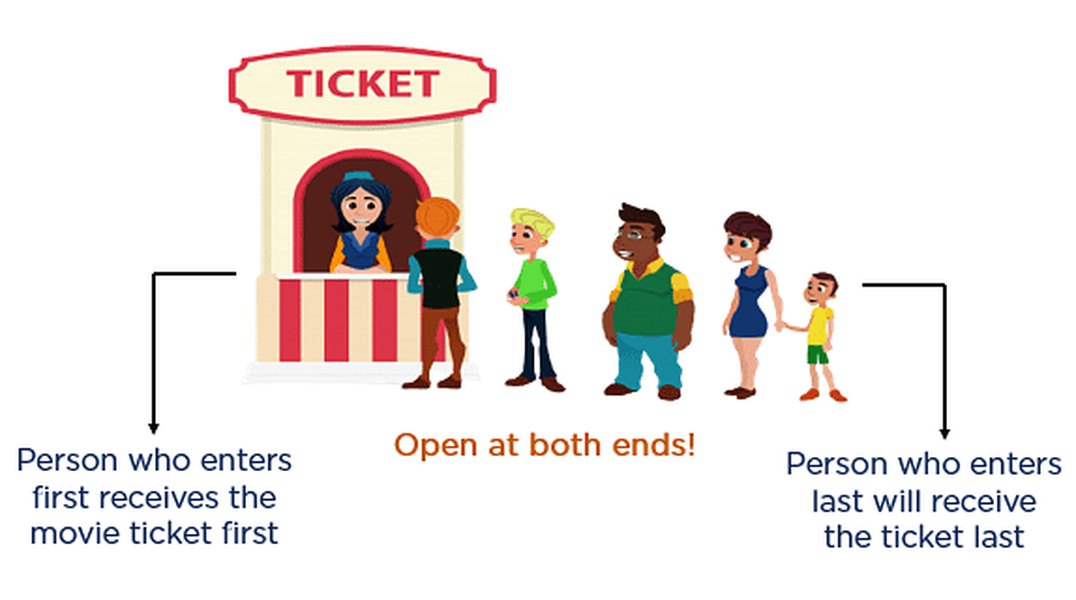
Real-world queues, like this ticket line, perfectly illustrate the First-In, First-Out concept.
Mastering Queue Operations
To effectively use queues, you need to understand their primary operations:
Enqueue: Adding an Element
The Enqueue operation adds a new element to the rear (end) of the queue. If you visualize the queue as a line, enqueueing means a new person joins the back of the line.
Dequeue: Removing an Element
The Dequeue operation removes and returns the element from the front (start) of the queue. This corresponds to the person at the front of the line being served and leaving.
Peek (or Front): Viewing the Front Element
The Peek (sometimes called Front) operation allows you to view the element at the front of the queue without removing it. This is useful for checking which element is next in line for processing.
IsEmpty: Checking for Emptiness
The IsEmpty operation returns a boolean value (true or false) indicating whether the queue currently contains any elements.
Size: Getting the Element Count
The Size operation returns the total number of elements currently present in the queue.
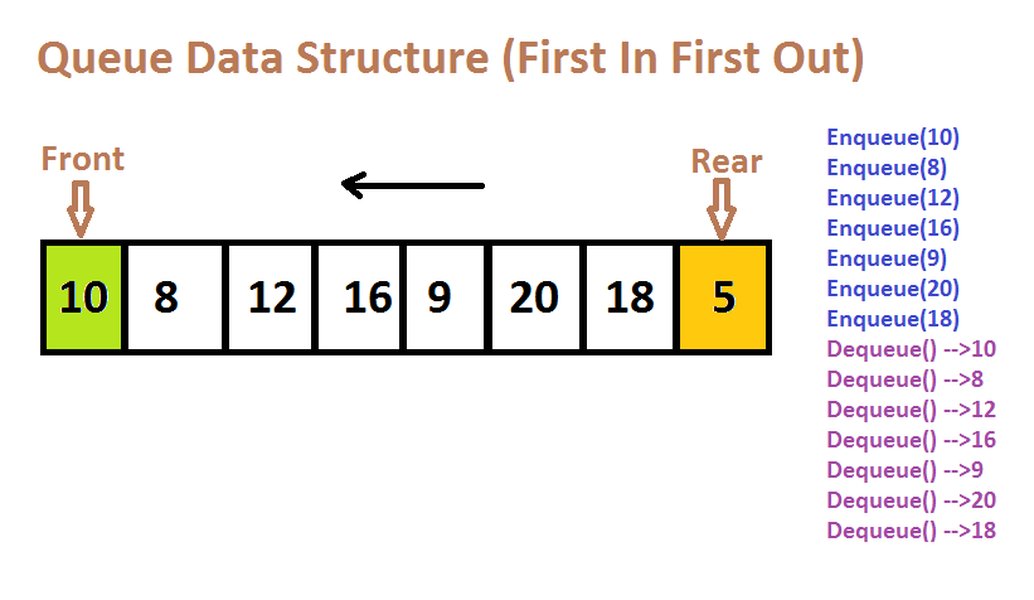
Visual representation of Enqueue (insertion at rear) and Dequeue (removal from front) operations.
Why and Where Are Queues Used?
The FIFO nature of queues makes them invaluable in various computing contexts:
- Task Scheduling: Operating systems often use queues to manage processes waiting for CPU time or resources like printers. Jobs are typically processed in the order they arrive.
- Buffering: Queues act as buffers in data streaming or network communication, holding data packets temporarily until they can be processed, ensuring smooth transmission.
- Web Servers: Handling incoming requests sequentially to manage server load and ensure fair processing for users.
- Breadth-First Search (BFS): A graph traversal algorithm that explores neighbor nodes level by level, using a queue to keep track of nodes to visit.
- Order Processing Systems: E-commerce platforms and ticketing systems use queues to process orders or bookings chronologically.
- Asynchronous Data Transfer: Used in messaging systems (like message queues) where data is produced and consumed independently, often at different rates.
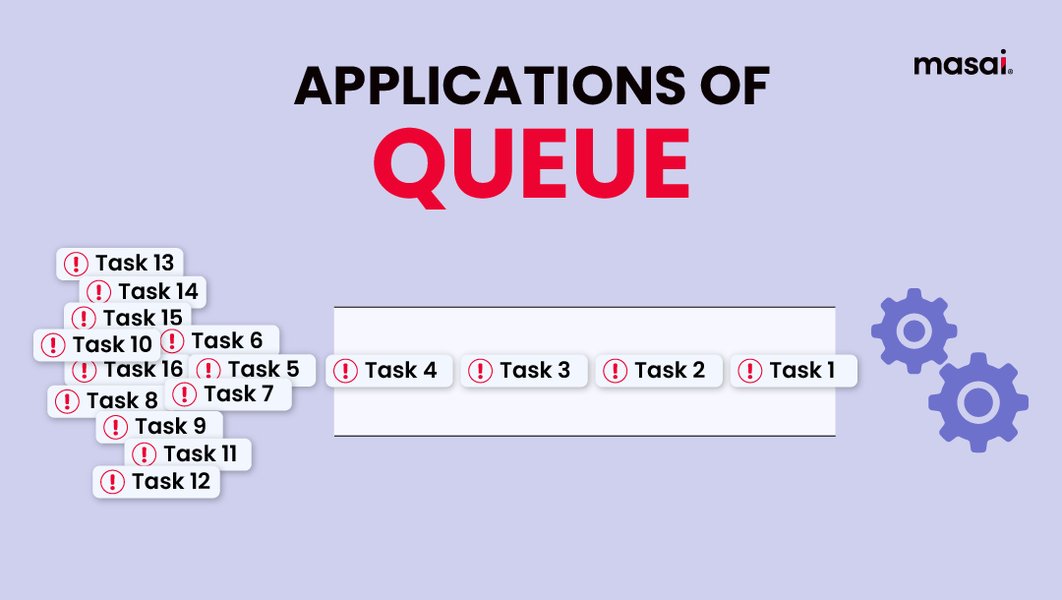
Queues find applications in diverse areas, from system processes to algorithms.
Exploring Different Types of Queues
While the basic queue is common, several variations cater to specific requirements:
- Simple Queue: The standard linear queue adhering strictly to FIFO.
- Circular Queue: An optimization, often implemented with arrays, where the rear index wraps around to the start of the array when it reaches the end. This reuses empty slots created by dequeue operations, improving space efficiency for fixed-size implementations.
- Priority Queue: Elements are dequeued based on an assigned priority rather than their arrival order. Higher priority elements are removed first. While queue-like, it doesn't strictly follow FIFO.
- Double-Ended Queue (Deque): A more flexible variation where elements can be added or removed from both the front and the rear.
Comparing Queue Variations: A Visual Analysis
Different queue types offer varying trade-offs in terms of performance, flexibility, and complexity. The radar chart below provides an opinionated comparison based on common characteristics (scale 1-10, higher is generally 'more' or 'better' depending on the characteristic):
This chart highlights how a Simple Queue excels in FIFO strictness but might be less efficient in fixed-size memory scenarios compared to a Circular Queue. Priority Queues offer element prioritization at the cost of FIFO, while Deques provide maximum flexibility for adding/removing elements from either end.
Implementing Queues: Code Examples
Queues can be implemented using various underlying structures, most commonly arrays and linked lists. Many programming languages also offer built-in queue implementations.
Implementation Using Arrays
Arrays provide a simple way to implement queues. However, dequeuing from the beginning of a standard array can be inefficient (O(n) time complexity) because subsequent elements need to be shifted. Circular arrays are often used to mitigate this.
Implementation Using Linked Lists
Linked lists are often more efficient for queues, especially for dequeue operations. By maintaining pointers to the head (front) and tail (rear) nodes, both enqueue and dequeue operations can typically achieve O(1) time complexity.
Example in Python
Python's `collections.deque` is highly optimized for queue (and stack) operations, providing O(1) appends and pops from both ends.
from collections import deque

# Initialize a queue
my_queue = deque()

# Enqueue elements
my_queue.append('Alice')
my_queue.append('Bob')
my_queue.append('Charlie')
print(f"Queue after enqueuing: {my_queue}")

# Dequeue an element
first_person = my_queue.popleft()
print(f"Dequeued element: {first_person}")
print(f"Queue after dequeuing: {my_queue}")

# Peek at the front element
if my_queue:
    print(f"Front element is now: {my_queue[0]}")

# Check if empty
if not my_queue:
    print("Queue is empty")
else:
    print(f"Queue size: {len(my_queue)}")
Example in JavaScript
JavaScript arrays can be used to simulate a queue using `push` (for enqueue) and `shift` (for dequeue). While convenient, `shift` can be inefficient for large arrays (O(n)). For performance-critical applications, a linked list implementation or a library might be better.
// Initialize a queue using an array
let myQueue = [];

// Enqueue elements
myQueue.push(10);
myQueue.push(20);
myQueue.push(30);
console.log(`Queue after enqueuing: [${myQueue.join(', ')}]`);

// Dequeue an element
let firstItem = myQueue.shift(); // Removes and returns the first element (10)
console.log(`Dequeued element: ${firstItem}`);
console.log(`Queue after dequeuing: [${myQueue.join(', ')}]`);

// Peek at the front element
if (myQueue.length > 0) {
    console.log(`Front element is now: ${myQueue[0]}`);
}

// Check if empty
if (myQueue.length === 0) {
    console.log("Queue is empty");
} else {
    console.log(`Queue size: ${myQueue.length}`);
}

// Custom Class Implementation (more structured)
class Queue {
    constructor() {
        this.items = [];
    }

    enqueue(element) {
        this.items.push(element); // Add to the end (rear)
    }

    dequeue() {
        if (this.isEmpty()) {
            return "Queue is empty";
        }
        return this.items.shift(); // Remove from the front (head)
    }

    peek() {
        if (this.isEmpty()) {
            return "Queue is empty";
        }
        return this.items[0];
    }

    isEmpty() {
        return this.items.length === 0;
    }

    size() {
        return this.items.length;
    }
}

const q = new Queue();
q.enqueue('Task 1');
q.enqueue('Task 2');
console.log(`\nUsing Queue Class:`);
console.log(`Front element: ${q.peek()}`); // Task 1
console.log(`Dequeued: ${q.dequeue()}`);   // Task 1
console.log(`New front element: ${q.peek()}`); // Task 2
console.log(`Queue size: ${q.size()}`);     // 1
Other Languages (Java, C++)
Languages like Java (with its `java.util.Queue` interface and implementations like `LinkedList` or `ArrayDeque`) and C++ (with `std::queue` in the STL) provide robust built-in support for queues.
Implementation Performance: Array vs. Linked List
The choice between an array-based or linked-list-based queue implementation impacts performance, particularly for dequeue operations. Here's a summary of typical time complexities:
| Operation | Array-based (Simple) | Linked List | Python `deque` / Circular Array |
|---|---|---|---|
| Enqueue | O(1) amortized* | O(1) | O(1) |
| Dequeue | O(n) | O(1) | O(1) |
| Peek/Front | O(1) | O(1) | O(1) |
| IsEmpty | O(1) | O(1) | O(1) |
| Size | O(1) | O(1)** | O(1) |
* Amortized O(1) for dynamic arrays that occasionally resize (like Python lists). Dequeue is O(n) due to element shifting.
** O(1) if size is maintained as a separate variable, otherwise O(n) if traversal is needed.
As the table shows, linked lists generally offer better and more consistent performance (O(1)) for both enqueue and dequeue operations compared to simple array implementations where dequeue can be costly (O(n)). Optimized structures like Python's `deque` or circular arrays achieve O(1) for both.
Visualizing Queue Concepts: Mindmap
This mindmap provides a visual summary of the core concepts related to the queue data structure:
(First-In, First-Out)"] id2b["Real-world Analogy:
Waiting Line"] id3["Operations"] id3a["Enqueue (Add Rear)"] id3b["Dequeue (Remove Front)"] id3c["Peek/Front (View Front)"] id3d["IsEmpty (Check Status)"] id3e["Size (Get Count)"] id4["Types"] id4a["Simple Queue"] id4b["Circular Queue"] id4c["Priority Queue (Non-FIFO)"] id4d["Deque (Double-Ended)"] id5["Implementations"] id5a["Arrays
(Simple or Circular)"] id5b["Linked Lists"] id5c["Built-in Libraries
(Python deque, Java Queue, C++ std::queue)"] id6["Applications"] id6a["Task Scheduling (OS, Printers)"] id6b["Buffering (Network, I/O)"] id6c["Breadth-First Search (BFS)"] id6d["Order Processing"] id6e["Asynchronous Messaging"]
The mindmap illustrates the interconnectedness of queue concepts, from the fundamental FIFO principle to its practical implementations and diverse applications in computing.
Watch: A Video Introduction to Queues
For a visual and auditory explanation, this video provides a clear introduction to the queue data structure, covering its definition, operations, and basic concepts. Watching this can help solidify your understanding of how queues work.
The video walks through the FIFO principle using animations and explains the core enqueue and dequeue operations, making it a great supplement to this written tutorial.
Frequently Asked Questions (FAQ)
What does FIFO mean in the context of queues?
FIFO stands for First-In, First-Out. It's the fundamental principle governing how queues operate. It means that the first element added to the queue (the one that has been waiting the longest) will be the first element to be removed or processed. This mirrors real-life queues, like waiting in line for service.
What's the difference between Peek and Dequeue?
Both Peek (or Front) and Dequeue involve the element at the front of the queue. However:
Peekretrieves the value of the front element without modifying the queue. You just look at it.Dequeueremoves the front element from the queue and usually returns its value. The queue's state changes as it becomes shorter.
Why would I use a Circular Queue instead of a simple array-based queue?
A simple array-based queue can suffer from wasted space. As elements are dequeued from the front, the initial slots in the array become empty but cannot be immediately reused without shifting elements (which is inefficient). A Circular Queue solves this by allowing the rear index to "wrap around" to the beginning of the array if space is available there. This efficiently reuses the vacated slots, making it ideal for fixed-size buffer implementations where memory efficiency is crucial.
When should I choose a linked list implementation over an array for a queue?
A linked list implementation is generally preferred when:
- You need efficient O(1) time complexity for both enqueue and dequeue operations. Simple array dequeues can be O(n).
- The size of the queue is highly dynamic and unpredictable, as linked lists can grow and shrink easily without large memory reallocations.
- You want to avoid the potential wasted space issues of simple fixed-size arrays (though circular arrays mitigate this).
Arrays (especially circular arrays or optimized library implementations like Python's `deque`) might be suitable if memory locality is critical or if you are working with a fixed-size queue.
Recommended Further Exploration
- How do you implement a circular queue efficiently in Python?
- What are the key differences and use cases for queues versus stacks?
- Can you explain how priority queues work and where they are applied?
- How are queues used step-by-step in the Breadth-First Search (BFS) graph algorithm?
References
Last updated May 5, 2025