
Unveiling the Levels: Assessing Radioactive Presence in Global Seafood
An in-depth look at scientific investigations into radioactive concentrations in sea bream, bonito, and mackerel across key maritime nations.
Highlights
- International monitoring efforts, including those by the IAEA, generally indicate that radioactive concentrations in most seafood from various regions are low and fall below established international safety limits.
- Specific data on radioactive levels in sea bream, bonito, and mackerel can be limited for some countries; often, broader studies on general seafood categories or environmental samples (water, sediment) provide contextual understanding.
- Key radioactive isotopes monitored include anthropogenic ones like Cesium-137 (\(^{137}\text{Cs}\)) and Cesium-134 (\(^{134}\text{Cs}\)), particularly after events like the Fukushima accident, as well as naturally occurring radionuclides such as Potassium-40 (\(^{40}\text{K}\)).
Global Context: Monitoring Radioactivity in Marine Life
The assessment of radioactive substances in aquatic products is a critical aspect of public health and environmental safety. Radioactivity in the marine environment can originate from natural sources, such as the decay of primordial radionuclides in the Earth's crust and cosmic radiation, or from anthropogenic activities, including nuclear weapons testing, operational releases from nuclear facilities, and accidents like Chernobyl and Fukushima Daiichi. International bodies, notably the International Atomic Energy Agency (IAEA), play a significant role in establishing safety standards, coordinating monitoring programs, and facilitating research to understand the distribution and impact of radionuclides in marine ecosystems. These efforts help ensure that seafood consumed globally is safe and that potential risks are adequately managed.
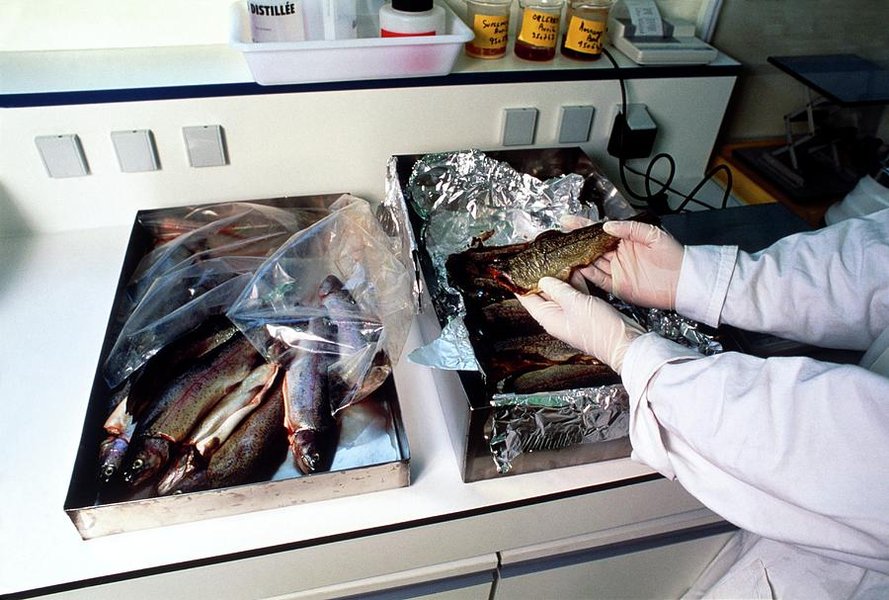
Fish samples being dried and powdered for laboratory radiation tests, a crucial step in monitoring seafood safety.
Radioactive concentrations in seafood are typically measured in Becquerels per kilogram (Bq/kg). A Becquerel represents one radioactive decay event per second. Different radionuclides have varying environmental behaviors and biological uptake rates, making comprehensive monitoring essential.
Country-Specific Findings on Radioactive Concentrations
Investigations into radioactive concentrations in specific fish like sea bream, bonito, and mackerel vary significantly by country. While some nations have robust monitoring programs, data for these particular species may not always be available, with studies often focusing on more commonly consumed or indicator species, or general environmental matrices.
Peru
Fishmeal Surveillance
For Peru, information points to radioactivity surveillance in Peruvian fishmeal, a product derived from various fish species prevalent in its fisheries. An IAEA-related report from 2008 indicated monitoring efforts for natural and potential anthropogenic radionuclides. While specific isotope levels for sea bream, bonito, or mackerel were not detailed in the available summaries, these surveillance activities suggest that Peruvian aquatic products are subject to radiological assessment, generally showing low levels of contamination. Broader concerns in Peruvian aquatic environments sometimes include heavy metal contamination, such as mercury, particularly in regions affected by artisanal gold mining, which is distinct from but can co-exist with radionuclide concerns.
Mexico
Natural Radioactivity and Other Contaminants
Studies in Mexico have measured natural radioactivity concentrations in species like shrimp and sea bass from the Mexican Pacific Ocean and the Gulf of Mexico. Gamma spectrometry has been used to detect isotopes such as Cesium-137 (\(^{137}\text{Cs}\)), with reported levels being well below international safety thresholds set by organizations like the World Health Organization (WHO). Alongside radionuclides, research in Mexico has also highlighted concerns about heavy metals like mercury in carnivorous fish species in northwestern Mexico, underscoring the multifaceted nature of seafood safety assessments. Specific data for sea bream, bonito, or mackerel remains limited in the provided information, but the general findings suggest low radiological risk in commonly tested seafood.
Myanmar
Focus on Other Pollutants
Scientific reports directly investigating radioactive concentrations in aquatic products from Myanmar, particularly for sea bream, bonito, or mackerel, are scarce in the available literature. Studies in Myanmar's aquatic environments have more prominently focused on other types of contamination, such as sewage pollution, disease-causing bacteria, and microcontaminants like plastics and oils in species such as oysters. This contamination is often linked to rapid urbanization and industrial discharges rather than radiological sources.
France
Limited Recent Data on Target Species
Recent, specific international reports detailing radioactive concentrations in sea bream, bonito, or mackerel from French waters were not prominently featured in the provided sources. While France, as a country with a significant nuclear industry, historically participates in radionuclide monitoring in aquatic environments, detailed contemporary data for these specific species from readily available international compilations appears limited. National authorities typically conduct such monitoring.
Canada
Post-Fukushima Monitoring
Canada has conducted comprehensive monitoring of its marine environments, particularly its west coast, following the Fukushima Daiichi nuclear accident in 2011. Studies analyzed commonly consumed species like salmon and groundfish for radioactive cesium isotopes (\(^{134}\text{Cs}\) and \(^{137}\text{Cs}\)). These Canadian studies, often in collaboration with international efforts, reported undetectable or very low levels of these isotopes in the tested samples, with detection limits around 2 Bq/kg, significantly below Health Canada's safety guidelines (e.g., 1000 Bq/kg for imported foods). While specific data for sea bream, bonito, or mackerel wasn't highlighted, the findings for other pelagic and demersal fish suggest a low radiological health risk from consuming Canadian seafood from the Pacific.
Egypt
Natural Radioactivity in Coastal Environments
In Egypt, research has focused on natural radioactivity in coastal and riverine environments, including marine sands along the Red Sea coast and sediments in the Nile Delta. These studies, using techniques like gamma spectrometry, have assessed levels of naturally occurring radionuclides such as Potassium-40 (\(^{40}\text{K}\)), Radium-226 (\(^{226}\text{Ra}\)), and Thorium-232 (\(^{232}\text{Th}\)). Findings generally indicate that these environmental radioactivity levels are within safe limits and below international standards, implying a relatively low radiological risk for seafood sourced from these waters. Some reports have noted elevated radium levels in certain groundwater sources, which could indirectly influence aquatic ecosystems, but direct data on radioactive concentrations in sea bream, bonito, or mackerel is not readily available in the provided materials.
Taiwan
Environmental Monitoring near Nuclear Facilities
For Taiwan, available information primarily pertains to assessments of soil radioactivity near nuclear power plants, such as the Maanshan facility. While these studies analyze radionuclide concentrations in terrestrial environments, which could indirectly influence adjacent marine ecosystems, direct scientific papers or international reports specifically investigating radioactive concentrations in aquatic products like sea bream, bonito, or mackerel from Taiwanese waters were not identified in the provided resources. Long-term monitoring programs may exist given Taiwan's geographical proximity to regions affected by events like Fukushima, but recent published international reports on specific fish species are limited.
Thailand
Natural Radioactivity in River Basins
Studies in Thailand have investigated natural radioactivity in environmental samples, such as riverbank soils along the Chao Phraya River basin. This research measured isotopes like Potassium-40 (\(^{40}\text{K}\)), Uranium-238 (\(^{238}\text{U}\)), and Thorium-232 (\(^{232}\text{Th}\)) in soils, which can provide indirect insights into potential background levels in aquatic ecosystems. The results typically indicate that radioactivity levels are within safe limits. However, specific data from international reports on radioactive concentrations directly in sea bream, bonito, or mackerel from Thai waters was not found in the provided information.
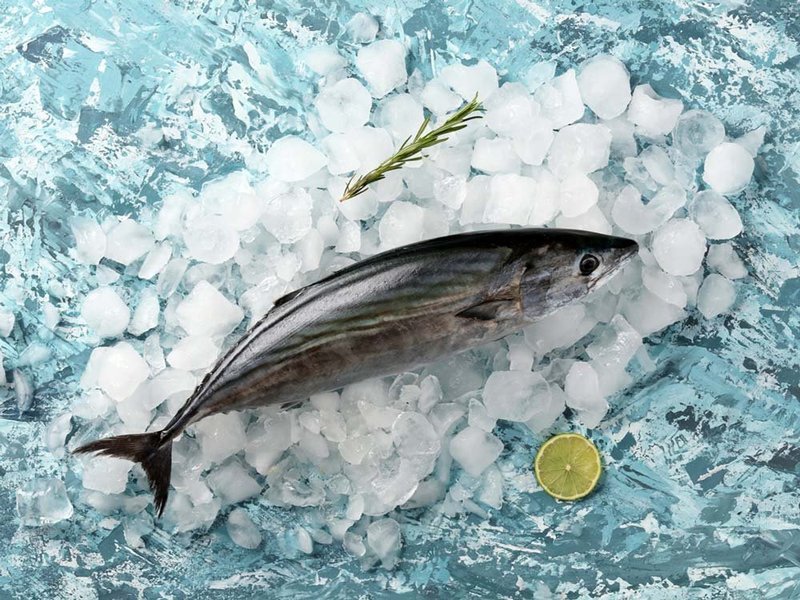
Bonito, one of the fish species of interest for radioactivity assessment, often requiring specific regional studies for accurate data.
The Fukushima Daiichi Accident: A Catalyst for Enhanced Monitoring
The 2011 Fukushima Daiichi nuclear power plant accident in Japan led to a significant release of radioactive contaminants into the Pacific Ocean, prompting widespread concern and intensified monitoring of seafood safety globally. Radiocesium isotopes, primarily Cesium-137 (\(^{137}\text{Cs}\)) and Cesium-134 (\(^{134}\text{Cs}\)), were of particular interest.
Subsequent studies revealed that while some fish caught in Japanese waters, especially near the Fukushima Harbor, initially exceeded Japanese government safety limits for radioactive cesium, levels in fish caught further afield, such as off the coasts of the United States and Canada, were generally well below regulatory limits. For example, bluefin tuna caught in California waters showed radioactive cesium levels significantly lower than both Japanese and U.S. safety limits. International collaborations and transparent data sharing became crucial in assessing the transboundary impact and reassuring consumers about seafood safety.
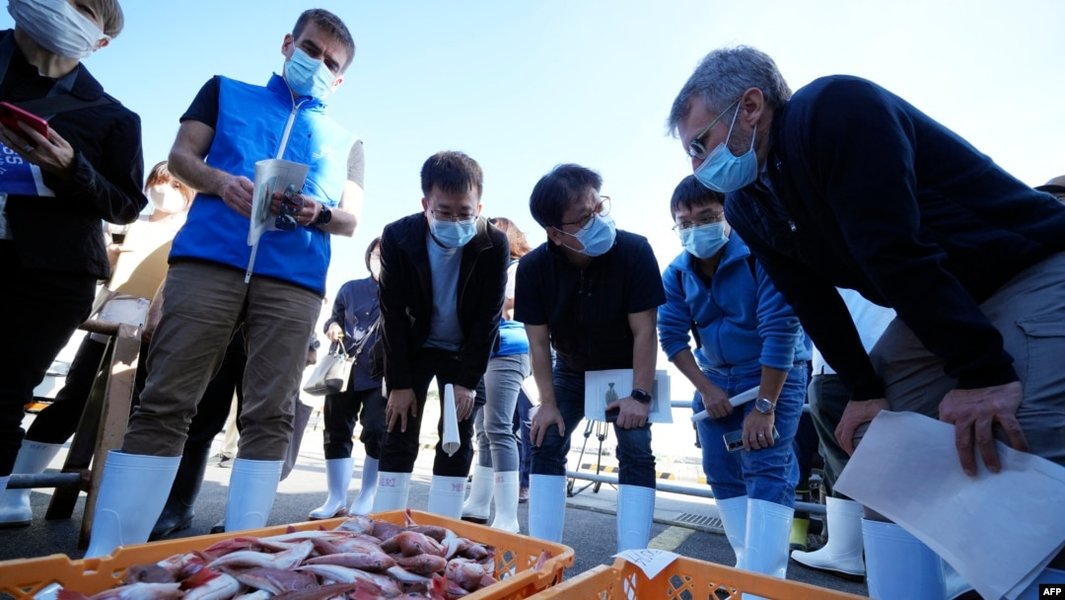
International efforts, such as inspections by UN-affiliated bodies, play a role in verifying seafood safety in regions potentially affected by radioactive releases.
Understanding Radioactivity in Seafood: Key Isotopes and Measurement
The primary radionuclides of concern in seafood can be categorized into naturally occurring radioactive materials (NORMs) and artificial radionuclides.
Naturally Occurring Radionuclides
These are present throughout the environment. The most significant in terms of dose from seafood consumption is typically Potassium-40 (\(^{40}\text{K}\)), a natural component of potassium, which is an essential element for life. Other NORMs include isotopes from the Uranium (\(^{238}\text{U}\)) and Thorium (\(^{232}\text{Th}\)) decay series, such as Radium-226 (\(^{226}\text{Ra}\)) and Polonium-210 (\(^{210}\text{Po}\)). \(^{210}\text{Po}\) can accumulate significantly in some marine organisms and contribute substantially to the natural radiation dose received by seafood consumers.
Artificial Radionuclides
These originate from human activities. Key isotopes include:
- Cesium-137 (\(^{137}\text{Cs}\)): With a half-life of about 30 years, it is a common fission product released from nuclear weapons testing and nuclear accidents. It is chemically similar to potassium and can be taken up by marine life.
- Cesium-134 (\(^{134}\text{Cs}\)): With a shorter half-life of about 2 years, its presence can indicate more recent contamination events, such as the Fukushima accident.
- Strontium-90 (\(^{90}\text{Sr}\)): Another fission product, chemically similar to calcium, it can accumulate in bones.
- Other isotopes like Cobalt-60 (\(^{60}\text{Co}\)) or Iodine-131 (\(^{131}\text{I}\)) (short-lived) may also be monitored depending on the potential source of contamination.
Concentrations are measured in Becquerels per kilogram (Bq/kg). Safety limits vary by country and international organization, but a common reference level for \(^{137}\text{Cs}\) in food set by the Codex Alimentarius Commission (relevant for WHO/FAO) is 1000 Bq/kg for most foodstuffs, though some countries adopt stricter limits (e.g., Japan's 100 Bq/kg for general foods).
The IAEA provides guidance and methodologies for assessing radionuclide transfer, including the use of concentration factors (CF). A concentration factor represents the ratio of a radionuclide's concentration in an organism to its concentration in the surrounding water at equilibrium. Historical models for permissible seawater concentrations (PSC) utilized these CFs: \[ \text{PSC} = \frac{\text{MPC}_{\text{fish}}}{\text{Concentration Factor}} \] where \(\text{MPC}_{\text{fish}}\) is the maximum permissible concentration of the radionuclide in fish tissue. Modern assessments often refine these models with region-specific and species-specific data.
Visualizing Monitoring Efforts and Data Availability
The extent of scientific investigation into radioactive contamination in seafood varies by country and by the type of focus—whether on specific commercial species like sea bream, bonito, and mackerel, broader seafood categories, or general environmental matrices like water and sediment. The following chart provides a qualitative overview of the relative data availability and monitoring intensity for the specified countries based on the synthesized information. Scores are on a relative scale from 10 (lower availability/intensity) to 50 (higher availability/intensity).
This visualization suggests that for countries like Canada, there's a relatively higher intensity of monitoring, especially concerning post-Fukushima impacts and general seafood. For several other nations, data specific to sea bream, bonito, and mackerel, or even general seafood radioactivity, appears less readily available in comprehensive international reports, with environmental matrix studies sometimes providing indirect insights.
Mapping the Complexity of Seafood Contamination Assessment
Understanding radioactive contamination in aquatic products is a multifaceted issue involving various sources, types of radionuclides, monitoring strategies, and potential impacts. The mindmap below illustrates these interconnected elements, providing a holistic overview of the domain.
This mindmap highlights that assessing radioactive contamination involves considering the origin of radionuclides, the specific isotopes involved, the comprehensive monitoring strategies employed by various bodies, ecological and geographical factors influencing accumulation, and ultimately, the implications for human health and food safety standards. The focus on species like sea bream, bonito, and mackerel fits within this broader framework of ensuring seafood safety.
Summary Table of Findings by Country
The following table summarizes the available information on radioactive concentration studies in aquatic products for the specified countries, based on the provided search results. It highlights the focus of studies, key isotopes mentioned (if any), and general findings.
| Country | Focus of Study/Samples | Key Isotopes Mentioned | General Findings/Levels | Key References/Notes |
|---|---|---|---|---|
| Peru | Fishmeal, General Aquatic Environment | General (natural & anthropogenic) | Low levels, surveillance programs in place. Mercury also a concern in some areas. | IAEA report on fishmeal (2008). |
| Mexico | Shrimp, Sea Bass, Carnivorous Fish | \(^{137}\text{Cs}\), Natural Radionuclides | Levels below international safety thresholds. Mercury also assessed. | ResearchGate (Natural radioactivity in shrimp/sea bass), Mercury studies. |
| Myanmar | Oysters (focus on bacteria, microplastics, other pollutants) | N/A for radioactivity from provided sources | Data on radioactivity limited; other contaminants are primary focus. | Reports on sewage/plastic contamination. |
| France | General (Historical Monitoring) | N/A from recent specific international reports in provided sources | Limited recent data on target species from provided sources. National monitoring exists. | General knowledge of nuclear monitoring. |
| Canada | Salmon, Groundfish (West Coast) | \(^{134}\text{Cs}\), \(^{137}\text{Cs}\) | Undetectable or very low levels, well below safety guidelines, especially post-Fukushima. | PMC (Fisheries and Oceans Canada report). |
| Egypt | Marine Sands, River Sediments, Water | \(^{226}\text{Ra}\), \(^{40}\text{K}\), Natural Radionuclides | Environmental levels generally low/safe, implying low risk for seafood. Radium in some groundwater noted. | SciRes, NCBI (Environmental radioactivity studies). |
| Taiwan | Soil near Nuclear Plants | General (environmental radionuclides) | Limited direct data on aquatic products; soil studies provide indirect context. | Reports on soil radioactivity. |
| Thailand | Riverbank Soils | \(^{40}\text{K}\), \(^{238}\text{U}\), \(^{232}\text{Th}\) | Soil radioactivity within safe limits, implying low risk for aquatic products. No direct fish data for target species. | ResearchGate (Natural radioactivity in soils). |
Note: "N/A from provided sources" indicates that specific information was not found within the synthesized answer set for that category. Data on sea bream, bonito, and mackerel specifically is often scarce, with findings extrapolated from broader seafood studies or environmental data.
Frequently Asked Questions (FAQ)
What are the main radioactive isotopes found in fish?
Fish can contain both naturally occurring radionuclides and artificial ones. The most significant naturally occurring isotope is typically Potassium-40 (\(^{40}\text{K}\)). Polonium-210 (\(^{210}\text{Po}\)) can also be a major contributor to natural radiation dose from seafood. Artificial radionuclides of concern, often resulting from human activities like nuclear accidents or past weapons testing, include Cesium-137 (\(^{137}\text{Cs}\)), Cesium-134 (\(^{134}\text{Cs}\)), and Strontium-90 (\(^{90}\text{Sr}\)).
How is radioactivity in seafood measured?
Radioactivity in seafood is measured using specialized laboratory equipment, most commonly gamma spectrometry. This technique identifies specific radionuclides and quantifies their activity. Samples are typically prepared (e.g., dried, ashed) to concentrate the radionuclides and improve detection sensitivity. The results are usually expressed in Becquerels per kilogram (Bq/kg) of fresh or dry weight.
Are current levels of radioactivity in seafood generally safe?
Based on extensive monitoring by international organizations (like the IAEA) and national authorities, radioactive concentrations in most commercially available seafood from around the world are generally low and well below established international safety limits (e.g., those set by the Codex Alimentarius Commission). However, localized areas affected by specific contamination events may require ongoing monitoring. It's important to rely on data from reputable scientific bodies and food safety agencies.
Why is specific data for sea bream, bonito, and mackerel not always available for all countries?
Monitoring programs often prioritize fish species based on several factors: commercial importance, high consumption rates, ecological role as an indicator species, or known bioaccumulation potential for certain contaminants. Sea bream, bonito, and mackerel might not always be the primary focus in all regional or national monitoring programs compared to other species. Additionally, comprehensive studies require significant resources, and international databases may not capture all localized research. General seafood surveys or environmental data are then used to infer potential contamination levels.
Recommended
To delve deeper into related topics, consider exploring these queries:
- What are the international safety limits for radioactivity in food products?
- How does natural background radiation contribute to radioactivity in fish?
- Are there ongoing global programs for monitoring radioactive contaminants in the marine environment?
- What is the difference between radioactive contamination and heavy metal contamination in seafood?
References
Last updated May 6, 2025