
Unveiling Redis's Power: How It Seamlessly Scales Your Data Universe
Discover the intricate architecture enabling Redis to handle massive datasets and high traffic with unparalleled efficiency.
Redis, an acclaimed in-memory data store, is renowned for its exceptional performance, versatility, and scalability. It serves a multitude of purposes, from caching and session management to real-time analytics and message brokering. Understanding its scaling mechanisms and internal architecture is key to harnessing its full potential. This exploration delves into how Redis scales, focusing on its core components: nodes, shards, replicas, and the ingenious system of hash slots.
Key Insights into Redis Scalability
- Horizontal Scaling with Redis Cluster: Redis primarily scales out by distributing data and load across multiple server instances (nodes) using its native Redis Cluster solution.
- Data Partitioning via Hash Slots: The entire keyspace is divided into 16,384 hash slots, with each key automatically assigned to a slot, ensuring even data distribution across shards.
- High Availability and Read Scalability through Replication: Replicas (copies of data) provide fault tolerance by enabling failover and boost read performance by offloading read queries from primary nodes.
The Architectural Blueprint for Scaling Redis
Redis's ability to scale hinges on a sophisticated architecture designed for distribution and resilience. It employs a combination of sharding data across multiple instances and replicating that data to ensure availability and enhance read capacity.
Core Scaling Concepts
Two primary strategies are employed for scaling Redis deployments:
Vertical Scaling (Scaling Up)
This method involves increasing the resources (CPU, RAM, network bandwidth) of a single Redis server. While Redis is largely single-threaded for command execution, more RAM allows a single instance to store a larger dataset. However, vertical scaling has practical limits and costs, eventually necessitating a move towards horizontal scaling for continued growth and higher availability.
Horizontal Scaling (Scaling Out)
This is the predominant scaling strategy for Redis, particularly for large-scale applications. It involves distributing the dataset and workload across multiple Redis instances, often running on different servers. Redis Cluster is the native solution that automates this process.
- Increased Throughput: By distributing data, requests can be processed in parallel across multiple nodes.
- Enhanced Availability: Data distribution and replication minimize the impact of single node failures.
- Larger Datasets: The total dataset size can exceed the memory capacity of a single server.
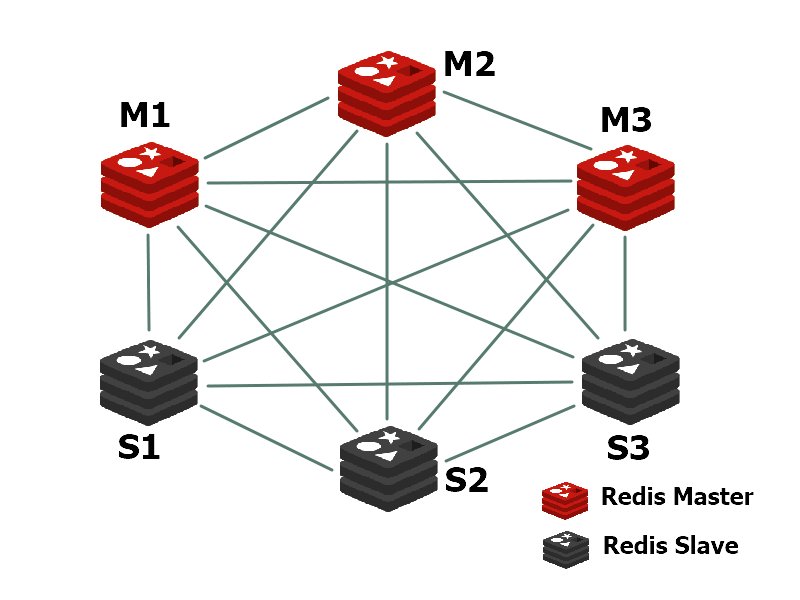
A conceptual view of a Redis Cluster, showing master nodes and their replicas distributed for scalability and high availability.
Fundamental Building Blocks of Redis Cluster
To understand Redis scaling, one must grasp these key architectural components:
Nodes: The Individual Powerhouses
A node is a single Redis server instance (a running Redis process). In a Redis Cluster, each node plays a specific role:
- Master Node (Primary): Responsible for handling both read and write operations for the subset of data (hash slots) it owns. Each shard has exactly one master node at any given time.
- Replica Node (Secondary/Slave): Maintains an asynchronous copy of the data from a master node. Replicas primarily serve read requests, offloading the master, and act as hot standbys for failover, ensuring high availability.
Shards: Partitioning the Data Landscape
A shard (also referred to as a node group in some contexts like AWS ElastiCache) is a logical partition of the overall dataset. Each shard is responsible for a distinct subset of the 16,384 hash slots. A typical shard consists of:
- One master node.
- Zero or more replica nodes that replicate data from that master.
Sharding is the mechanism by which Redis divides the entire keyspace into manageable pieces, enabling horizontal scaling. By distributing these shards across different physical servers, Redis achieves greater storage capacity and processing power.
Hash Slots: The Key to Data Distribution
Redis Cluster partitions the entire keyspace into a fixed number of 16,384 hash slots. Every key stored in a Redis Cluster is algorithmically mapped to one of these slots. The mapping is determined by:
slot = CRC16(key) % 16384
Where CRC16(key) is the CRC16 checksum of the key. This deterministic hashing ensures that:
- Each key belongs to exactly one hash slot.
- Each hash slot is assigned to exactly one master node (and thus, one shard).
This mechanism ensures a relatively even distribution of keys across the available master nodes in the cluster. When the cluster topology changes (e.g., nodes are added or removed), these hash slots can be rebalanced (migrated) between nodes with minimal to no downtime.
Replicas: Ensuring Resilience and Read Performance
Replication is the process of creating and maintaining copies of data. In Redis, replicas serve several crucial functions:
- High Availability (HA): If a master node fails, one of its replicas can be automatically promoted to become the new master. This failover process minimizes downtime and prevents data loss (depending on persistence settings and replication lag). Redis Enterprise and managed services often enhance this by automatically migrating replica shards to available nodes.
- Read Scalability: Client applications can direct read queries to replica nodes. This distributes the read load, reducing the burden on the master node and improving overall read throughput. Clients can use the
READONLYcommand to ensure they are reading from a replica, accepting potentially slightly stale data. - Data Persistence Augmentation: Replicas can be configured with persistence mechanisms (like AOF or RDB snapshots) even if the master is not, adding another layer of data safety.
Typically, each master node in a shard can have multiple replicas (e.g., up to 5 in some managed environments like AWS ElastiCache). For optimal resiliency, master and replica nodes of the same shard are usually placed on different physical servers or availability zones.
Visualizing Redis Scaling Attributes
The following chart provides a comparative overview of different Redis deployment models based on key scaling attributes. These are qualitative assessments to illustrate general trade-offs:
This radar chart illustrates that while a single Redis node offers excellent raw performance for individual operations, Redis Cluster provides superior scalability for reads and writes, higher availability, and greater data capacity, albeit with increased operational complexity.
The Mechanics of Redis Cluster
Redis Cluster orchestrates the distribution and management of data across multiple nodes. Here’s how it operates internally:
Cluster Bus Protocol
Nodes in a Redis Cluster communicate with each other using a dedicated TCP connection known as the cluster bus. This bus uses a binary protocol and operates on a port different from the one clients use to connect to Redis (typically the client port + 10000, e.g., if client port is 6379, cluster bus might be 16379). The cluster bus is used for:
- Sending heartbeats (ping/pong packets) for node health monitoring and failure detection.
- Propagating configuration updates, such as changes in slot assignments.
- Coordinating failover procedures when a master node becomes unreachable.
- Facilitating slot migration during resharding operations.
Each node maintains metadata about all other nodes in the cluster, including their IDs, IP addresses, ports, flags (master/replica), and the range of hash slots they serve.
Client Interaction and Redirection
Smart Redis clients (or client libraries) are aware of the cluster topology. They typically fetch the slot-to-node mapping using commands like CLUSTER SLOTS or CLUSTER SHARDS. When a client needs to execute a command for a specific key:
- The client calculates the hash slot for the key.
- It sends the command directly to the master node responsible for that hash slot.
If a client, due to outdated topology information, sends a command to an incorrect node (i.e., a node that does not own the key's hash slot), that node will respond with a redirection error:
-MOVED <slot> <ip>:<port>: This indicates that the requested slot is permanently served by a different node. The client should update its local cluster topology map and resend the command to the correct node.-ASK <slot> <ip>:<port>: This is a temporary redirection used during slot migration (resharding). It instructs the client to send the command to the destination node for this specific query only, preceded by anASKINGcommand. The client should not update its permanent slot map based on an-ASKredirect.
Adding and Removing Nodes (Resharding)
Redis Cluster allows for dynamic scaling by adding or removing nodes:
- Scaling Out: When a new master node is added to the cluster, hash slots (and their associated data) must be moved from existing nodes to the new node. This process, known as resharding, is performed using cluster management tools (e.g.,
redis-cli --cluster reshard) and is designed to occur without downtime. - Scaling In: When a node is removed, its hash slots must first be migrated to other existing nodes before the node can be decommissioned.
Understanding Redis Architecture: A Mindmap View
The following mindmap visualizes the hierarchical relationships within a Redis Cluster, illustrating how nodes, shards, replicas, and slots interrelate to achieve scalability and high availability.
This mindmap highlights that a Redis Cluster is composed of multiple nodes, organized into shards. Each shard contains a master and optionally replicas. The data itself is distributed based on hash slots, with replication ensuring high availability and improved read performance. The cluster bus facilitates internal communication, crucial for maintaining a cohesive and resilient distributed system.
Exploring Redis Clustering Further
For a visual demonstration of how Redis clusters are set up and how they function, including concepts like master-slave replication and sharding, the following video provides a practical overview:
This video demonstrates setting up a Redis cluster, which is fundamental to understanding its scaling capabilities.
The video above, "How to Create a Cluster in Redis," walks through the practical steps of setting up a clustered Redis environment. It covers creating multiple Redis instances and configuring them to work together as a cohesive unit. This hands-on perspective complements the theoretical understanding of nodes, shards, and slots by showing how these components are initialized and interact in a real deployment. Understanding cluster creation is key to appreciating how Redis achieves horizontal scaling and high availability through distributed data and automated failover mechanisms.
Key Components at a Glance
Here's a summary table of the essential components involved in Redis scaling and architecture:
| Component | Description | Primary Role in Scaling/Architecture |
|---|---|---|
| Node | A single Redis server instance. | The fundamental unit of a Redis deployment; can be a master or a replica. Hosts data and processes commands. |
| Shard (Node Group) | A logical partition of the dataset, typically consisting of one master node and its replica(s). | Divides the total dataset and write load. Adding shards increases write throughput and total data capacity. |
| Replica (Slave) | A copy of a master node's data. | Provides high availability (failover for master), read scalability (offloading read traffic), and data redundancy. |
| Hash Slot | One of 16,384 conceptual divisions of the Redis keyspace. | Determines which shard (master node) is responsible for a given key, ensuring even data distribution. Facilitates resharding. |
| Redis Cluster | The native solution for creating a distributed Redis deployment. | Automates sharding, replication, failover, and node communication, enabling horizontal scaling and high availability. |
Multi-Key Operations
An important consideration in Redis Cluster is that operations involving multiple keys (e.g., transactions, Lua scripts, commands like SUNION) are only supported if all keys involved map to the same hash slot. To ensure this, Redis offers a feature called "hash tags." If a key contains a substring enclosed in curly braces {}, only that substring is used to calculate the hash slot. For example, {user1000}:name and {user1000}:email will hash to the same slot, allowing multi-key operations on these keys.
Managed Redis Services
For many users, deploying and managing a Redis Cluster can be complex. Managed Redis services, such as Redis Cloud (from Redis Inc.) or Amazon ElastiCache for Redis, abstract away much of this operational overhead. They offer features like automated provisioning, scaling, patching, backups, monitoring, and high availability configurations, simplifying the use of Redis at scale.
Frequently Asked Questions (FAQ)
What happens if a master node fails in a Redis Cluster?
How are keys distributed across nodes in Redis Cluster?
CRC16(key) % 16384) to determine its hash slot. Each master node in the cluster is responsible for a subset of these hash slots.Can I perform multi-key operations in Redis Cluster?
{user123}:profile) to force different keys to map to the same slot by only hashing the content within the curly braces.What is the role of the cluster bus?
Is data replication synchronous or asynchronous in Redis?
WAIT command) but can impact write latency.Conclusion
Redis achieves impressive scalability and resilience through its sophisticated distributed architecture. By leveraging horizontal scaling via Redis Cluster, it partitions data across multiple nodes using a system of 16,384 hash slots. Shards, consisting of master nodes and their replicas, ensure both data distribution for performance and data redundancy for high availability. Replicas play a vital role in offloading read traffic and enabling quick failover. This combination of sharding, replication, and automated cluster management allows Redis to handle vast datasets and high request volumes, making it a cornerstone technology for modern, high-performance applications.
Recommended Further Exploration
- How exactly does Redis Cluster move hash slots during resharding without downtime?
- What are the best practices for configuring Redis persistence (AOF, RDB) in a clustered environment with replication?
- What are the key considerations for client libraries when connecting to and interacting with a Redis Cluster?
- How does Redis Cluster compare to other distributed caching and key-value store solutions in terms of performance and features?
References
 docs.aws.amazon.com
 docs.amazonaws.cn
docs.aws.amazon.com

Last updated May 21, 2025