
Can Rockets Defy Physics and Reach the Moon Without Fuel?
Exploring the fundamental principles that power lunar journeys and why fuel is currently indispensable.
Launching a spacecraft from Earth to the Moon is an incredible feat of engineering, deeply rooted in the laws of physics. Your question touches upon a fascinating idea: could a rocket make this journey without carrying fuel? While the concept challenges our current understanding and technology, let's delve into the physics governing rocket propulsion to see why fuel plays such a critical role.
Highlights: The Essentials of Lunar Rocketry
- Newton's Third Law is Key: Rockets generate thrust by expelling mass (like hot gas from burning fuel) backward at high speed, causing an equal and opposite reaction that pushes the rocket forward.
- Fuel as Reaction Mass: Conventional rockets fundamentally require propellant (fuel and oxidizer) to provide the mass needed for expulsion and the energy to expel it, overcoming gravity and accelerating in space.
- Mass Matters: The Tsiolkovsky rocket equation mathematically demonstrates that achieving the necessary velocity changes (\(\Delta v\)) for space travel depends directly on the ratio of the rocket's initial mass (with fuel) to its final mass (without fuel).
The Physics Powering Rockets: Thrust and Gravity
To understand why launching to the Moon currently requires fuel, we need to look at the core physics principles involved in getting a massive object off the ground and into space.
Newton's Third Law: The Engine's Push
At the heart of rocket propulsion lies Sir Isaac Newton's Third Law of Motion: For every action, there is an equal and opposite reaction. This isn't just a textbook concept; it's the literal driving force behind a rocket launch.
- Action: A rocket engine burns fuel and oxidizer, creating extremely hot, high-pressure gas. This gas is expelled downwards through a nozzle at very high speeds.
- Reaction: As the rocket pushes this mass of gas downwards, the gas exerts an equal force upwards on the rocket. This upward force is called thrust.
For a rocket to lift off the launchpad, the thrust generated by its engines must be greater than the force of gravity pulling it down, plus any atmospheric drag. Without expelling mass (the exhaust gas), there is no "action" and therefore no "reaction" – no thrust can be generated.
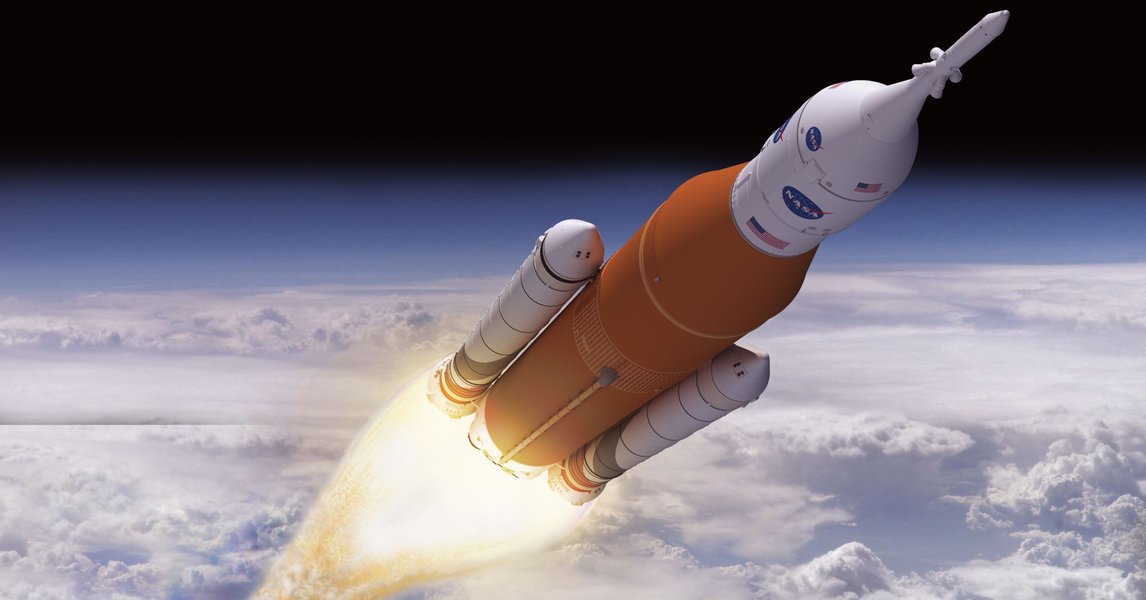
A powerful rocket generating immense thrust to overcome Earth's gravity during launch.
The Tsiolkovsky Rocket Equation: Quantifying the Journey
The challenge of reaching space, especially a destination like the Moon, is quantified by the Tsiolkovsky rocket equation. Developed by Russian scientist Konstantin Tsiolkovsky, it relates the change in velocity a rocket can achieve (\(\Delta v\), pronounced "delta-vee") to the speed of its exhaust gases (\(v_e\)) and the ratio of its initial mass (\(m_0\), rocket + fuel) to its final mass (\(m_f\), rocket after fuel is burned).
The basic form of the equation is:
\[ \Delta v = v_e \ln\left(\frac{m_0}{m_f}\right) \]Where:
- \(\Delta v\) represents the total change in velocity the rocket can achieve. Reaching the Moon requires a specific, significant \(\Delta v\).
- \(v_e\) is the effective exhaust velocity – how fast the propellant is ejected. Higher exhaust velocity is more efficient.
- \(\ln\) is the natural logarithm function.
- \(\frac{m_0}{m_f}\) is the mass ratio. This is crucial: it shows that the amount of velocity change achievable depends heavily on how much of the rocket's initial mass is propellant.
This equation highlights a fundamental reality: to achieve a large \(\Delta v\), a rocket must either have a very high exhaust velocity or expel a very large fraction of its initial mass as propellant. If a rocket carries no fuel (\(m_0 = m_f\)), the mass ratio is 1. The natural logarithm of 1 is 0, meaning \(\Delta v = 0\). A rocket without fuel, according to this cornerstone equation of rocketry, cannot change its velocity and therefore cannot launch itself anywhere.
Why Delta-V is Everything
Space missions are planned around achieving specific amounts of delta-v. Escaping Earth's gravity, traveling to the Moon, entering lunar orbit, landing, and returning all require distinct velocity changes. The Saturn V rocket, which took Apollo astronauts to the Moon, was mostly fuel by mass precisely because the delta-v requirements were so enormous.
Launching Without Fuel: Challenging Conventional Physics
Based on Newton's laws and the Tsiolkovsky equation, a rocket launching from Earth and traveling to the Moon requires the expulsion of mass – propellant – to generate thrust. Therefore, the idea of doing so "without having fuel in it" directly contradicts the established physics of conventional rocket propulsion.
The Necessity of Onboard Propellant for Launch
Rockets work by carrying their reaction mass with them. Unlike a car pushing against the road or a plane pushing against the air, a rocket in the vacuum of space has nothing external to push against. All propulsion comes from throwing mass overboard (the exhaust gas). Without fuel to serve as this reaction mass, a conventional rocket is inert.
Consider the Apollo missions:
- The massive Saturn V rocket needed nearly 4 million kilograms of propellant just to get the Apollo spacecraft into Earth orbit and on its way to the Moon.
- Even launching the relatively small Lunar Module ascent stage *from* the Moon, where gravity is only about 1/6th of Earth's, required over 2,200 kg of propellant to reach lunar orbit.
Visualizing Rocket Propulsion Concepts
To better understand the relationships between these concepts, the following mindmap illustrates the core principles of rocket propulsion and how they relate to the need for fuel, while also branching into alternative ideas.
This mindmap shows that while conventional rockets absolutely need fuel, research explores alternatives. However, none currently offer a way to launch a substantial payload like a lunar mission from Earth entirely without some form of onboard propellant or external launch system, and even then, in-space propulsion is usually still needed.
Exploring Alternatives: Beyond Chemical Rockets
While a conventional rocket launch without fuel is physically impossible, the idea prompts consideration of alternative propulsion methods or launch techniques that minimize or conceptually replace traditional chemical propellants.
Propulsion Without Chemical Fuel
Several concepts exist, though they come with significant limitations, especially for launching from Earth:
- Solar Sails: These use the minute pressure exerted by photons from the Sun reflecting off vast, thin sails. They require no propellant, but the thrust is extremely low, making them suitable for long-duration, slow acceleration in space, not for launching from a planet or rapid transit to the Moon. They must first be launched into space by a conventional rocket.
- Electric Propulsion (e.g., Ion Thrusters): These use electric fields to accelerate charged particles (propellant, like xenon gas) to very high speeds. They are incredibly fuel-efficient (high specific impulse) but produce very low thrust. Like solar sails, they are used for in-space propulsion over long periods and cannot launch from Earth. They still require propellant, just much less than chemical rockets, and a significant power source (solar panels or nuclear).
- Nuclear Thermal Propulsion: Uses a nuclear reactor to heat a propellant (like hydrogen) to very high temperatures before expelling it. This offers higher efficiency than chemical rockets but still fundamentally relies on expelling reaction mass.
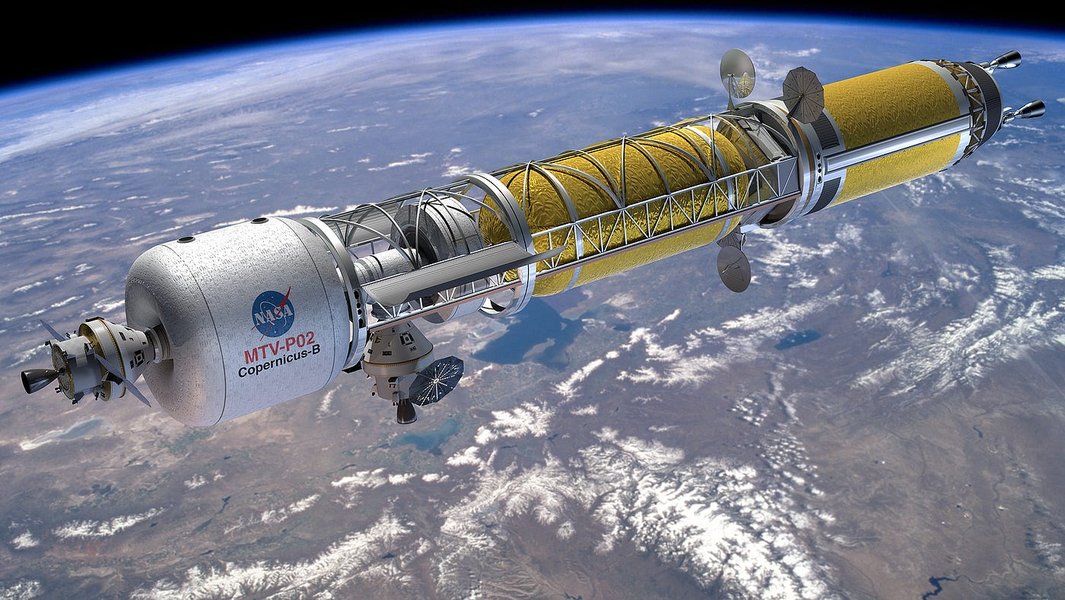
Conceptual future spacecraft might utilize advanced propulsion, but launching from Earth remains a challenge governed by fundamental physics.
External Launch Assist Concepts
Some concepts aim to provide the initial launch velocity without onboard fuel, using ground-based infrastructure:
- Electromagnetic Launch: Ideas like space elevators, launch loops, or electromagnetic catapults (railguns/coilguns) propose using electromagnetic forces to accelerate payloads to high speeds or altitudes. These are massive engineering challenges and haven't been realized for orbital launches.
- Kinetic Energy Launch (e.g., SpinLaunch): This concept involves spinning a payload at high speed in a large centrifuge before releasing it upwards through a launch tube. SpinLaunch has conducted suborbital tests, demonstrating the principle, but reaching orbital velocity and surviving the extreme G-forces remain significant hurdles. Payloads launched this way would still likely need an onboard upper stage with propellant for orbital insertion and maneuvering.
Hypothetical and Speculative Physics
Occasionally, concepts emerge claiming "reactionless" propulsion (generating thrust without expelling mass), potentially violating the conservation of momentum (and Newton's Third Law). Examples include drives based on quantum vacuum fluctuations (like the "Q-thruster" concept sometimes mentioned). However, these ideas remain highly speculative, lack robust experimental verification, face significant skepticism within the physics community, and are far from being considered viable propulsion systems.
Comparing Propulsion Methods
Different propulsion methods have vastly different characteristics. The radar chart below provides a conceptual comparison of several types based on key factors relevant to space travel, particularly lunar missions. Note that values are illustrative representations based on general characteristics, not precise data points.
This chart visually reinforces why chemical rockets, despite their lower efficiency and high propellant needs, remain the only currently viable method for launching heavy payloads from Earth's surface. Other technologies excel in different areas (like efficiency in space) but cannot provide the necessary initial thrust to overcome gravity and atmosphere, or they are still experimental/hypothetical.
Fuel Requirements: Earth vs. Moon
The amount of fuel needed depends heavily on the gravitational field being overcome. This table provides a simplified comparison illustrating why launching from Earth is so much more demanding than launching from the Moon, emphasizing the critical role of propellant.
| Launch Scenario | Approximate Propellant Mass Needed (Example: Apollo Program) | Primary Challenge | Reason for Propellant Need |
|---|---|---|---|
| Saturn V Launch (Earth to Lunar Trajectory) | ~3,000,000 - 4,000,000 kg | Earth's Strong Gravity (~9.8 m/s²) & Atmosphere | Generate immense thrust to achieve escape velocity and reach Moon transfer orbit. |
| Apollo Lunar Module Ascent (Moon Surface to Lunar Orbit) | ~2,200 kg | Moon's Weaker Gravity (~1.62 m/s²) & No Atmosphere | Generate sufficient thrust to reach lunar orbit from the surface. |
| Hypothetical Fuel-less Launch (Earth to Moon) | 0 kg | Violates known physics (Newton's 3rd Law, Conservation of Momentum) | No mechanism to generate thrust without expelling mass or an external force. |
This comparison clearly shows the scale difference. Launching from Earth requires orders of magnitude more propellant because of its significantly stronger gravitational pull. Even the Moon launch, while much easier, still absolutely required onboard fuel according to established physics.
Understanding the Rocket Equation Visually
The Tsiolkovsky rocket equation is fundamental to understanding space travel. This video features renowned astrophysicist Neil deGrasse Tyson explaining the concept and its implications for rocket design and fuel requirements.
As explained in the video, the equation dictates that to achieve higher velocities, rockets need either extremely efficient engines (high exhaust velocity) or must be composed mostly of fuel (high mass ratio). This reinforces why carrying propellant is not just a practical choice but a mathematical necessity for significant space travel like a Moon mission using current paradigms.
Frequently Asked Questions (FAQ)
Could solar sails be used to launch from Earth?
No, solar sails generate extremely low thrust, far too weak to overcome Earth's gravity and atmospheric drag. They rely on the pressure of sunlight, which is minuscule near Earth's surface compared to the forces holding a rocket down. Solar sails are designed for propellant-free propulsion *in space*, after being launched there by a conventional rocket.
What about anti-gravity or reactionless drives?
Currently, "anti-gravity" exists only in science fiction. All known physics indicates gravity is a fundamental property of mass and energy, and we don't have any confirmed way to negate or repel it. Reactionless drives, which would produce thrust without expelling propellant, violate the fundamental principle of conservation of momentum (linked to Newton's Third Law). While some theoretical concepts and controversial experiments exist (like the EmDrive or claims about Q-thrusters), none have been scientifically validated or proven to work. They remain highly speculative.
Can trajectory tricks eliminate the need for fuel?
Clever trajectory planning, like using gravity assists ("slingshots") around Earth, the Moon, or other planets, or employing low-energy transfer orbits (like the Interplanetary Transport Network), can significantly *reduce* the amount of fuel needed for a mission. However, they cannot eliminate it entirely. Spacecraft still need propellant for initial launch, course corrections, orbital insertion, and braking maneuvers. These techniques trade fuel savings for longer travel times.
If a rocket runs out of fuel in space, does it stop?
No. According to Newton's First Law of Motion (inertia), an object in motion stays in motion with the same speed and in the same direction unless acted upon by an unbalanced force. In the vacuum of space, if a rocket engine shuts down (runs out of fuel), the rocket will continue to coast along its current trajectory at the velocity it had when the engine stopped, influenced only by gravity from nearby celestial bodies. Fuel is needed to *change* velocity (accelerate, decelerate, change direction), not to maintain it.
Recommended Reading
Explore these related topics for a deeper dive:
- How does the Tsiolkovsky rocket equation limit space travel?
- What are the most promising alternative rocket propulsion technologies?
- Explain the physics of gravity assist maneuvers for spacecraft.
- Challenges and concepts for non-rocket spacelaunch systems.
References
Last updated May 5, 2025