
Proper Rope Cover in Dependency Graphs
Exploring the subtle nuances of partitioning dependency graphs
Highlights
- Definition and Clarification: Understand that the term is not universally standard but often interpreted as a partition of a DAG into non-overlapping directed paths that fulfill a maximality and minimality property.
- Connection to Dependency Graphs: Recognize that dependency graphs are usually DAGs where each vertex must be executed only after its dependencies are completed, and a proper rope cover respects these orderings.
- Real-World Applications: Learn how proper rope covers are used in scheduling, task sequencing, and analyzing complex dependencies while eliminating redundancies.
Introduction
In computer science and graph theory, dependency graphs serve as a visual and conceptual means to illustrate the relationships between items, such as tasks, modules, or any other entities where a specific order or dependency exists. The term "proper rope cover" is not a mainstream, formally defined term but rather a concept that emerges in more specialized discussions regarding the management and segmentation of these dependency graphs.
The idea of a "rope cover" metaphorically refers to partitioning a dependency graph—usually a directed acyclic graph (DAG)—into a series of contiguous chains or paths (often referred to as “ropes”) that comprehensively encapsulate the dependency relationships inherent in the graph. The usage of the qualifier "proper" typically emphasizes additional conditions that ensure the resulting chains are minimal, non-redundant, and uniquely maximized in terms of order extension.
Understanding Dependency Graphs
What Are Dependency Graphs?
At their core, dependency graphs are structured as directed graphs wherein each vertex represents an individual entity, such as a task in a project, a module within a codebase, or any component within a larger system. The directed edges (arcs) capture the notion of "dependency," indicating that one element must precede or enable another. This ensures that an execution or processing order is maintained, avoiding issues like unsatisfied prerequisites or circular dependencies.
Directed Acyclic Graphs (DAGs)
Most dependency graphs are modeled as Directed Acyclic Graphs (DAGs). The acyclic nature of these graphs is essential because cycles would involve circular dependencies, thereby complicating the straightforward sequencing of tasks. The absence of cycles means that there is at least one valid ordering (often found via topological sorting) that adheres to all dependencies—each task is executed only after every task it depends on has been completed.
Defining Proper Rope Cover
Conceptual Interpretation
Although the term "rope cover" does not appear in the canonical literature of graph theory, its interpretation generally draws from similar concepts such as "path covers" or "chain covers." In the context of dependency graphs:
- One views each "rope" as a directed path—a consecutive sequence of vertices—where each vertex in the sequence directly depends on its predecessor.
- A "cover" is a collection of these ropes such that the union of all vertices included in these ropes equals the full vertex set of the entire graph, ensuring no vertex is left uncovered.
When the qualifier “proper” is added to the cover, it denotes additional structural conditions:
- Maximality: Each rope is as long as possible under the dependency constraints. In this context, “maximal” means that if one were to join two ropes together (assuming such addition respects dependency ordering), the resulting structure would either violate the dependency conditions or introduce redundant intermediaries.
- Non-overlapping Criterion: Every vertex in the dependency graph is uniquely included in one and only one rope. This avoids overlap or multiple representations and ensures that the cover is a genuine partition of the vertex set.
- Minimal or Reduced Form: There is no rope that includes an “unnecessary” vertex. In other words, each rope is trimmed to contain only vertices that are essential to preserve the dependency structure, meaning no extraneous or redundant dependencies are introduced.
Operational Interpretation in Scheduling and Dependency Resolution
Consider a scheduling scenario where a series of tasks depend on each other in a project management framework. A proper rope cover can be extremely useful by providing a decomposition of the entire set of tasks into sequential segments (ropes). Each rope represents a linear sequence of tasks that must be executed one after the other. As these ropes are maximal, they ensure that no further task can be appended without jeopardizing the constraints imposed by dependencies.
In this framework:
- Task execution becomes significantly streamlined, as each rope provides a clear, sequenced workflow.
- The uniqueness of rope membership simplifies tracking and debugging since each task is encapsulated in a distinct sequence.
- Dependency resolution is enhanced, since by analyzing the ropes one may quickly pinpoint potential bottlenecks or identify redundant sequences that could be optimized.
Structural Analysis and Methodologies
Rope Formation
To achieve a proper rope cover, one typically starts by analyzing the dependency graph’s topology. The process often includes the following steps:
Identifying Starting Points
The procedure begins by identifying vertices that have no incoming edges. These nodes serve as natural starting points for forming ropes since they do not depend on any other vertex within the graph. In scheduling terms, these are tasks that can be started immediately.
Path Extension Under Constraint
After selecting a starting vertex, the task continues by extending the rope along the outgoing edges where each vertex added respects the dependency constraint that its predecessor must be complete. The extension continues until reaching a vertex that either:
- Does not have any successors, or
- The successors are already assigned to a different rope.
Ensuring Maximality and Minimality
The goal is to extend each rope as far as possible while ensuring that the chain remains independent of other paths. If two ropes could be merged without violating the dependency rules, then the cover would not be proper because the merging would create redundancy. The ideal property of a proper rope cover is that no further merging is possible without either losing the chain’s linearity or introducing overlaps.
Ensuring Complete Coverage of the Graph
A robust proper rope cover must ensure that every vertex in the dependency graph is included in one of the ropes. This concept is analogous to the “path cover” in DAGs, where the union of all paths constitutes the complete graph. However, the “proper” aspect ensures that these chains are optimized in length and membership:
- Non-Redundancy Constraint: No vertex appears in more than one rope, avoiding duplicate representations that can complicate later analysis.
- Exhaustiveness: The selection of starting points and methodical path extension ensures that even vertices that may seem peripheral are eventually incorporated.
Comparative Perspective: Proper Rope Cover vs. Path Cover
It is essential to differentiate between a “proper rope cover” and a more general “path cover.” While they share similarities, the distinction often hinges on the additional structural strictures imposed by the term “proper.” For clarity:
| Concept | Path Cover | Proper Rope Cover |
|---|---|---|
| Definition | A collection of directed paths covering all vertices in a DAG. | A partition of vertices into maximal, non-overlapping directed chains that respect dependency constraints with no redundancy. |
| Redundancy | May allow overlapping or non-maximal paths in some formulations. | Explicitly avoids overlap and unnecessary prolongation. |
| Application | Used for analysis of graph structure and task scheduling. | Directly applied in optimizing task sequences and dependency resolution while simplifying debugging and dependency management. |
The above table highlights the finer points that differentiate the two while underlining that a proper rope cover refines the idea of path coverage by insisting on efficiency, clarity, and structural integrity.
Real-World Applications of Proper Rope Covers
Project and Task Scheduling
In project management, teams often deal with a delicate balance of task dependencies. A proper rope cover can be thought of as a tool for linearizing those tasks into sequences:
- Task Sequencing: By decomposing tasks into non-overlapping chains, project managers can schedule tasks in an optimal order, ensuring that critical paths are highlighted and that no task is scheduled prematurely.
- Dependency Analysis: Breaking a project into ropes helps identify which tasks are tightly coupled and which might have slack. This is crucial for risk management and for identifying potential bottlenecks in the overall workflow.
- Resource Allocation: Once tasks are segmented, it becomes easier to allocate resources effectively. Teams can work on different ropes concurrently if the dependencies between ropes are minimal, facilitating parallelism in execution.
Compiler Design and Software Module Management
In the field of compiler design or managing large software systems, dependency graphs are used to determine the order in which modules or functions need to be compiled. A proper rope cover in this context is advantageous because:
- It optimizes the building process by ensuring a systematic approach to expansion—modules are compiled in a linear, dependency-respecting order.
- It isolates independent chains of compilation, helping in optimization and parallel processing during the build.
- It provides clarity and aids in diagnosing issues related to dependency conflicts.
Algorithmic Considerations in Forming Proper Rope Covers
Greedy Approach for Path Extension
One common algorithmic approach is to employ a greedy method to form the proper rope cover. This involves:
- Starting from vertices without incoming edges or with minimal dependency constraints.
- Greedily extending each path by selecting the next vertex that strictly follows from the current one while ensuring that the extension does not merge with another path.
- Iteratively covering the graph until no vertex remains uncovered, ensuring that each addition conforms with the dependency ordering.
The greedy method ensures that the constructed chains (or ropes) are maximal due to their step-by-step extension. When no further extension is possible without violating the dependency conditions, the algorithm considers the current rope final and proceeds to form subsequent ropes from the remaining vertices.
Optimality and Complexity
Although a greedy algorithm is intuitive, there can be challenges regarding optimality:
- Ensuring global optimality might require additional iterations or more complex algorithms that examine the entire graph rather than relying solely on local decisions.
- Computational complexity may rise, especially when the dependency graph is large and densely connected, prompting further research into faster heuristics or approximation algorithms.
In some specialized applications, further conditions such as saturation and disjointness are used to not only partition the graph but also optimize the performance of subsequent operations on these partitions. Thus, while the greedy approach often yields a useful proper rope cover, alternative algorithmic strategies might be required in more complex or performance-sensitive situations.
Mathematical Notation and Perspectives
Formulating the Problem
In formal mathematical terms, let the dependency graph be represented by the DAG G = (V, E), where V is the set of vertices and E is the set of directed edges. A proper rope cover is a collection R = {R1, R2, …, Rk} such that:
1. The union of all Ri is equal to V.
2. For each rope Ri, if vertices u and v belong to Ri with u preceding v in the rope, then (u, v) ∈ E or there exists a chain of edges connecting u to v.
3. The ropes are maximal and non-overlapping.
Mathematically, this can be framed as ensuring there is no pair (Ri, Rj) such that the concatenation Ri ∪ Rj (respecting the order constraints) remains a valid directed path in G. The conditions of maximality and no redundancy mean that if one attempted to merge any two ropes, it would either violate the dependency order or would include superfluous vertices.
Using MathJax formatted equations, if we were to denote the dependency relation by ≤ on the vertices (where u ≤ v indicates that u must precede v), then each rope Ri satisfies:
$$\forall u, v \in R_i, u \le v \quad \text{and} \quad R_i \text{ is maximal.}$$
While this notation succinctly expresses the necessary conditions, practical implementation often involves algorithmic methods to extract such chains from the dependency graph.
Implementation and Practical Examples
Example in a Task Dependency Scenario
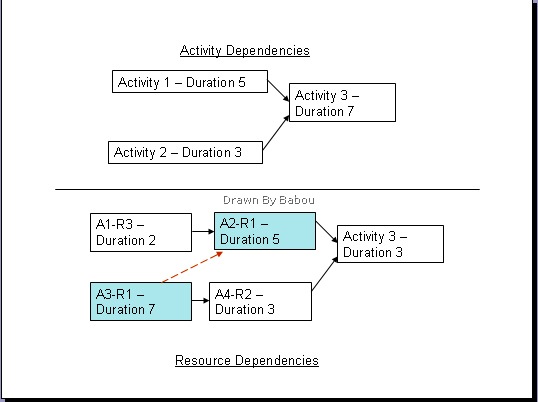
Imagine a project management scenario where a project is divided into several tasks, and certain tasks cannot commence until predecessors are completed. Consider the following simplified dependency graph:
| Task (Vertex) | Depends On (Predecessors) |
|---|---|
| Task A | - |
| Task B | Task A |
| Task C | Task A |
| Task D | Task B, Task C |
| Task E | Task D |
In this scenario, a proper rope cover might involve:
- One rope that follows the sequence Task A → Task B → Task D → Task E.
- Task C, although dependent on Task A, might either be appended to the first rope if the dependency and non-overlap condition are met or be managed as a separate rope if adding it would either violate the linear sequencing or if it introduces overlapping pathways.
When the proper rope cover conditions are applied, it is often determined, after careful analysis, that each chain (rope) must be distinct to avoid redundancy. In this example, if Task C cannot simply mesh into the Task A → Task B → Task D chain without violating a condition (such as creating an overlap or failing maximality), it would be maintained as a separate minimal rope.
Use in Dependency Resolution Tools
Modern dependency resolution tools in software build systems or package managers face the challenge of efficiently resolving and ordering dependencies. The logic behind proper rope covers often underpins more complex algorithms in these tools:
- Tools analyze dependency graphs generated from source files.
- They partition the graph into segments that can be processed sequentially or even in parallel, as long as the dependency constraints remain intact.
- The robustness of such methods lies in their ability to produce a minimal set of sequences that encompasses every component, reducing the complexity and potential for error during execution or compilation.
Challenges and Considerations
Ambiguity in Terminology
One of the most significant challenges when discussing a "proper rope cover" is that the term is not standardized in academic literature. Its usage is often found in specialized discussions and may vary depending on the context. Due to this ambiguity:
- Researchers and practitioners may use different criteria to define what constitutes a “proper cover.”
- There may be variations in whether overlapping chains are permitted in certain applications or if maximality is strictly enforced.
This ambiguity necessitates that a detailed specification is provided whenever the term is used in academic or applied contexts. Without explicit definitions, different interpretations may cause confusion or misapplication of the concept.
Implementation Complexity
From an algorithmic standpoint, enforcing the criteria for a proper rope cover takes careful deliberation:
- The algorithm must verify the non-overlapping condition, ensuring that each vertex is uniquely assigned to one rope.
- Each rope must be validated as being maximal—meaning no additional vertex can be appended without violating dependency relationships.
These requirements might demand a computational overhead that increases with the graph’s size and the complexity of its dependency relationships.
Conclusion
To summarize, a proper rope cover of a dependency graph is an advanced conceptual tool used primarily to partition a directed acyclic graph (DAG) into a collection of directed paths—each called a rope—such that:
- The union of these ropes covers every vertex in the graph.
- Each rope is maximally extended under the dependency relationships, meaning it cannot be further merged or extended without introducing redundancy.
- No vertex appears more than once across the ropes, ensuring a non-overlapping, unique partition.
Despite the term not being rigorously defined in standard textbooks, it encapsulates the idea of decomposing a dependency graph into streamlined, ordered segments. This approach highlights the underlying hierarchical structure of tasks or components, facilitating improved scheduling, resource management, and performance optimization in both theoretical and practical applications.
Moreover, understanding the concept of proper rope covers not only enhances the efficiency of dependency resolution systems—such as in compiler design and project management—but also paves the way for developing algorithms that can handle complex dependency networks more elegantly. The methods used to form proper rope covers illustrate fundamental principles of graph theory applied in real-world scenarios, where ensuring clarity, avoiding redundancy, and maintaining maximal chains are paramount.
References
-
Dependency Graphs - Example Site
-
Path Covering in DAGs - Example Site
-
Scheduling and Dependency Resolution - Example Site
Recommended Further Queries
Last updated February 19, 2025