
Unlock Your Path to Staff Software Engineer: Mastering Design, DSA, and Strategy
A granular roadmap covering Low-Level Design, High-Level Design, Design Patterns, System Design, and Data Structures & Algorithms for aspiring Staff Engineers.
Transitioning to a Staff Software Engineer role requires deepening your technical expertise across several key areas while also developing strategic thinking and leadership capabilities. This roadmap provides a detailed, granular breakdown of the essential topics and subtopics you need to master, focusing on Low-Level Design (LLD), High-Level Design (HLD), Design Patterns, System Design, and Data Structures & Algorithms (DSA).
Key Takeaways for Your Journey
- Broader Scope & Longer Horizon: Staff Engineers shift focus from 6-12 month project cycles (typical for Seniors) to a 1-2 year strategic vision, considering long-term maintainability, scalability, and business impact.
- Deep Technical & Strategic Integration: Mastery involves not just knowing individual concepts (like DSA or Design Patterns) but integrating them effectively within complex HLD and LLD, making informed trade-offs, and aligning technical decisions with product goals.
- Leadership & Mentorship: Beyond technical prowess, Staff Engineers are expected to lead design discussions, mentor other engineers, establish technical roadmaps, and champion best practices across teams.
Foundational Pillar: Data Structures and Algorithms (DSA)
Why DSA Still Matters at the Staff Level
While system design takes center stage, a robust understanding of DSA remains critical. It informs efficient implementation choices, helps analyze performance bottlenecks in complex systems, and provides the building blocks for optimizing components within larger architectures. Staff Engineers leverage DSA knowledge to make informed decisions about data handling, processing, and retrieval at scale.
Core Data Structures
- Linear Structures:
- Arrays (including dynamic arrays)
- Linked Lists (Singly, Doubly, Circular)
- Stacks
- Queues (including Deques, Priority Queues)
- Hashing:
- Hash Tables (Hash Maps, Dictionaries)
- Hash Sets
- Collision Resolution Techniques
- Trees:
- Binary Trees
- Binary Search Trees (BST)
- Self-Balancing Trees (AVL Trees, Red-Black Trees)
- Heaps (Min-Heap, Max-Heap)
- Tries (Prefix Trees)
- B-Trees / B+ Trees (Database indexing concepts)
- Segment Trees
- Merkle Trees (Data verification)
- Graphs:
- Representations (Adjacency Matrix, Adjacency List)
- Graph Traversal Algorithms (Breadth-First Search - BFS, Depth-First Search - DFS)
- Advanced Structures:
- Skip Lists
- Bloom Filters
Essential Algorithms
- Sorting: Bubble Sort, Insertion Sort, Selection Sort, Merge Sort, Quick Sort, Heap Sort, Counting Sort, Radix Sort (Understand trade-offs)
- Searching: Linear Search, Binary Search, Ternary Search
- Graph Algorithms:
- Shortest Path (Dijkstra's, Bellman-Ford, Floyd-Warshall)
- Minimum Spanning Tree (Prim's, Kruskal's)
- Topological Sort
- Connected Components
- Union-Find (Disjoint Set Union - DSU)
- Algorithmic Paradigms:
- Recursion and Backtracking
- Dynamic Programming (Memoization, Tabulation)
- Greedy Algorithms
- Divide and Conquer
- Sliding Window Technique
- Two Pointers Technique
- String Algorithms: KMP (Knuth-Morris-Pratt), Rabin-Karp
- Bit Manipulation Techniques
- Mathematical Concepts: Basic Number Theory, Combinatorics
- Advanced Search: A* Search
- Probabilistic/Heuristic Algorithms: Monte Carlo simulations, Genetic algorithms (Conceptual understanding)
Complexity Analysis
- Time Complexity (Big O, Big Omega, Big Theta notation)
- Space Complexity
- Amortized Analysis
- Understanding trade-offs between time and space
- Cache-conscious algorithm design (Conceptual)
Crafting the Code: Low-Level Design (LLD)
Translating Architecture into Implementation Details
LLD focuses on the detailed design of individual components, modules, classes, and functions within a system. It bridges the gap between the high-level architectural vision and the actual code implementation. For Staff Engineers, mastering LLD means creating code that is not just functional but also maintainable, extensible, testable, and robust, often setting standards for the team.
Object-Oriented Design (OOD) Principles
- SOLID Principles:
- Single Responsibility Principle (SRP)
- Open/Closed Principle (OCP)
- Liskov Substitution Principle (LSP)
- Interface Segregation Principle (ISP)
- Dependency Inversion Principle (DIP) / Dependency Injection
- Other Key Principles:
- DRY (Don't Repeat Yourself)
- KISS (Keep It Simple, Stupid)
- YAGNI (You Aren't Gonna Need It)
- Composition over Inheritance
- Law of Demeter (Principle of Least Knowledge)
- Design by Contract
- GRASP Patterns (General Responsibility Assignment Software Patterns): Understanding concepts like Information Expert, Creator, Controller, Low Coupling, High Cohesion.
Class and Interface Design
- Defining attributes and methods
- Constructors, Getters/Setters
- Access Modifiers (Public, Private, Protected)
- Use of Interfaces and Abstract Classes
- Relationships: Inheritance, Composition, Aggregation
LLD Artifacts and Techniques
- UML Diagrams:
- Class Diagrams
- Sequence Diagrams
- Activity Diagrams
- State Charts (State Machine Diagrams)
- Refactoring Techniques (Identifying code smells, applying refactorings like Extract Method, Introduce Parameter Object, Replace Conditional with Polymorphism)
- Error Handling and Exception Management Strategies
- Logging Mechanisms and Best Practices
- Concurrency Control Basics (Mutexes, Semaphores, Locks - conceptual understanding within component design)
- Memory Management Considerations (where applicable, e.g., C++)
- Serialization/Deserialization Choices
- API Design at the Component Level (Internal Contracts)
- Unit Testing Strategies and Testability Design
Common LLD Interview Problems
- Design a Parking Lot System
- Design an ATM
- Design an Elevator System
- Design a Library Management System
- Design a Hotel Management System
- Design a Chess Game
- Design a Vending Machine
Reusable Solutions: Design Patterns
Applying Proven Techniques for Common Problems
Design patterns provide standardized, reusable solutions to recurring problems in software design. Understanding and applying these patterns leads to more flexible, maintainable, and scalable code. Staff Engineers should not only know these patterns but also understand their trade-offs and when (and when not) to apply them in the context of larger systems.
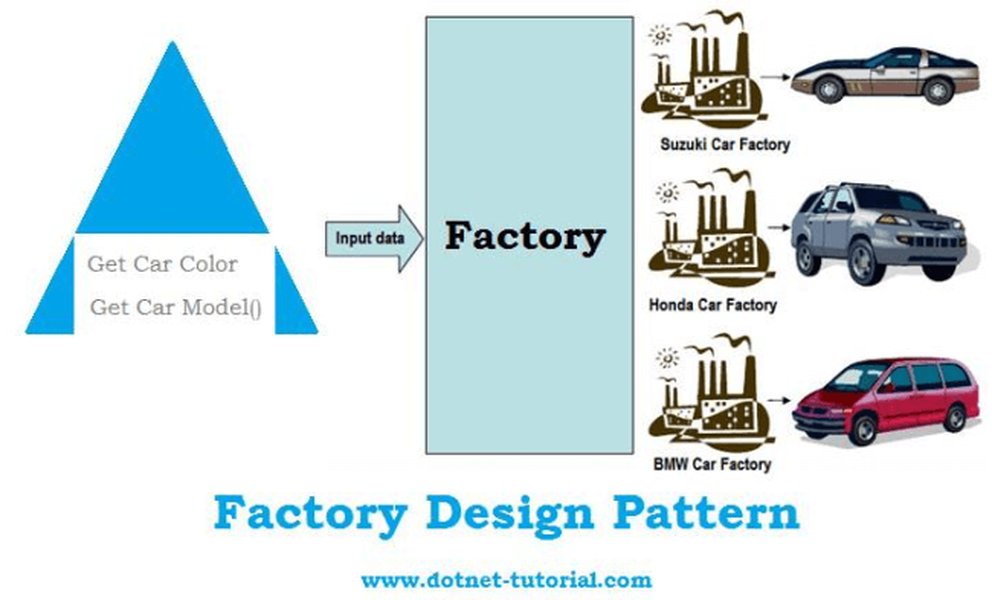
Example of a Creational Pattern: The Factory Pattern simplifies object creation.
Creational Patterns (Object Creation Mechanisms)
- Singleton: Ensure a class only has one instance and provide a global point of access. (Understand thread-safety implications and potential downsides/anti-pattern aspects).
- Factory Method: Define an interface for creating an object, but let subclasses decide which class to instantiate.
- Abstract Factory: Provide an interface for creating families of related or dependent objects without specifying their concrete classes.
- Builder: Separate the construction of a complex object from its representation, allowing the same construction process to create different representations. (Useful for objects with many optional parameters).
- Prototype: Specify the kinds of objects to create using a prototypical instance, and create new objects by copying this prototype. (Consider deep vs. shallow copy).
Structural Patterns (Object Composition and Relationships)
- Adapter: Convert the interface of a class into another interface clients expect. (Wrapper).
- Bridge: Decouple an abstraction from its implementation so the two can vary independently.
- Composite: Compose objects into tree structures to represent part-whole hierarchies. Composite lets clients treat individual objects and compositions of objects uniformly.
- Decorator: Attach additional responsibilities to an object dynamically. Decorators provide a flexible alternative to subclassing for extending functionality. (Wrapper).
- Facade: Provide a unified interface to a set of interfaces in a subsystem. Facade defines a higher-level interface that makes the subsystem easier to use.
- Flyweight: Use sharing to support large numbers of fine-grained objects efficiently. (Memory optimization).
- Proxy: Provide a surrogate or placeholder for another object to control access to it. (Virtual, Protection, Remote Proxies).
Behavioral Patterns (Object Interaction and Responsibility)
- Chain of Responsibility: Avoid coupling the sender of a request to its receiver by giving more than one object a chance to handle the request. Chain the receiving objects and pass the request along the chain until an object handles it.
- Command: Encapsulate a request as an object, thereby letting you parameterize clients with different requests, queue or log requests, and support undoable operations.
- Iterator: Provide a way to access the elements of an aggregate object sequentially without exposing its underlying representation.
- Mediator: Define an object that encapsulates how a set of objects interact. Mediator promotes loose coupling by keeping objects from referring to each other explicitly.
- Memento: Without violating encapsulation, capture and externalize an object's internal state so that the object can be restored to this state later. (Undo/Redo).
- Observer: Define a one-to-many dependency between objects so that when one object changes state, all its dependents are notified and updated automatically. (Publish-Subscribe).
- State: Allow an object to alter its behavior when its internal state changes. The object will appear to change its class.
- Strategy: Define a family of algorithms, encapsulate each one, and make them interchangeable. Strategy lets the algorithm vary independently from clients that use it.
- Template Method: Define the skeleton of an algorithm in an operation, deferring some steps to subclasses. Template Method lets subclasses redefine certain steps of an algorithm without changing the algorithm's structure.
- Visitor: Represent an operation to be performed on the elements of an object structure. Visitor lets you define a new operation without changing the classes of the elements on which it operates. (Useful for adding operations to complex object structures).
Architecting the System: High-Level Design (HLD) and System Design
Blueprint for Scalable and Resilient Systems
HLD focuses on the macro-level structure: the main components, services, databases, APIs, and their interactions. System Design is the broader discipline encompassing HLD, LLD, and considerations like scalability, reliability, performance, security, and maintainability, especially for large-scale, distributed systems. Staff Engineers are expected to lead HLD efforts, make critical architectural decisions, and design systems that can evolve over time.
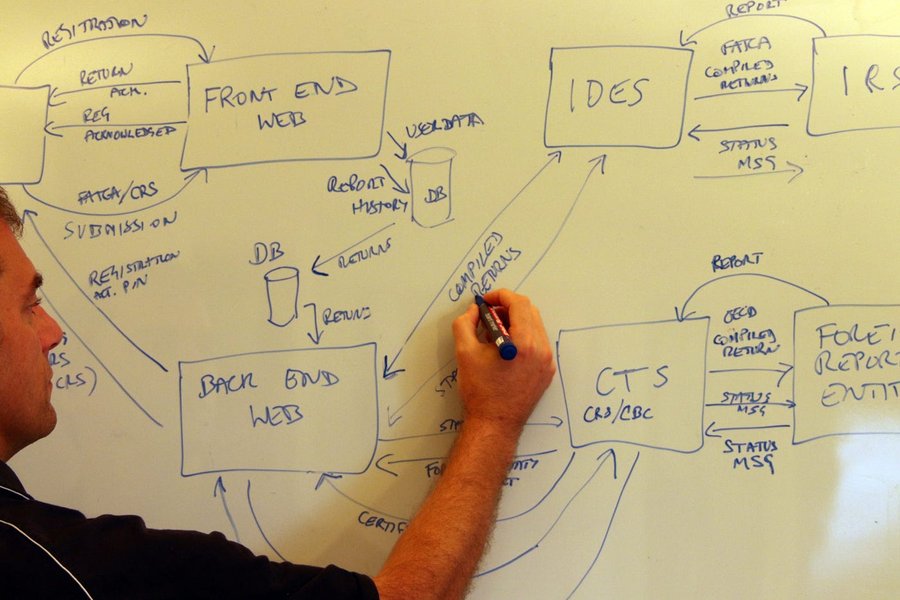
Visualizing high-level components and their interactions is key in HLD.
HLD Core Concepts
- Defining System Goals, Scope, Functional & Non-Functional Requirements (NFRs)
- Breaking Down the System into Modules/Components/Services
- Defining Interfaces and Contracts between Components (API Design: REST, gRPC, GraphQL)
- Data Modeling (High-level schema design, choice of data storage)
- Data Flow Diagrams and Interaction Flowcharts
- Understanding Architectural Patterns (See below)
System Design Fundamentals
- Scalability:
- Vertical vs. Horizontal Scaling
- Load Balancing Strategies (Round Robin, Least Connections, etc.)
- Stateless vs. Stateful Services
- Availability & Reliability:
- Redundancy and Failover Mechanisms
- Fault Tolerance (e.g., graceful degradation)
- Health Checks
- Understanding SLAs/SLOs/SLIs
- Performance & Latency:
- Caching Strategies (Client-side, CDN, Server-side - In-memory like Redis/Memcached, Database caching)
- Cache Invalidation Policies
- Latency Budgeting
- Asynchronous Processing (Message Queues)
- Data Storage & Management:
- Choosing Databases: SQL (Relational) vs. NoSQL (Key-Value, Document, Columnar, Graph) - understanding trade-offs.
- Database Replication (Master-Slave, Master-Master)
- Database Sharding/Partitioning Strategies
- Data Consistency Models (Strong, Eventual - ACID vs. BASE)
- CAP Theorem and PACELC Theorem
- Indexing Strategies
- Networking Concepts:
- Proxies (Forward and Reverse)
- Content Delivery Networks (CDNs)
- DNS (Domain Name System)
- TCP/IP, HTTP/HTTPS Basics
- Communication Patterns:
- Synchronous vs. Asynchronous Communication
- Message Queues (e.g., Kafka, RabbitMQ, SQS) - Use cases (Decoupling, Buffering, Rate Limiting)
- Publish/Subscribe Pattern
- WebSockets (Real-time communication)
- Security Aspects:
- Authentication & Authorization (OAuth, JWT, SAML)
- Encryption (At-rest, In-transit)
- Rate Limiting and Throttling
- Input Validation
- Threat Modeling Basics
- API Gateways
- Monitoring & Observability:
- Logging (Structured Logging)
- Metrics Collection
- Tracing (Distributed Tracing)
- Alerting
- Deployment Strategies:
- CI/CD Pipelines Overview
- Containerization (Docker) & Orchestration (Kubernetes basics)
- Deployment Patterns (Blue-Green, Canary Releases)
Architectural Patterns
- Monolithic Architecture
- Microservices Architecture
- Service-Oriented Architecture (SOA)
- Layered (N-Tier) Architecture
- Event-Driven Architecture (EDA)
- Client-Server Architecture
- Peer-to-Peer (P2P) Architecture
- Space-Based Architecture (Less common, for high scalability)
- CQRS (Command Query Responsibility Segregation)
- Serverless Architecture
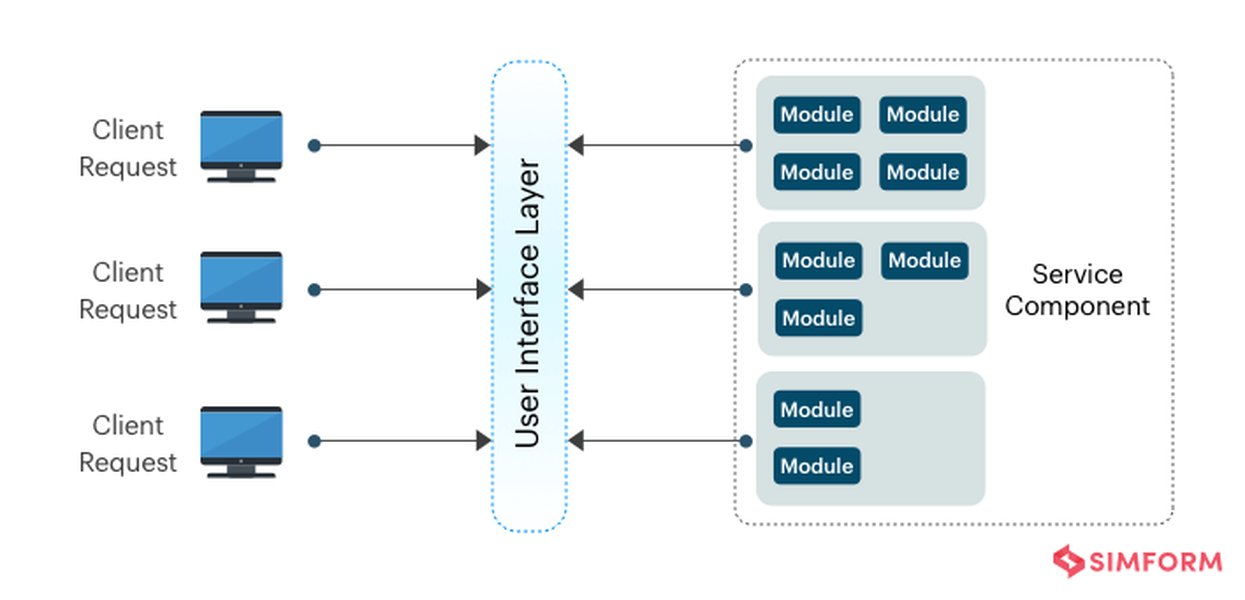
Microservices: A common pattern for building scalable, independent services.
Common System Design Interview Problems
- Design a URL Shortening Service (like TinyURL)
- Design a Social Media Feed (like Twitter, Facebook, Instagram)
- Design a Chat System (like WhatsApp, Slack)
- Design a Ride-Sharing Service (like Uber, Lyft)
- Design an E-commerce Platform (like Amazon)
- Design a Video Streaming Service (like YouTube, Netflix)
- Design a Distributed Key-Value Store / Cache (like Redis, Memcached)
- Design a Rate Limiter
- Design a Web Crawler
- Design a Notification System
- Design a Distributed Job Scheduler
- Design Google Docs / Collaborative Editing System
- Design a Typeahead Suggestion Service
System Design Process & Evaluation
- Requirement Gathering (Functional & Non-Functional)
- Back-of-the-Envelope Estimation (Traffic, Storage, Bandwidth)
- High-Level Design / API Design
- Data Model Design
- Detailed Component Design
- Identifying Bottlenecks and Scaling
- Addressing Fault Tolerance, Security, Monitoring
- Trade-off Analysis (Articulating choices and justifications)
Staff Engineer Skill Emphasis Radar
Comparing Senior vs. Staff Engineer Focus Areas
While Senior Engineers possess strong technical skills, Staff Engineers typically demonstrate greater depth and breadth, particularly in strategic thinking, system-level perspective, and leadership. This radar chart visually contrasts the typical emphasis on various skills between the two roles. Note that both roles require proficiency in all areas, but the emphasis shifts.
As illustrated, while core technical skills (DSA, LLD, Patterns) remain vital, the Staff role demands significantly more focus on HLD/Architecture, Scalability, Cross-functional collaboration, Leadership, Strategic Planning, and understanding the Business/Product context.
Visualizing the Learning Path
Mindmap Overview of Key Domains
This mindmap provides a high-level visual overview of the interconnected domains you need to master on your journey to becoming a Staff Software Engineer. It highlights the core areas and some key sub-topics within each.
(Arrays, Lists, Stacks, Queues, Hashes)"] id1_2["Trees
(BST, AVL, Heaps, Tries)"] id1_3["Graphs
(Traversal, Shortest Path, MST)"] id1_4["Algorithms
(Sorting, Searching, DP, Greedy)"] id1_5["Complexity Analysis
(Time, Space)"] id2["Low-Level Design (LLD)"] id2_1["OOD Principles
(SOLID, DRY, KISS, YAGNI)"] id2_2["Class & Interface Design"] id2_3["UML Diagrams
(Class, Sequence)"] id2_4["Refactoring & Testability"] id2_5["Error Handling & Logging"] id3["Design Patterns"] id3_1["Creational
(Singleton, Factory, Builder)"] id3_2["Structural
(Adapter, Decorator, Facade, Proxy)"] id3_3["Behavioral
(Observer, Strategy, Command, State)"] id3_4["Trade-offs & Application Context"] id4["High-Level Design (HLD) & System Design"] id4_1["Architectural Patterns
(Microservices, Monolith, EDA)"] id4_2["Scalability & Performance
(Load Balancing, Caching, Sharding)"] id4_3["Reliability & Availability
(Redundancy, Failover, CAP Theorem)"] id4_4["Data Storage
(SQL vs NoSQL, Replication)"] id4_5["Networking & Communication
(APIs, Queues, CDNs)"] id4_6["Security & Monitoring"] id4_7["Common Design Problems
(URL Shortener, Feeds, Chat)"] id5["Staff-Level Competencies"] id5_1["Strategic Thinking (1-2 Yr Horizon)"] id5_2["Technical Leadership & Mentoring"] id5_3["Cross-Functional Collaboration"] id5_4["Product Sense & Business Acumen"] id5_5["Trade-off Analysis & Decision Making"] id5_6["Technical Roadmapping"]
Comparing HLD and LLD
Understanding the Scope and Focus
Distinguishing between High-Level Design (HLD) and Low-Level Design (LLD) is fundamental. HLD provides the blueprint, while LLD details the construction plan. The following table summarizes their key differences:
| Aspect | High-Level Design (HLD) | Low-Level Design (LLD) |
|---|---|---|
| Scope | Overall system architecture, macro components | Internal design of specific modules/components |
| Focus | System components, services, databases, APIs, interactions, architectural patterns | Classes, interfaces, functions, algorithms, data structures within a component |
| Abstraction | High (Bird's-eye view) | Low (Detailed implementation view) |
| Audience | Architects, tech leads, potentially product managers, other teams | Developers implementing the component, testers |
| Key Outputs | Architecture diagrams, component breakdowns, API contracts, data model overview, tech stack choices | Class diagrams, sequence diagrams, detailed algorithms, interface specifications, database schema details |
| Concerns | Scalability, availability, reliability, overall performance, inter-service communication, major technology choices | Code quality, maintainability, testability, efficiency of specific algorithms, adherence to coding standards, SOLID principles |
| Example Analogy | Architectural blueprint of a building (floors, rooms layout, main systems) | Detailed construction plan for a specific room (electrical wiring, plumbing specifics, material details) |
System Design Interview Example
Observing Staff-Level Thinking in Practice
Watching experienced engineers tackle system design problems is invaluable. This video demonstrates a mock interview for designing YouTube, featuring an ex-Meta Staff Engineer. Pay attention to how requirements are clarified, trade-offs are discussed, components are chosen, and scalability is addressed – key aspects of Staff-level design thinking.
This example highlights the process of breaking down a complex problem, making estimations, designing core components (like video upload, storage, streaming, and recommendations), considering scaling challenges, and discussing potential bottlenecks. Notice the depth of discussion around databases, CDNs, encoding, and metadata management.
Frequently Asked Questions (FAQ)
How long does it typically take to prepare for a Staff Engineer role focusing on these areas? +
Preparation time varies greatly depending on your current experience level and the intensity of your study. However, a dedicated effort focusing on these areas could range from 3-6 months for someone already operating at a strong Senior Engineer level to potentially longer (6-12+ months) if needing to significantly deepen knowledge in multiple areas like distributed systems or advanced DSA. Continuous learning is key, even after reaching the Staff level.
What's the biggest difference between Senior and Staff Engineer in a System Design interview? +
While both roles require strong system design skills, the expectations differ in scope and strategic thinking. Senior Engineers often focus on designing a robust and scalable solution for the immediate problem, typically within a 6-12 month horizon. Staff Engineers are expected to demonstrate a broader perspective, considering the system's evolution over 1-2 years, potential future requirements, cross-team dependencies, operational aspects, and stronger justification of trade-offs aligned with business/product goals. They often lead the design process more authoritatively and delve deeper into reliability, maintainability, and long-term cost implications.
Should I focus more on HLD or LLD preparation? +
For a Staff Engineer role, both are crucial, but HLD and System Design often carry more weight in interviews and the role itself. Staff engineers are primarily responsible for setting the architectural direction (HLD). However, strong LLD skills (including design patterns and SOLID principles) are essential to ensure the high-level vision can be translated into quality, maintainable code and to effectively mentor others. Neglecting LLD will undermine your ability to execute or evaluate the detailed implementation of your designs.
How important is DSA compared to System Design for Staff roles? +
System Design proficiency is generally considered more critical for Staff Engineer roles, as it directly relates to the core responsibilities of architecting and overseeing large-scale systems. However, DSA remains a foundational requirement. While you might not face extremely complex algorithmic puzzles as frequently as in entry-level interviews, you'll be expected to have a solid grasp of common data structures and algorithms, understand their complexity, and apply them appropriately within system components to ensure efficiency and optimal performance. Weakness in DSA can still be a blocker.
Recommended Next Steps
- Explore detailed breakdowns of common system design interview questions, such as designing a distributed cache.
- Investigate the trade-offs between various architectural patterns like microservices and event-driven architectures.
- Learn practical strategies for applying SOLID principles effectively within complex, large-scale codebases.
- Discover effective techniques for mentoring junior engineers and promoting design best practices within a team.
References
Last updated May 5, 2025