
Is the Universe's Gravitational Dance the Secret to Divine Unity?
Exploring the distinct realms of the scientific Three-Body Problem and the theological Trinity.
The question of whether a complex scientific phenomenon like the "Three-Body Problem" could represent the profound mystery of the Christian Trinity—God as Father, Son, and Holy Spirit in one Being—touches upon the intersection of physics, astronomy, and theology. While both concepts involve a 'threeness,' a closer examination reveals they belong to fundamentally different domains of knowledge and describe vastly different realities.
Key Distinctions at a Glance
- Fundamentally Different Realms: The Three-Body Problem is a concept within classical mechanics and physics, dealing with the gravitational interaction of physical objects. The Trinity is a core doctrine of Christian theology, describing the nature of God.
- Nature of Components: The "bodies" in the scientific problem are distinct physical masses (like stars or planets). The "Persons" in the Trinity (Father, Son, Holy Spirit) are distinct aspects within one indivisible divine essence, not separate physical entities.
- Basis of Understanding: The Three-Body Problem is studied through mathematics, observation, and empirical methods. The Trinity is understood through faith, revelation (scripture), and theological reflection, considered a divine mystery beyond full human comprehension.
Decoding the Three-Body Problem in Science
A Celestial Puzzle of Chaos and Complexity
In the realm of physics and astronomy, the "Three-Body Problem" refers to the challenge of predicting the individual movements of three celestial bodies (like stars, planets, or moons) interacting gravitationally with each other according to Newton's laws of motion and universal gravitation. While the two-body problem (e.g., a single planet orbiting a single star) has elegant, predictable solutions, adding just one more body dramatically increases the complexity.
Why is it a "Problem"?
The core difficulty lies in the intricate and highly sensitive interplay of gravitational forces. Unlike the two-body system, there is no general closed-form solution for the three-body problem. This means we cannot write down simple equations that predict the exact positions and velocities of the three bodies for all future times given their initial conditions.
- Chaotic Dynamics: Most configurations of three bodies lead to chaotic motion. This means that minuscule changes in the starting positions or velocities can lead to drastically different outcomes over time. Predictability breaks down, making long-term forecasting impossible without extensive numerical simulations.
- Instability: Many three-body systems are inherently unstable. Over time, interactions can lead to bodies being ejected from the system, collisions, or radical shifts in orbits.
- Special Cases: While a general solution is elusive, mathematicians and physicists have found specific, stable solutions for particular arrangements and mass ratios, such as Lagrange points or the remarkable figure-eight orbit. However, these are exceptions rather than the rule.
The Three-Body Problem is a fascinating area of study in celestial mechanics and dynamics, relevant to understanding star systems, asteroid movements, and even the intricate dance of the Earth, Moon, and Sun. It highlights the emergence of complexity and unpredictability even within systems governed by relatively simple physical laws.
Visualizing the Challenge
The following video provides a deeper dive into the scientific intricacies of the Three-Body Problem:
A detailed explanation of the physics behind the Three-Body Problem.
Understanding the Doctrine of the Trinity
A Core Mystery of Christian Faith
The Christian doctrine of the Trinity is a foundational theological concept that defines the nature of God. It posits that God is one single Being (essence or substance) who exists eternally and simultaneously as three distinct, co-equal, and co-eternal Persons: the Father, the Son (incarnated as Jesus Christ), and the Holy Spirit.
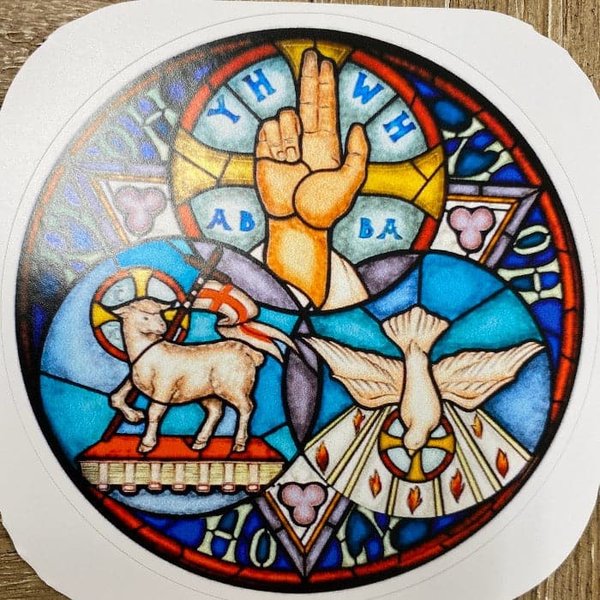
A common visual representation of the Trinity doctrine, emphasizing unity and distinction.
Key Theological Tenets
- One God, Three Persons: Christianity is strictly monotheistic. The Trinity does not imply three separate gods but asserts that the Father, Son, and Holy Spirit are each fully God, sharing the same divine nature.
- Distinct Persons: While sharing one essence, the Father, Son, and Holy Spirit are distinct in their relationships to one another (e.g., the Father sends the Son, the Son obeys the Father, the Spirit proceeds from the Father and the Son) and in their roles in creation and redemption (often referred to as the 'economic Trinity').
- Co-equal and Co-eternal: All three Persons are considered equal in divinity, power, and glory, having existed eternally together. There is no hierarchy in their divine nature.
- Divine Mystery: Theologians emphasize that the Trinity is ultimately a divine mystery that surpasses full human comprehension. It is understood through faith and God's self-revelation in scripture and tradition, not through empirical proof or logical deduction alone.
The Trinity is central to Christian belief, shaping its understanding of God's character, salvation, prayer, and worship. It distinguishes Christianity from other monotheistic religions like Judaism and Islam.
Comparing Concepts: Science vs. Theology
Why the Three-Body Problem is Not the Trinity
While the number "three" appears in both concepts, any similarity ends there. Equating the physical, often chaotic interactions of three celestial bodies with the theological mystery of God's triune nature is a categorical error. The table below highlights the fundamental differences:
| Aspect | Three-Body Problem (Science) | Trinity (Theology) |
|---|---|---|
| Domain | Physics, Astronomy, Mathematics | Theology, Religion, Metaphysics |
| Subject | Motion of physical objects (e.g., stars, planets) | Nature and Being of God |
| Nature of 'Entities' | Three distinct, separate physical masses | Three distinct Persons sharing one indivisible divine essence |
| Interaction | Mutual gravitational force, often leading to chaos/instability | Perfect, eternal, harmonious relationship within the Godhead |
| Basis of Knowledge | Empirical observation, mathematical calculation, scientific laws | Divine revelation (Scripture), faith, theological tradition |
| Concept of Unity | System of interacting parts, no inherent single substance | One single Being/Essence, absolute unity |
| Outcome/Nature | Often unpredictable, chaotic, solvable only in specific cases | Eternal, stable, perfect, a mystery of faith |
The Limits of Analogy
Throughout history, thinkers have sometimes used analogies from the natural world or science (like the three states of water, aspects of quantum mechanics, or geometric shapes) to *illustrate* aspects of the Trinity. However, these are always acknowledged as imperfect metaphors. They might help visualize certain facets, like distinction within unity, but they inevitably fall short of capturing the unique theological depth and mystery of the doctrine. The Three-Body Problem, with its emphasis on gravitational interaction and potential chaos, serves poorly even as an analogy for the perfect, eternal unity and relationship within the Godhead described by the Trinity.
Conceptual Dimensions Compared
A Radar Chart Perspective
This chart visually represents the contrasting characteristics of the Three-Body Problem and the Trinity across several dimensions. The scales are qualitative, reflecting the fundamental nature of each concept rather than precise numerical values. Notice how the profiles differ significantly, highlighting their distinct domains and attributes.
Mapping the Concepts
A Mindmap Visualization
This mindmap further illustrates the distinct nature and characteristics of the scientific Three-Body Problem and the theological Trinity, highlighting their separate domains and core ideas.
(Science)"] id1a["Domain: Physics & Astronomy"] id1b["Subject: Celestial Mechanics"] id1c["Entities: 3 Physical Bodies"] id1d["Interaction: Gravity"] id1e["Nature: Often Chaotic,
Mathematically Complex"] id1f["Basis: Empirical Observation,
Newtonian Laws"] id1g["Solution: No General
Closed-Form Solution"] id2["Trinity
(Theology)"] id2a["Domain: Christian Theology"] id2b["Subject: Nature of God"] id2c["Entities: 3 Divine Persons
(Father, Son, Holy Spirit)"] id2d["Interaction: Eternal Relationship,
Perfect Unity"] id2e["Nature: Divine Mystery,
One Essence"] id2f["Basis: Revelation (Scripture),
Faith, Tradition"] id2g["Understanding: Beyond Full
Human Comprehension"]
Frequently Asked Questions (FAQ)
Are there any valid connections between science and the Trinity?
While the Three-Body Problem itself is not related to the Trinity, some theologians and thinkers explore potential *dialogues* or *analogies* between modern science (like quantum mechanics or cosmology) and theological concepts. These are generally seen as reflective or illustrative, aiming to show compatibility or resonance rather than direct proof or equivalence. The Trinity remains a concept rooted in faith and revelation, distinct from scientific inquiry.
Could the complexity of the Three-Body Problem be seen as a metaphor for divine mystery?
One could *metaphorically* use the complexity and unpredictability of the Three-Body Problem to illustrate the idea that some realities surpass simple human understanding, perhaps drawing a parallel to the concept of divine mystery. However, this is purely an analogy. The *nature* of the complexity is different: one is mathematical/physical chaos arising from known laws, while the other is a theological assertion about the transcendent nature of God, considered inherently beyond full empirical or logical grasp.
Is the "Three-Body Problem" related to the Netflix show "3 Body Problem"?
Yes, the Netflix show (and the novel series it's based on) centrally features the scientific Three-Body Problem. In the story, an alien civilization resides on a planet orbiting three suns, whose unpredictable gravitational interactions cause cycles of stability and catastrophic destruction. This chaotic celestial mechanics is a core element driving the narrative. It uses the real scientific problem as a major plot device.
Why is the Trinity described as Father, Son, and Holy Spirit?
These terms are derived from Christian scripture (primarily the New Testament) and tradition. They reflect perceived roles and relationships within the Godhead as revealed through biblical narratives and teachings. "Father" often signifies the source or origin, "Son" refers to Jesus Christ (God incarnate), and "Holy Spirit" denotes God's active presence and power in the world and in believers. These names represent the distinct Persons within the unified Godhead, as understood in Christian theology.
Recommended Further Exploration
- What are the known stable solutions to the Three-Body Problem in physics?
- How do different Christian denominations understand and explain the doctrine of the Trinity?
- Can you provide more examples of chaos theory applied in astronomy besides the Three-Body Problem?
- What are some common analogies used to explain the Christian Trinity, and what are their limitations?
References

Last updated April 28, 2025