
Understanding Density: Concepts and Calculations
A Comprehensive Guide to Density and Its Practical Applications
Key Takeaways
- Density is a fundamental property that describes how much mass is contained in a unit volume of a substance.
- Accurate density calculations are essential for predicting the behavior of objects in various fluids.
- Experimental methods allow for the practical determination of density in both regular and irregularly shaped objects.
1. Introduction to Density
Density is a crucial concept in both physics and chemistry, providing insight into the composition and behavior of various substances. It is defined as the mass of an object divided by its volume and is typically expressed in units such as grams per cubic centimeter (g/cm³) for solids and liquids, or kilograms per cubic meter (kg/m³) for gases.
1.1. Definition and Importance
Density (\(\rho\)) is mathematically represented by the formula:
\(\rho = \frac{m}{V}\)
where:
- \(\rho\) = Density
- m = Mass
- V = Volume
Understanding density is essential for various applications, including material identification, quality control in manufacturing, and predicting whether an object will float or sink in a fluid.
1.2. Units of Density
Density can be measured in different units depending on the context:
- Solids: grams per cubic centimeter (g/cm³) or kilograms per cubic meter (kg/m³)
- Liquids: grams per milliliter (g/mL) or kilograms per liter (kg/L)
- Gases: grams per liter (g/L) or kilograms per cubic meter (kg/m³)
2. Calculating Density
2.1. Basic Density Formula
The fundamental equation to calculate density is:
\(\rho = \frac{m}{V}\)
Where:
- Mass (m): Measured using a balance or scale.
- Volume (V): For regular shapes, calculated using geometric formulas; for irregular shapes, determined via displacement methods.
2.2. Example Calculation
Suppose you have a solid cube with a mass of 50 grams and each side of the cube is 3 centimeters long. To find its density:
- Calculate the volume of the cube:
- Apply the density formula:
Volume (\(V\)) = side³ = \(3 \, \text{cm} \times 3 \, \text{cm} \times 3 \, \text{cm} = 27 \, \text{cm}³\)
\(\rho = \frac{50 \, \text{g}}{27 \, \text{cm}³} \approx 1.85 \, \text{g/cm}³\)
3. Experimental Determination of Density
3.1. Determining the Density of a Liquid
Materials Needed
- Graduated cylinder
- Digital balance
- Liquid sample
- Thermometer (optional, for temperature measurements)
Procedure
- Weigh an empty graduated cylinder using the digital balance and record its mass.
- Fill the graduated cylinder with a known volume of the liquid (e.g., 50 mL) and measure the combined mass of the cylinder and liquid.
- Subtract the mass of the empty cylinder from the combined mass to obtain the mass of the liquid (\(m\)).
- Use the known volume (\(V\)) and the calculated mass to determine density:
\(\rho = \frac{m}{V}\)
Example Calculation
If 50 mL of liquid has a mass of 60 grams:
\(\rho = \frac{60 \, \text{g}}{50 \, \text{mL}} = 1.2 \, \text{g/mL}\)
3.2. Determining the Density of a Regularly Shaped Solid
Materials Needed
- Digital balance
- Ruler or caliper
- Regularly shaped solid (e.g., cube, cylinder)
- Calculator
Procedure
- Measure the mass of the solid using the digital balance and record it (\(m\)).
- Measure the dimensions of the solid:
- For a cube: Measure the length of one side.
- For a cylinder: Measure the radius and height.
- Calculate the volume (\(V\)) using appropriate geometric formulas:
- Cube: \(V = \text{side}^3\)
- Cylinder: \(V = \pi r^2 h\)
- Apply the density formula:
\(\rho = \frac{m}{V}\)
Example Calculation
A cube with a side length of 4 cm and a mass of 128 grams:
Volume (\(V\)) = \(4 \, \text{cm} \times 4 \, \text{cm} \times 4 \, \text{cm} = 64 \, \text{cm}³\)
\(\rho = \frac{128 \, \text{g}}{64 \, \text{cm}³} = 2 \, \text{g/cm}³\)
3.3. Determining the Density of an Irregularly Shaped Solid by Displacement
Materials Needed
- Graduated cylinder or overflow can
- Water
- Digital balance
- Irregularly shaped solid
Procedure
- Fill the graduated cylinder with a known volume of water (\(V_{\text{initial}}\)) and record the level.
- Carefully submerge the irregularly shaped solid into the water without spilling, ensuring it is fully submerged.
- Record the new water level (\(V_{\text{final}}\)).
- Calculate the volume of the solid using the displacement method:
- Weigh the solid using the digital balance to obtain its mass (\(m\)).
- Determine the density:
Volume (\(V\)) = \(V_{\text{final}} - V_{\text{initial}}\)
\(\rho = \frac{m}{V}\)
Example Calculation
Initial water volume: 100 mL
Final water volume after submerging the solid: 150 mL
Volume of the solid (\(V\)) = 150 mL - 100 mL = 50 mL
Mass of the solid (\(m\)) = 75 grams
\(\rho = \frac{75 \, \text{g}}{50 \, \text{mL}} = 1.5 \, \text{g/mL}\)
4. Predicting Buoyancy: Float or Sink?
4.1. Understanding Buoyancy
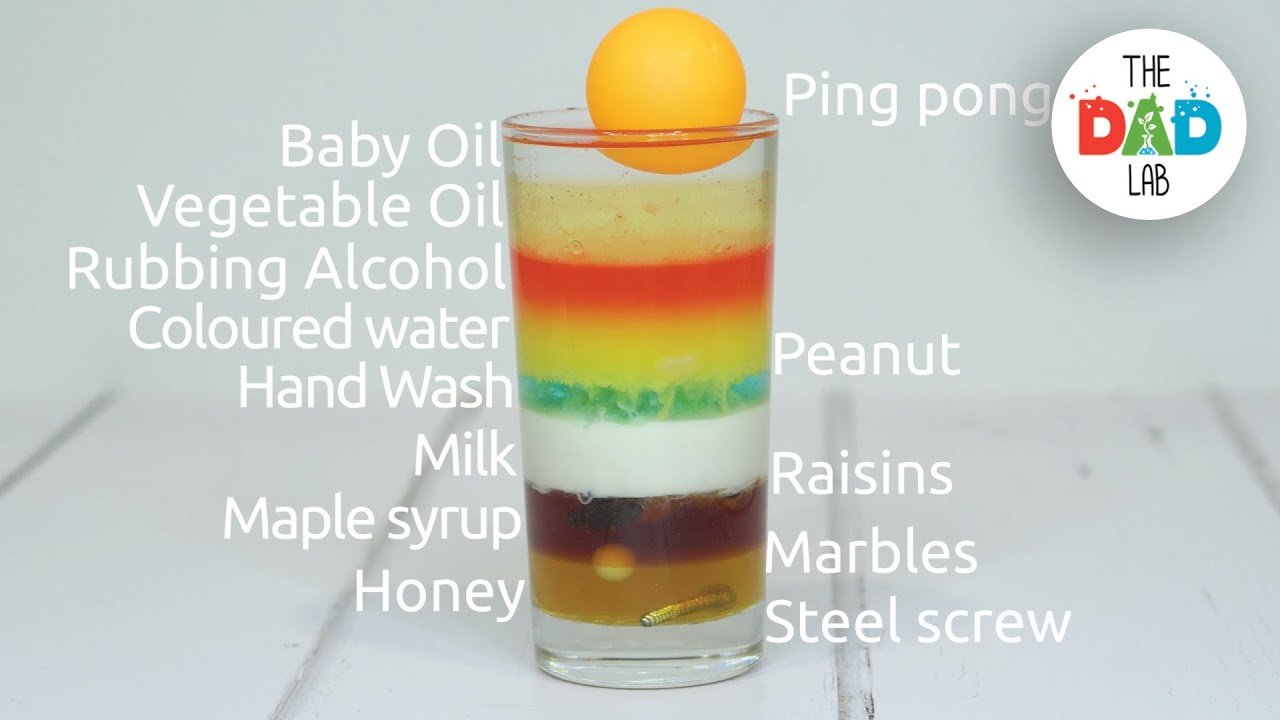
Buoyancy is the force that determines whether an object will float or sink when placed in a fluid. This behavior is primarily influenced by the object's density relative to the fluid's density.
4.2. Criteria for Floating or Sinking
| Object Density (\(\rho_{\text{object}}\)) | Fluid Density (\(\rho_{\text{fluid}}\)) | Result |
|---|---|---|
| \(\rho_{\text{object}} < \rho_{\text{fluid}}\) | Lower density fluid | ~ Float |
| \(\rho_{\text{object}} > \rho_{\text{fluid}}\) | Higher density fluid | ~ Sink |
| \(\rho_{\text{object}} = \rho_{\text{fluid}}\) | Equal density fluid | ~ Neutrally buoyant |
4.3. Practical Examples
- Wood: Typically has a density of around 0.5 to 0.8 g/cm³, which is less than the density of water (1 g/cm³). Therefore, wood generally floats on water.
- Lead: With a density of approximately 11.3 g/cm³, lead is much denser than water and will sink.
- Ice: Ice has a density of about 0.92 g/cm³, making it less dense than liquid water, which is why icebergs float.
4.4. Prediction Procedure
- Determine the density of the object (\(\rho_{\text{object}}\)) using the density formula.
- Determine the density of the fluid (\(\rho_{\text{fluid}}\)) in which the object will be placed.
- Compare the two densities:
-
If \(\rho_{\text{object}} < \rho_{\text{fluid}}\), the object will float.
-
If \(\rho_{\text{object}} > \rho_{\text{fluid}}\), the object will sink.
-
If \(\rho_{\text{object}} = \rho_{\text{fluid}}\), the object will be neutrally buoyant.
-
5. Advanced Applications of Density Calculations
5.1. Material Identification
By calculating and comparing the density of an unknown substance to known densities, one can identify materials. This is particularly useful in quality control and forensic investigations.
5.2. Engineering and Design
Understanding the density of materials is vital in engineering disciplines. It influences decisions in material selection for construction, aerospace, automotive industries, and more to ensure structural integrity and performance.
5.3. Environmental Science
Density plays a role in understanding phenomena such as oil spills in water. Oil, being less dense than water, floats, which informs strategies for cleanup and environmental protection.
6. Common Mistakes and How to Avoid Them
6.1. Inaccurate Measurements
Ensuring precise measurement of mass and volume is critical. Use calibrated instruments and repeat measurements to minimize errors.
6.2. Neglecting Temperature Effects
Temperature can affect the density of liquids. Always record the temperature of the liquid during experiments and account for its impact on density.
6.3. Misapplying Geometric Formulas
When calculating the volume of regularly shaped solids, ensure the correct geometric formula is used based on the object's shape to avoid calculation errors.
Conclusion
Density is a fundamental physical property that provides valuable insights into the composition and behavior of substances. Mastery of density calculations and experimental determination methods is essential for applications across various scientific and engineering fields. By accurately determining density, one can predict the buoyancy of objects, identify materials, and make informed decisions in design and environmental conservation.
References
Last updated February 12, 2025