
Analyzing the Potential Impact of a US Treasury Default
A deep dive into the potential consequences and market reactions
Key Insights from the Analysis
- Catastrophic Global Impact: A US Treasury default is widely predicted to trigger a severe global financial crisis, causing widespread insolvencies and market collapses.
- Treasuries as the Foundation: US Treasuries are the bedrock of the global financial system, serving as the risk-free rate and primary collateral. Their default would shatter this foundation.
- Ripple Effect Across Markets: The consequences of a default would extend beyond government bonds, impacting stocks, corporate debt, mortgages, insurance, and even cryptocurrencies.
Understanding the Gravity of a US Treasury Default
The prospect of the United States defaulting on its debt is a scenario that carries immense and potentially catastrophic consequences for the global financial system. Unlike a government shutdown, which affects government services, a debt default means the U.S. Treasury is unable to pay its financial obligations, including interest and principal payments on Treasury securities. This unprecedented event would have far-reaching effects, impacting everything from individual savings to international markets.
The Role of US Treasuries in the Global Financial System
US Treasury securities, such as Treasury bills, notes, and bonds, are considered among the safest investments in the world. This perception of safety is based on the historical reliability of the U.S. government in meeting its debt obligations. As a result, Treasuries serve as the foundation of the global financial system, acting as a benchmark for risk-free assets and a primary form of collateral in countless financial transactions worldwide.
The current national debt of the United States stands at over $36 trillion, financed through the issuance of these Treasury securities. The perceived safety and liquidity of these instruments make the U.S. dollar the dominant currency in international finance and trade.
The Mechanics of a Potential Default
A U.S. debt default would occur if the Treasury exhausts its borrowing authority, known as the debt limit, and runs out of cash to pay its obligations. While Congress has historically raised or suspended the debt limit to avoid this scenario, the risk of a default escalates significantly when the limit is reached and extraordinary measures are exhausted. Some analyses suggest that the U.S. government could face default risk as early as July if the debt limit is not addressed.
In the event of a default, the Treasury Department would face the difficult decision of prioritizing payments. However, proposals to prioritize certain payments, such as those to bondholders, are considered unworkable and would not prevent a default on other obligations, potentially including Social Security payments.
The Ripple Effect: Consequences Across Financial Markets
A default on U.S. debt would not be an isolated event; its repercussions would propagate throughout the global financial system, triggering a cascade of negative effects.
Impact on Bond and Stock Markets
The immediate impact of a U.S. default would be felt in the bond markets. The perceived risk of holding Treasury debt would skyrocket, leading to a rapid repricing of these assets and a likely slump in their value. This would, in turn, cause interest rates to rise significantly across the board, making it more expensive for the government and corporations to borrow money.
Stock markets would also experience significant turmoil. The uncertainty and fear generated by a default, coupled with higher borrowing costs, would likely lead to a sharp decline in stock prices, potentially triggering a stock market crash.
The following image illustrates the concept of a debt crisis, which a US default could exacerbate:
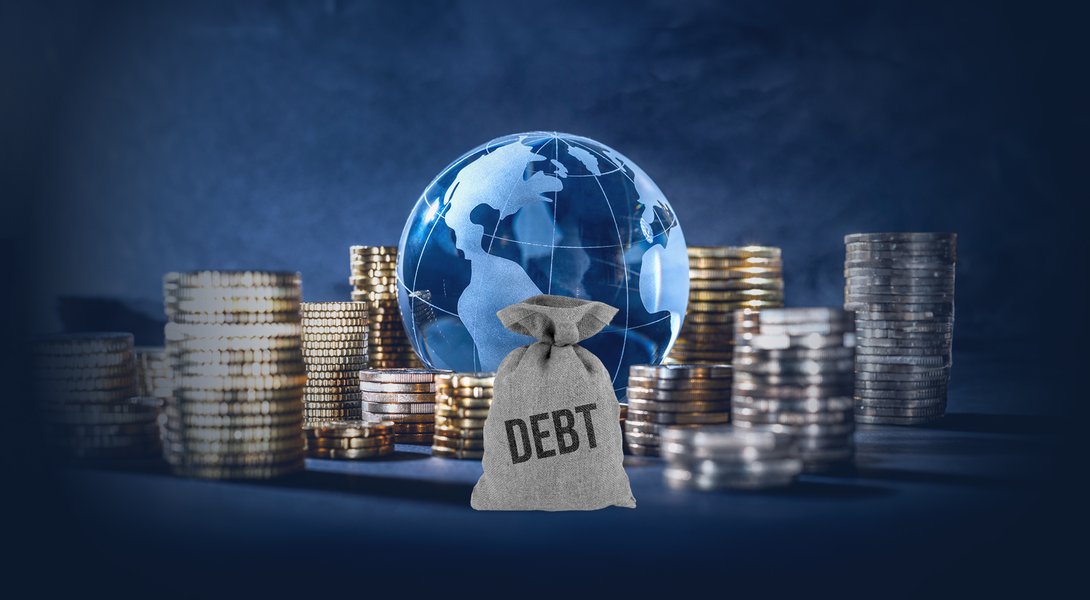
Illustration of a global debt crisis
The Collateral Crunch and Banking System Stability
US Treasuries are widely used as collateral in financial transactions, underpinning markets such as the repo market. A default would cause the value of this collateral to plummet, triggering widespread margin calls and forcing institutions to post more collateral or unwind positions. This "collateral crunch" could lead to a freezing of credit markets and significantly impact the stability of banks and other financial institutions that hold large quantities of Treasuries in their reserves.
Basel regulations require banks to hold high-quality liquid assets, with US Treasuries serving as Tier 1 capital. A default would force banks worldwide to write down the value of their Treasury holdings, weakening their balance sheets and potentially leading to insolvencies.
Global Sovereign Debt and Currency Implications
A U.S. default would shatter the notion of a risk-free asset and serve as a benchmark repricing event for sovereign debt globally. Other countries' bonds, which are often priced relative to Treasuries, would also be repriced violently. This could trigger a multi-sovereign debt crisis, particularly impacting economies heavily reliant on Treasuries or those with existing debt vulnerabilities.
The U.S. dollar's status as the world's reserve currency could also be eroded. A default would undermine confidence in the U.S. financial system, potentially leading to a decline in the dollar's value and increased volatility in currency markets.
Impact on Insurance and Pensions
Insurance companies and pension funds hold significant investments in US Treasuries as part of their reserves. A default would erode the value of these holdings, potentially impacting their ability to meet future obligations to policyholders and retirees. This could lead to forced asset sales, further destabilizing financial markets.
Consequences for Everyday Americans
The effects of a U.S. default would not be limited to financial markets and institutions; they would have a direct impact on the lives of everyday Americans. Higher interest rates would make borrowing more expensive, affecting mortgages, car loans, and credit cards. A recession could lead to job losses and decreased economic activity. Disruptions in government operations could impact various services and benefit payments.
Factuality and Writing Style Assessment of the Provided Content
The provided content from write.as/alexparker/what-a-us-treasury-default-might-look-like presents a compelling and largely factual analysis of the potential consequences of a US Treasury default. The core arguments regarding the catastrophic global impact, the foundational role of US Treasuries, and the ripple effect across various financial markets are well-supported by economic theory and the consensus among financial experts. The piece accurately highlights the interconnectedness of the global financial system and the critical role that US debt plays within it.
Factuality Assessment
The key claims made in the article align with the potential outcomes discussed by economists and financial institutions when considering a US default scenario. Specifically:
- The assertion that a default would lead to a rapid repricing of assets and significant turmoil in financial markets is widely accepted. (Source: AAF, Reuters)
- The description of US Treasuries as the bedrock of global finance and risk-free assets is accurate. (Source: Investopedia, Reuters)
- The potential for widespread insolvencies in banks and other financial institutions due to the devaluation of Treasury holdings is a significant concern. (Source: budgeting.thenest.com, write.as)
- The impact on sovereign debt markets globally and the potential for a multi-sovereign debt crisis are plausible consequences given the benchmark status of Treasuries. (Source: write.as)
- The discussion of the collateral crunch and the role of rehypothecation in magnifying the crisis is a relevant and concerning aspect of a default. (Source: write.as)
- The potential for significant impacts on insurance companies and pension funds holding Treasuries is also a valid point. (Source: write.as)
- While the section on Bitcoin's fate in a default scenario is speculative, the underlying point about the reliance of cryptocurrency on the existing financial infrastructure for liquidity and operational costs is a reasonable consideration.
The article's strength lies in its detailed explanation of the mechanisms through which a default would propagate through the financial system, particularly the emphasis on the collateral function of Treasuries and the implications for global banks and insurance companies. It effectively conveys the systemic risk involved.
Writing Style Assessment
From a writing style perspective, the article is engaging and uses strong, evocative language to convey the severity of a potential default. Phrases like "algorithmic meltdown," "crushing collateral crunch," and "system-wide margin call" effectively capture the dramatic nature of the scenario. The structure of the article, breaking down the impact on different sectors, helps to organize complex information.
The writing is accessible to a general audience while still providing sufficient detail for those with some financial knowledge. The use of headings and subheadings improves readability and allows readers to easily follow the different aspects of the analysis. The tone is urgent and cautionary, which is appropriate for the subject matter.
One notable characteristic of the writing style is the use of somewhat informal or colloquial language in places (e.g., "shenanigans," "Dotards of DOGE"). While this can make the writing more engaging for some readers, it might detract from the perceived seriousness or objectivity for others. However, the overall clarity and effectiveness in explaining complex financial concepts outweigh this stylistic choice.
Overall Score
Based on the factuality and writing style, the provided content can be assessed as follows:
| Criterion | Assessment | Score (out of 5) |
|---|---|---|
| Factuality/Accuracy | Presents largely accurate information aligned with expert consensus on the potential consequences of a US default. | 4.5 |
| Comprehensiveness | Covers a broad range of potential impacts across different financial sectors and globally. | 4.0 |
| Clarity and Structure | Well-structured and explains complex concepts in an understandable manner. | 4.0 |
| Engagement | Uses strong language and a compelling narrative to engage the reader. | 4.0 |
| Objectivity (Minor Note) | While factual, the language can be highly charged in places. | 3.5 |
| Overall | A strong and informative piece that effectively communicates the severe risks of a US Treasury default. | 4.0 |
The article provides a valuable perspective on the potential fallout of a US default, emphasizing the systemic risks that could lead to a global financial crisis. While the specific political commentary might be subjective, the economic analysis of the consequences of a default is largely consistent with expert opinions.
Expert Perspectives on US Debt Default
Economists and financial analysts widely agree that a U.S. debt default would have devastating economic consequences. The U.S. Treasury Department itself has warned that failing to increase the debt limit would be catastrophic. The Government Accountability Office (GAO) also highlights the risks associated with the debt limit and the potential for default if borrowing authority is exhausted.
Watch this video for more insights on the potential risks of a U.S. debt default:
This video discusses the potential for a government default and its impact on markets, emphasizing the seriousness of the debt ceiling issue.
The potential consequences include:
-
Higher interest rates for borrowers.
-
A potential stock market crash and recession.
-
Massive job losses.
-
Disruption of government operations and payments.
-
Damage to the U.S.'s financial standing and credit rating.
-
Increased market volatility.
While the U.S. has never historically defaulted on its debt in the modern sense, there was an instance in 1979 where a technical delay in payments occurred, though it was not a full-fledged default on principal or interest.
Frequently Asked Questions About US Debt Default
What is the debt ceiling?
The debt ceiling, or debt limit, is a statutory cap on the total amount of money the U.S. government is authorized to borrow to meet its existing legal obligations. These obligations include Social Security and Medicare benefits, military salaries, interest on the national debt, tax refunds, and other payments.
How is a U.S. debt default different from a government shutdown?
A government shutdown occurs when Congress fails to pass appropriations bills to fund government operations, leading to a cessation of non-essential services. A debt default, however, means the government is unable to pay its bills, including payments on its debt obligations. A default is considered far more serious than a shutdown due to its potential to trigger a financial crisis.
Has the U.S. ever defaulted on its debt before?
While there was a technical delay in payments in 1979, the U.S. has never experienced a full-scale default on its debt obligations. This history contributes to the perception of Treasuries as extremely safe assets.
What would happen to Treasury bills if the U.S. defaulted?
If the U.S. were to default, payments on Treasury bills, notes, and bonds could be delayed or missed. This would cause their value to drop significantly and could lead to liquidity problems for institutions that hold them, including banks and money market funds.
Can Congress prevent a default?
Yes, Congress can prevent a default by raising or suspending the debt limit, allowing the Treasury to continue borrowing money to pay the government's obligations.
References
Last updated May 8, 2025