
Delta Lake Unveiled: Revolutionizing Your Data Lake Capabilities
Discover how this open-source storage layer brings reliability, performance, and advanced features to your big data infrastructure.
Delta Lake is an innovative open-source storage layer designed to significantly enhance the functionality of data lakes. By overlaying robust data management features onto existing data lake storage (like Apache Parquet files), Delta Lake transforms them into reliable, high-performance platforms suitable for a wide array of data operations. It effectively bridges the gap between the flexibility of data lakes and the reliability of data warehouses, pioneering the "lakehouse" architecture.
Key Highlights of Delta Lake
- ACID Transactions for Data Lakes: Delta Lake introduces Atomicity, Consistency, Isolation, and Durability (ACID) transactions, ensuring data integrity and reliability, which is often a challenge in traditional data lakes, especially during concurrent operations.
- Enhanced Data Management & Versioning: It provides robust schema enforcement, schema evolution, and "time travel" capabilities, allowing users to access historical versions of data, audit changes, and roll back to previous states.
- Unified Batch and Streaming: Delta Lake enables a single source of data for both batch and real-time streaming operations, simplifying data pipelines and ensuring data freshness with exactly-once ingestion semantics.
Understanding the Core of Delta Lake
Delta Lake was initially developed by Databricks and open-sourced in 2019. It doesn't replace your existing data lake storage (e.g., AWS S3, Azure Blob Storage, Google Cloud Storage) but rather augments it. The fundamental innovation is the addition of a file-based **transaction log** to data files, which are typically stored in the Apache Parquet format. This log meticulously records every operation performed on the data, acting as a single source of truth and enabling many of Delta Lake's advanced features.
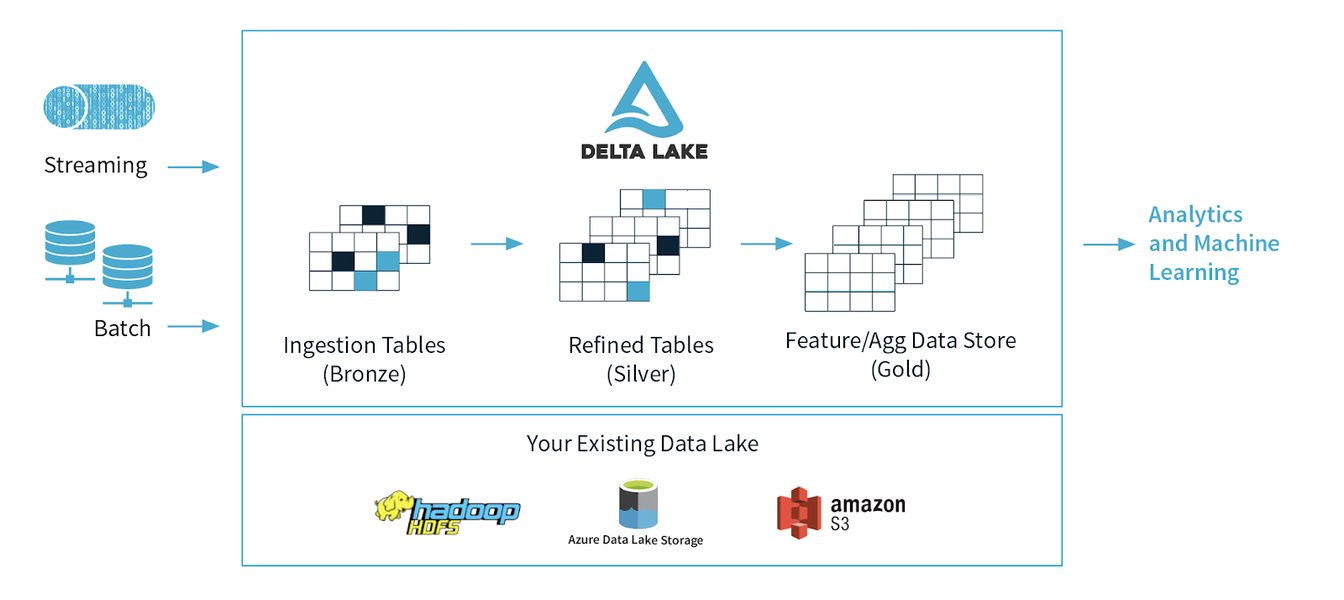
A typical multi-hop data pipeline architecture leveraging Delta Lake, often referred to as a Medallion Architecture (Bronze, Silver, Gold tables).
The Power of the Transaction Log
The transaction log is the cornerstone of Delta Lake. It's a chronologically ordered collection of JSON and Parquet files stored within the _delta_log directory of a Delta table. Each atomic commit to the table results in a new JSON file in the log. Periodically, these JSON files are checkpointed into Parquet files for efficiency. This log enables:
- ACID Transactions: Ensuring that operations are atomic, consistent, isolated, and durable. This prevents data corruption from failed writes or concurrent modifications.
- Scalable Metadata Handling: Efficiently managing metadata for vast datasets, even those with billions of files, by leveraging Spark's distributed processing capabilities for log-related operations.
- Time Travel: Allowing users to query previous versions of the table by referencing a version number or a timestamp. This is invaluable for debugging, auditing, and reproducing experiments.
Key Features Driving Delta Lake's Adoption
Delta Lake offers a rich set of features that address common pain points associated with traditional data lakes:
Schema Enforcement and Evolution
Ensuring Data Quality
Delta Lake provides schema enforcement, which means it validates that data being written to a table conforms to the table's predefined schema. This prevents data corruption caused by mismatched data types or unexpected columns. If a write operation attempts to introduce data that violates the schema, Delta Lake will reject the write by default, safeguarding data quality.
Adapting to Changing Data
Simultaneously, Delta Lake supports schema evolution. As data requirements change, users can easily add new columns to an existing Delta table or modify existing column types (with certain compatibility considerations) without needing to rewrite the entire dataset. This flexibility is crucial for agile development and evolving analytical needs.
Unified Batch and Streaming Data Processing
A significant advantage of Delta Lake is its ability to serve as a single source of truth for both batch and streaming data workloads. It allows for exactly-once semantics for streaming ingest, ensuring that data is processed reliably without duplicates or loss. This simplifies architectures by eliminating the need for separate, complex lambda architectures to handle batch and real-time data.
Comprehensive Data Manipulation Language (DML) Support
Delta Lake supports standard DML operations like UPDATE, DELETE, and MERGE (upsert). These capabilities are fundamental for many data management tasks, including:
- Implementing Change Data Capture (CDC) workflows.
- Managing Slowly Changing Dimensions (SCD).
- Performing record-level modifications for compliance (e.g., GDPR right to be forgotten).
These operations, often difficult or inefficient in traditional data lakes, are natively supported and optimized in Delta Lake.
Performance Optimizations
Delta Lake incorporates several features to enhance query performance:
- Data Skipping: Utilizes statistics (min/max values for columns) stored in the transaction log to skip files that don't contain relevant data for a given query, drastically reducing I/O.
- Compaction (OPTIMIZE command): Combines small files into larger ones, which is more efficient for read operations on distributed file systems.
- Z-Ordering (OPTIMIZE ZORDER BY command): Colocates related information in the same set of files, further enhancing data skipping effectiveness.
- Caching: When used with platforms like Databricks, Delta Lake benefits from intelligent caching mechanisms that keep frequently accessed data in faster storage tiers.
Open Source and Interoperable
Delta Lake is an open-source project under the Linux Foundation, ensuring vendor neutrality and fostering a vibrant community. It is designed to be compatible with Apache Spark APIs, meaning existing Spark jobs can often run on Delta tables with minimal modification. Furthermore, Delta Lake offers a growing ecosystem of connectors for various compute engines and tools, including PrestoDB, Flink, Trino, Hive, and integrations with major cloud data warehouses like Snowflake, Google BigQuery, Amazon Redshift, and Azure Synapse Analytics.
Delta Lake Feature Impact Assessment
The following radar chart visualizes an opinionated assessment of the impact of key Delta Lake features on modern data architectures. The scores (out of 10) reflect their significance in addressing common data lake challenges and enabling advanced capabilities. Higher scores indicate a greater impact.
This chart highlights that features like ACID transactions, time travel, and unified processing are particularly transformative, addressing critical gaps in traditional data lake management and unlocking new levels of reliability and analytical power.
Delta Lake vs. Traditional Data Lakes
To better understand Delta Lake's value, it's helpful to compare it directly with traditional data lakes, which typically consist of raw files stored in formats like Parquet, ORC, or CSV without an overarching transactional management layer.
| Feature | Traditional Data Lake | Delta Lake |
|---|---|---|
| ACID Transactions | No (data corruption risk during concurrent writes or failures) | Yes (ensures data integrity) |
| Schema Enforcement | Limited or none (risk of "schema drift" and bad data) | Yes (prevents bad data from corrupting tables) |
| Schema Evolution | Difficult, often requires rewriting entire datasets | Yes (allows adding columns, changing types gracefully) |
| Data Versioning (Time Travel) | No (difficult to access historical states) | Yes (easy access to any previous version of the data) |
| DML Operations (UPDATE, DELETE, MERGE) | Inefficient or not supported (typically requires full rewrites) | Yes (optimized for efficient record-level changes) |
| Unified Batch & Streaming | Often requires separate systems (e.g., Lambda architecture) | Yes (single table for both batch and streaming sources) |
| Metadata Handling | Can become a bottleneck for very large numbers of files | Scalable (optimized for large tables and many files) |
| Data Quality | Prone to "data swamp" issues due to lack of governance | Improved through schema enforcement and ACID properties |
| Performance Optimizations | Relies on file format capabilities (e.g., Parquet predicate pushdown) | Advanced (data skipping, Z-Ordering, compaction) |
This comparison clearly shows how Delta Lake addresses many of the inherent limitations of traditional data lakes, making them more robust, performant, and easier to manage.
Visualizing Delta Lake Concepts: A Mindmap
The following mindmap provides a hierarchical overview of Delta Lake, branching out from its core definition to its key features, benefits, and underlying architectural components. It serves as a quick visual summary of the technology.
This mindmap illustrates how Delta Lake’s foundational transaction log enables a cascade of features that deliver significant benefits for data management and analytics.
Understanding Delta Lake: Video Explainer
For a more dynamic explanation, the following video provides an excellent overview of Delta Lake, its core concepts, and how it forms the heart of the modern data lakehouse architecture. It covers how Delta Lake provides reliability and performance for data engineering and data science workloads.
This video, "Understanding Delta Lake - The Heart of the Data Lakehouse," visually demonstrates how Delta Lake's features like ACID transactions and time travel contribute to building robust and efficient data platforms.
Common Use Cases for Delta Lake
Delta Lake's capabilities make it suitable for a wide range of applications across various industries:
- Building Lakehouse Architectures: Combining the low-cost storage of data lakes with the reliability and performance features of data warehouses. This is often implemented using a Medallion Architecture (Bronze for raw data, Silver for cleaned/filtered data, Gold for business-level aggregates).
- Reliable ETL/ELT Pipelines: Ensuring that data transformations are atomic and that pipelines can recover gracefully from failures without leaving data in inconsistent states.
- Real-time Analytics: Ingesting and processing streaming data alongside batch data to provide up-to-the-minute insights, for example, in fraud detection or IoT applications.
- Machine Learning Workflows: Providing versioned, reliable datasets for training ML models, ensuring reproducibility and enabling easier debugging of model performance issues.
- Compliance and Governance: Facilitating GDPR/CCPA compliance by enabling efficient deletion or updating of specific records, along with providing a comprehensive audit trail of data changes.
- Financial Services: Managing and analyzing large volumes of transactional data, ensuring integrity and supporting regulatory reporting.
- E-commerce: Handling complex customer and product data for personalized recommendations, inventory management, and real-time analytics on user behavior.
- Healthcare: Storing and analyzing sensitive patient records, ensuring data accuracy, and supporting research initiatives with reliable datasets.

Conceptual overview of Delta Lake's place within a data architecture, highlighting its key features.
Frequently Asked Questions (FAQ)
Is Delta Lake a replacement for a data warehouse?
Can I use Delta Lake with my existing Parquet files?
Does Delta Lake require Databricks?
How does "Time Travel" work in Delta Lake?
What is the difference between Delta Lake and Apache Iceberg or Apache Hudi?
Conclusion
Delta Lake represents a significant advancement in data lake technology, addressing critical challenges related to data reliability, performance, and manageability. By introducing ACID transactions, schema enforcement, data versioning, and unifying batch and stream processing, it empowers organizations to build robust and scalable "lakehouse" architectures. Its open-source nature and growing interoperability ensure its place as a foundational technology for modern data platforms, enabling more reliable data engineering, powerful analytics, and reproducible machine learning.
Recommended Further Exploration
- How are ACID transactions specifically implemented within Delta Lake's architecture?
- What are the detailed differences and trade-offs between Delta Lake, Apache Iceberg, and Apache Hudi?
- What are the best practices for optimizing performance in Delta Lake tables, including compaction and Z-Ordering?
- How does Delta Lake integrate with streaming frameworks like Spark Structured Streaming for real-time data processing?