
Unlocking Star Power: What Exactly is a Dyson Sphere?
Exploring the colossal hypothetical structures designed to harness the total energy output of a star.
Imagine a civilization so advanced that the energy resources of an entire planet are insufficient. Where could it turn for more power? The answer might lie in constructing one of the most audacious engineering concepts ever conceived: a Dyson sphere.
Essential Insights
- Stellar Energy Harvester: A Dyson sphere is a hypothetical megastructure proposed to completely or partially enclose a star to capture its immense energy output.
- Advanced Civilization Marker: Its existence would signify a highly advanced (Type II on the Kardashev scale) civilization capable of manipulating stellar-scale resources.
- Not Necessarily a Solid Shell: While often depicted as a rigid sphere, the most plausible designs involve a "swarm" of independent orbiting collectors or habitats.
Origins of a Megastructure Concept
From Science Fiction to Scientific Paper
The concept of the Dyson sphere was formally introduced to the scientific community by physicist and mathematician Freeman Dyson in his seminal 1960 paper, "Search for Artificial Stellar Sources of Infra-Red Radiation." Dyson theorized that as technological civilizations advance, their energy demands would eventually outstrip planetary resources, leading them inevitably towards harnessing the power of their host star directly. He acknowledged inspiration from the 1937 science fiction novel *Star Maker* by Olaf Stapledon, which featured similar ideas.
Dyson proposed that such megastructures would be a logical, perhaps even inevitable, consequence of a civilization's long-term survival and expansion needs. By capturing a significant fraction, or even the entirety, of a star's energy, a civilization could power technologies and support populations on scales vastly exceeding planetary limits. This level of energy utilization corresponds to a Type II civilization on the Kardashev scale, a framework categorizing civilizations by their energy consumption capabilities.

Conceptual artwork depicting a Dyson sphere capturing energy from its host star.
Structure and Variations: More Than Just a Sphere
Although the term "Dyson sphere" often evokes images of a single, solid shell completely encasing a star, this specific configuration faces significant, likely insurmountable, challenges. Such a rigid structure would be subject to immense gravitational stresses and is considered mechanically unstable and practically impossible with known physics and materials.
Plausible Designs
Freeman Dyson himself, and subsequent researchers, primarily envisioned more feasible configurations:
- Dyson Swarm: This is the most widely accepted and scientifically plausible model. It consists of a massive number of independent collectors, satellites, or habitats orbiting the star in a dense, coordinated formation. Each element would capture solar energy and potentially transmit it wirelessly (e.g., via microwave beams) to where it's needed. A swarm avoids the structural issues of a solid shell and could be built incrementally.
- Dyson Bubble: Similar to a swarm, but composed of 'statites' – stationary satellites using enormous solar sails. These would be balanced by the star's radiation pressure against its gravity, allowing them to remain fixed relative to the star without orbiting.
- Dyson Ring: A simpler, preliminary step could be constructing a massive ring of energy collectors or habitats in orbit around the star, similar in concept to the Ringworld from Larry Niven's novels (though Niven Rings are distinct in scale and purpose).
- Dyson Shell: The classic, but largely impractical, idea of a continuous, solid shell enclosing the star. While visually striking in science fiction, its instability and material requirements make it highly speculative.
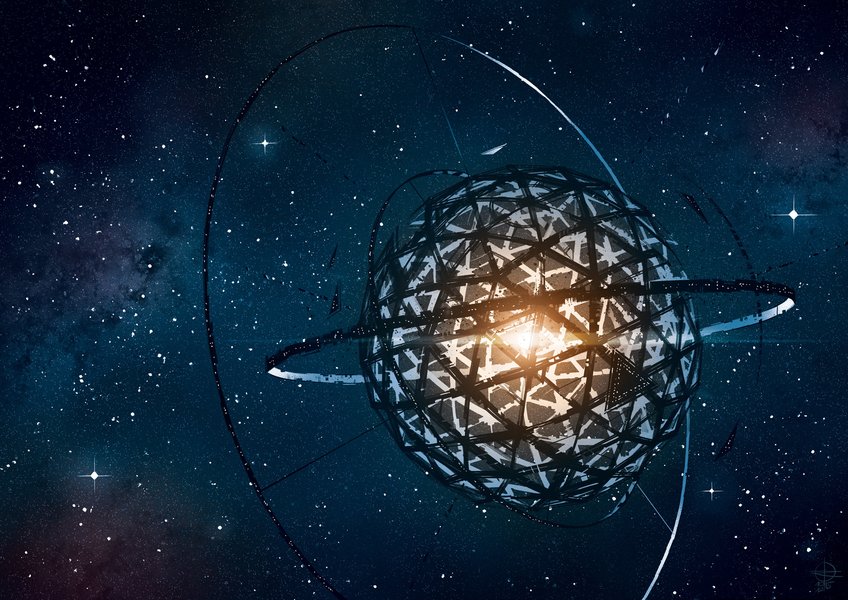
Artistic representation of a Dyson Swarm, featuring numerous orbiting structures.
Comparing Dyson Sphere Concepts
Different theoretical Dyson structures present trade-offs in terms of feasibility, energy capture efficiency, stability, and detectability. The radar chart below offers a speculative comparison based on current understanding. Higher scores indicate greater advantage in that category.
Key Differences Summarized
The following table outlines the primary distinctions between the main conceptual types of Dyson megastructures:
| Feature | Dyson Shell | Dyson Swarm | Dyson Ring | Dyson Bubble |
|---|---|---|---|---|
| Structure | Single, solid sphere | Many independent orbiting collectors/habitats | Single, continuous ring structure | Many independent statites using solar sails |
| Feasibility | Extremely low (likely impossible) | Relatively high (most plausible) | Moderate (simpler than swarm/shell) | Moderate (depends on sail tech) |
| Stability | Very unstable gravitationally | Stable via orbital mechanics | Requires active stabilization | Stable via radiation pressure balancing gravity |
| Construction | Requires simultaneous, massive effort | Can be built incrementally | Incremental build possible | Can be built incrementally |
| Energy Capture | Potentially total (100%) | High, depends on density (potentially near 100%) | Partial, depends on ring width | High, depends on density (potentially near 100%) |
Mindmap of Dyson Sphere Concepts
This mindmap provides a visual overview of the core ideas surrounding Dyson spheres, including their purpose, types, detection methods, and challenges.
Independent Orbiting Collectors"] id2b["Dyson Shell (Impractical)
Solid Sphere"] id2c["Dyson Ring
Orbital Ring Structure"] id2d["Dyson Bubble
Statites with Solar Sails"] id3["SETI Relevance"] id3a["Search for Extraterrestrial Intelligence"] id3b["Detection via Infrared Signature (Waste Heat)"] id3c["Astronomical Anomalies (e.g., Dimming)"] id4["Challenges"] id4a["Immense Material Requirements
(Planet-Scale Resources)"] id4b["Extreme Engineering Hurdles"] id4c["Gravitational Stability (Shell Issue)"] id4d["Energy Transmission & Management"] id4e["Distinguishing from Natural Phenomena"] id5["Originator"] id5a["Freeman Dyson (1960 Paper)"] id5b["Inspired by Olaf Stapledon ('Star Maker')"]
The Ultimate Energy Source
Tapping the Power of a Star
The fundamental purpose of constructing a Dyson sphere, regardless of its specific form, is to capture the colossal energy output of a star. Our own Sun, for example, radiates approximately \(3.8 \times 10^{26}\) watts of power continuously. A Dyson structure surrounding it could potentially harness nearly all of this energy, providing a civilization with a power source trillions of times greater than humanity's current total energy consumption.
This captured energy could be converted into usable forms like electricity or directed energy beams. Potential applications are vast and transformative, including:
- Powering immense computational systems.
- Supporting continent-sized habitats or artificial worlds.
- Fueling interstellar travel and communication.
- Enabling large-scale geoengineering or stellar engineering projects.
The inner surface of some hypothetical designs, particularly shells or rings, might even offer enormous areas for habitation, though maintaining a stable environment would present its own set of challenges.
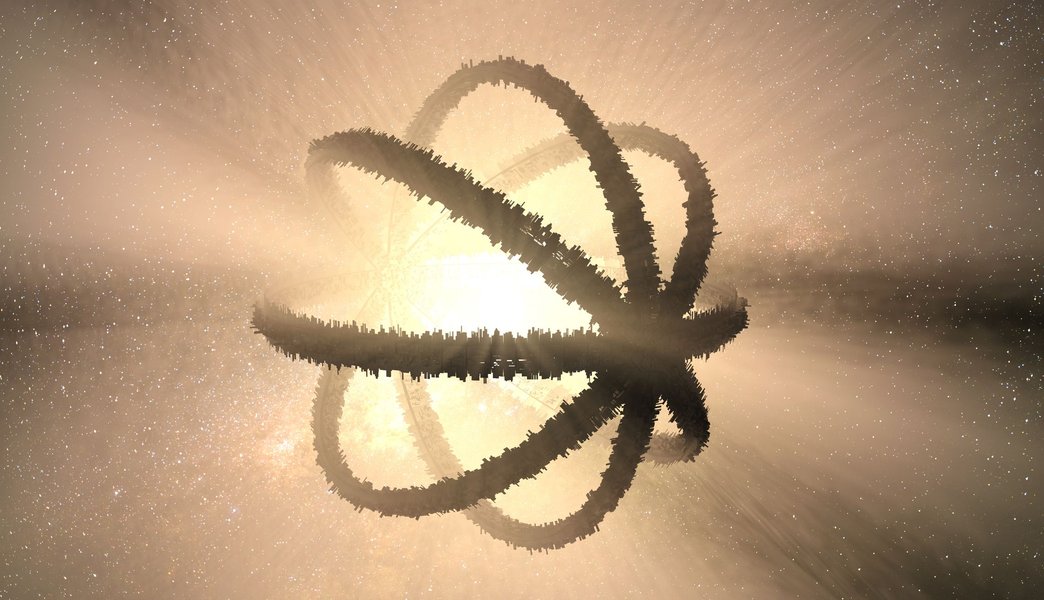
An illustration depicting the concept of harvesting energy from a central star using a surrounding megastructure.
Building the Unbuildable? Challenges and Feasibility
An Astronomical Undertaking
Constructing any form of Dyson sphere represents an engineering challenge of staggering proportions, far beyond current human capabilities. Key difficulties include:
- Material Requirements: Building a structure with a radius comparable to Earth's orbit (1 Astronomical Unit) would require dismantling entire planets or asteroid belts to gather sufficient raw materials. Some estimates suggest needing the mass equivalent of Jupiter or multiple inner solar system planets.
- Energy Investment: The energy required to deconstruct planets, process materials, transport them, and assemble the structure would itself be immense.
- Engineering and Stability: Managing the structural integrity, orbital mechanics (for swarms or rings), and gravitational forces involved is incredibly complex. A solid shell, as mentioned, is considered inherently unstable.
- Heat Dissipation: A structure absorbing nearly all of a star's energy must efficiently radiate waste heat (likely as infrared radiation) to avoid melting.
- Timescale: Such a project would likely take centuries or millennia to complete, even for a highly advanced civilization.

Artistic impression of a Dyson sphere under construction, highlighting the immense scale.
Visualizing the Construction
The sheer scale and complexity of building a Dyson sphere are hard to grasp. The following video provides a compelling visualization and discussion of the theoretical steps and challenges involved in undertaking such an ultimate megaproject.
Video exploring the concept and hypothetical construction of a Dyson sphere.
The Search for Alien Megastructures (SETI)
Looking for Infrared Clues
One of the most intriguing aspects of the Dyson sphere concept is its relevance to the Search for Extraterrestrial Intelligence (SETI). Freeman Dyson proposed that such structures, being a potential necessity for advanced life, would produce observable signatures. Specifically, a structure capturing most of a star's visible light would inevitably absorb vast amounts of energy. By the laws of thermodynamics, this absorbed energy must be re-radiated as waste heat, likely in the infrared part of the electromagnetic spectrum.
Therefore, a star partially or fully enclosed by a Dyson structure might appear unusually dim in visible light but exhibit a significant excess of infrared radiation compared to what's expected from natural stellar processes. Astronomers actively search for these "infrared excess" signatures using data from telescopes like IRAS, WISE, Gaia, and Spitzer.
Challenges in Detection
Identifying a genuine Dyson sphere candidate is extremely difficult. Several natural astrophysical phenomena can mimic the expected infrared signature:
- Protoplanetary Disks: Young stars surrounded by dense disks of dust and gas naturally emit strongly in the infrared.
- Asymptotic Giant Branch (AGB) Stars: These evolved stars shed large amounts of dusty material, creating circumstellar envelopes that glow in infrared.
- Dust-Obscured Galaxies: Distant galaxies heavily shrouded in dust can sometimes be mistaken for nearby infrared sources.
Scientists must rigorously rule out all known natural explanations before considering the extraordinary possibility of an artificial megastructure. While intriguing candidates have emerged over the years, such as KIC 8462852 ("Tabby's Star") which exhibited unusual dimming patterns, or more recent analyses identifying potential M-dwarf candidates (as reported in 2024), none have been confirmed. Further observations and analysis are always required, and natural explanations (like dust clouds) often prove sufficient.
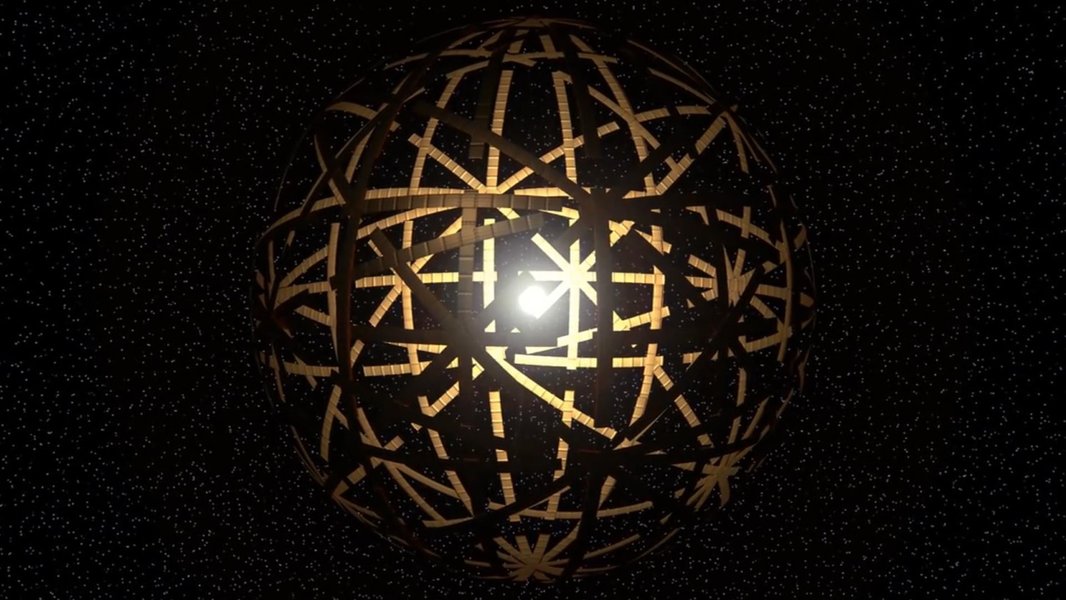
Artist's impression related to the strange dimming of KIC 8462852, which initially fueled speculation about megastructures.
Projects like the Swedish-led Project Hephaistos continue systematic searches, refining techniques to differentiate potential artificial signals from natural mimics. The quest for Dyson spheres remains a fascinating, albeit challenging, avenue in the ongoing search for life beyond Earth.
Frequently Asked Questions (FAQ)
Is a Dyson sphere a solid object?
Why would a civilization build a Dyson sphere?
Could we detect a Dyson sphere if one existed?
Is building a Dyson sphere actually possible?
References
- Dyson sphere - Wikipedia
- How Dyson Spheres Work - HowStuffWorks
- What are Dyson spheres, and how do we look for them? - Space.com
- Dyson sphere - Energy Education
- What is a Dyson sphere? - EarthSky
- Dyson spheres: Could alien megastructures exist in the Milky Way? - CNN
- Dyson sphere - Scholarpedia
Recommended Reading
Last updated April 24, 2025