
Unveiling the Azure Mystery: The Science Behind Our Blue Sky
A Journey into Light, Atmosphere, and Human Perception
Key Insights into the Sky's Blue Hue
- Rayleigh Scattering: The primary reason the sky appears blue is due to a phenomenon called Rayleigh scattering, where shorter, blue and violet wavelengths of sunlight are scattered more efficiently by tiny nitrogen and oxygen molecules in Earth's atmosphere than longer wavelengths.
- Wavelength and Scattering: Blue light travels in shorter, smaller waves, causing it to "bounce around" and disperse in all directions more readily than other colors like red or yellow, which have longer wavelengths and pass through the atmosphere with less scattering.
- Human Eye Sensitivity: While violet light is scattered even more than blue light, our eyes are more sensitive to blue light and the sun emits more blue light than violet, leading us to perceive the sky as predominantly blue rather than violet.
Have you ever paused to gaze at the vast expanse above and wondered, "Why is the sky blue?" This seemingly simple question unlocks a fascinating world of atmospheric physics, light interactions, and human biology. The explanation goes far beyond a reflection of the ocean and delves into the intricate dance between sunlight and Earth's gaseous envelope.
The Fundamental Principles: Light and Atmosphere
To truly grasp why our sky is blue, we must first understand the nature of sunlight and the composition of Earth's atmosphere.
Sunlight: A Spectrum of Colors
Sunlight, which appears white to our eyes, is actually a composite of all the colors of the visible spectrum. Just like a rainbow, white light can be broken down into red, orange, yellow, green, blue, indigo, and violet. Each of these colors corresponds to a different wavelength, with red having the longest wavelength and violet having the shortest.
The visible light spectrum ranges roughly from 400 nanometers (violet) to 700 nanometers (red). These different wavelengths are crucial to understanding how light interacts with our atmosphere.
Earth's Atmosphere: A Molecular Blanket
Our planet is enveloped by an atmosphere composed primarily of nitrogen (about 78%) and oxygen (about 21%) molecules. These molecules are incredibly tiny, far smaller than the wavelengths of visible light. This size difference is key to the scattering phenomenon that colors our sky.
Without an atmosphere, our sky would appear black, with the Sun shining as a brilliant star amidst other stars, much like on the Moon or in space. It is the interaction of sunlight with these atmospheric molecules that gives our sky its characteristic hues.
The Science of Scattering: Rayleigh's Legacy
The primary scientific explanation for the sky's blueness is known as Rayleigh scattering, named after British physicist Lord John William Strutt (Lord Rayleigh), who first described this phenomenon in the 1870s.
What is Rayleigh Scattering?
Rayleigh scattering occurs when light encounters particles much smaller than its wavelength. In Earth's atmosphere, the nitrogen and oxygen molecules act as these tiny scattering particles. When sunlight enters the atmosphere, these molecules absorb and then re-emit (scatter) the light in different directions.
The crucial aspect of Rayleigh scattering is its wavelength dependence: shorter wavelengths of light are scattered much more effectively than longer wavelengths. This relationship can be expressed by the formula:
\[ \text{Intensity of Scattered Light} \propto \frac{1}{\lambda^4} \]Where \(\lambda\) is the wavelength of light. This means that blue and violet light, with their shorter wavelengths, are scattered significantly more than red, orange, and yellow light, which have longer wavelengths.
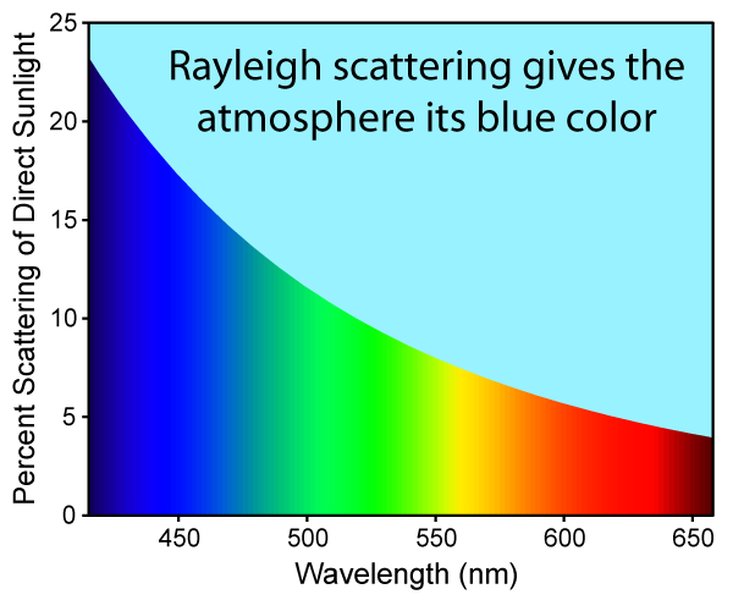
Illustration depicting Rayleigh scattering, where shorter blue wavelengths are dispersed in multiple directions.
Why Blue Dominates Over Violet
Given that violet light has an even shorter wavelength than blue light, and thus scatters even more strongly, a common question arises: why isn't the sky violet? There are two main reasons:
- Sunlight Composition: The Sun does not emit all colors of light with equal intensity. It actually emits more blue light than violet light in the visible spectrum.
- Human Eye Sensitivity: Our eyes are not equally sensitive to all colors. We are more sensitive to blue light than to violet light. Our visual system interprets the scattered blue-violet light as a mixture that we predominantly perceive as blue.
Therefore, even though violet light is scattered efficiently, the combination of less violet light from the Sun and our eyes' lower sensitivity to it results in the sky appearing blue.
Variations in Sky Color: Beyond Just Blue
While the sky is typically blue, its hue can change dramatically depending on the time of day, atmospheric conditions, and even location on other planets.
Sunrise and Sunset: The Fiery Hues
At sunrise and sunset, the sky often transforms into brilliant reds, oranges, and yellows. This spectacular display is also a result of Rayleigh scattering, but with a different geometric configuration.
When the Sun is low on the horizon, its light has to travel a much greater distance through Earth's atmosphere to reach our eyes. During this longer journey, almost all of the shorter-wavelength blue and violet light is scattered away by the atmosphere. What remains are the longer-wavelength colors—red, orange, and yellow—which are less scattered and thus pass through to our eyes, painting the sky with warm tones.
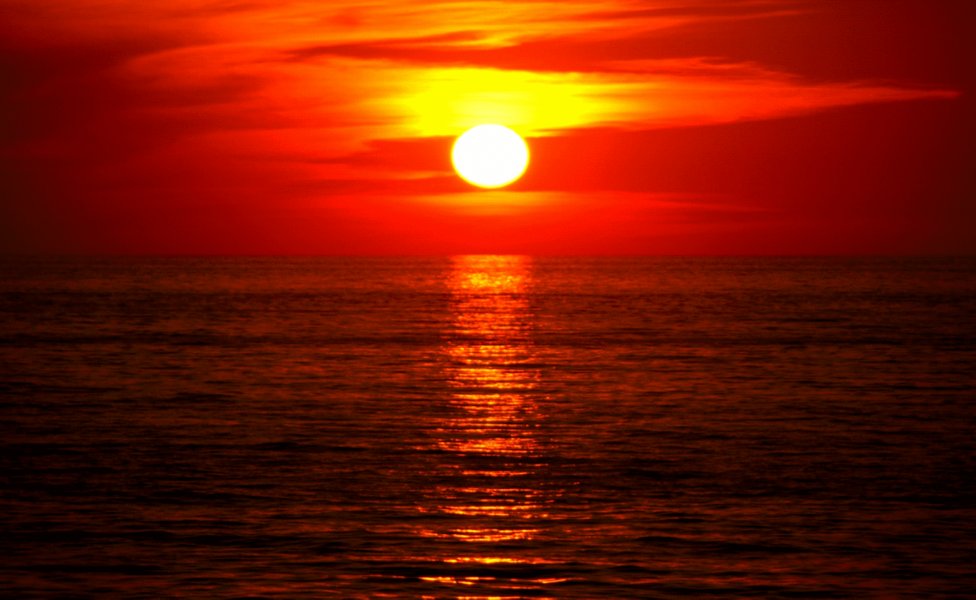
The scattering of blue light at sunset allows longer red and orange wavelengths to dominate.
Atmospheric Conditions and Sky Color
The presence of aerosols—tiny particles and liquid droplets in the air, such as dust, pollen, or pollution—can also influence the sky's color. When there are fewer aerosols, the sky appears a deeper, richer blue. However, when the atmosphere contains more aerosols, they can scatter light non-selectively, causing the sky to appear a lighter blue or even whitish.
For example, clouds appear white because they are composed of water droplets or ice crystals that are much larger than the wavelengths of visible light. These larger particles scatter all wavelengths of light equally, resulting in the perception of white light.
Sky Colors on Other Planets
The sky's color isn't uniform across the solar system; it depends entirely on a planet's atmospheric composition and density. For instance, the sky on Mars typically appears an orange or reddish color during the daytime due to its atmosphere being filled with reddish dust particles. However, interestingly, the Martian sky can take on a blue-gray tone around the setting Sun due to the way these dust particles scatter light at low angles.
Understanding Light Scattering Mechanisms
The phenomenon of light scattering is not uniform and varies based on the size of the scattering particles relative to the wavelength of light. Here's a table summarizing the different types of scattering relevant to sky colors:
| Scattering Type | Particle Size Relative to Wavelength | Wavelength Dependence | Effect on Sky Color | Example |
|---|---|---|---|---|
| Rayleigh Scattering | Much smaller than wavelength | Highly wavelength dependent (shorter <(\lambda)> scatter more) | Blue sky during the day, red/orange sunsets | Nitrogen and Oxygen molecules in Earth's atmosphere |
| Mie Scattering | Comparable to wavelength | Weakly wavelength dependent (scatters all colors more equally) | White clouds, hazy skies | Water droplets in clouds, aerosols like dust and pollen |
| Non-selective Scattering | Much larger than wavelength | No wavelength dependence (all colors scattered equally) | White appearance (e.g., fog, thick clouds) | Large water droplets or ice crystals |
Perceptual Nuances of Sky Color
Our perception of the sky's color is a complex interplay of physical phenomena and biological factors. While Rayleigh scattering dictates which colors are scattered, our eyes and brain ultimately interpret these signals.
The Human Visual System
The human eye contains specialized cells called cones, which are responsible for color vision. We have three types of cone cells, each sensitive to different parts of the visible spectrum: red, green, and blue. The combined signals from these cones allow us to perceive a vast range of colors.
Our cones are most sensitive to wavelengths in the blue part of the spectrum, which is why the scattered blue light from the sky is so prominent to us. If our eyes were more sensitive to violet, or if the Sun emitted more violet light, our sky might indeed appear purple.
Why the Sky is Lighter Near the Horizon
You might notice that the sky directly overhead is a deeper blue, while it appears paler or whiter closer to the horizon. This is because the light reaching our eyes from the horizon has traveled through a greater thickness of atmosphere. This increased path length means more scattering and re-scattering of blue light occurs, mixing with other wavelengths and causing the blue to become less saturated and appear whiter.
This radar chart illustrates how different factors contribute to various sky appearances. The 'Rayleigh Scattering Dominance' and 'Wavelength Sensitivity' are high for a typical blue sky, indicating that blue light scattering is very effective and our eyes are highly responsive to it. For sunsets, 'Atmospheric Density' and 'Sunlight Intensity' (related to the longer path light travels) become more dominant, causing the red/orange hues. A hazy sky shows a reduced 'Rayleigh Scattering Dominance' and increased 'Atmospheric Density', reflecting how aerosols interfere with pure blue scattering, leading to a whiter appearance.
Delving Deeper: A Visual Explanation
For those who wish to explore this phenomenon further, the following video offers a compelling visual explanation of why the sky is blue and how Rayleigh scattering leads to the beautiful blues and reds we observe.
An educational video explaining the science behind why the sky is blue.
This video provides an excellent deep dive into the physics of light, demonstrating how different wavelengths interact with atmospheric particles. It reinforces the concepts of Rayleigh scattering and how the varying paths of sunlight through the atmosphere at different times of day create the diverse palette of sky colors we witness.
Frequently Asked Questions (FAQ)
Why isn't the sky purple if violet light scatters most?
Does the ocean's color affect the sky's color?
Why does the sky turn red or orange during sunrise and sunset?
What is Rayleigh scattering?
Conclusion
The blue color of our sky is a testament to the elegant laws of physics and the unique composition of Earth's atmosphere. It is primarily due to Rayleigh scattering, where tiny air molecules preferentially scatter shorter blue and violet wavelengths of sunlight. Our human eyes, with their specific sensitivities, interpret this scattered light as a vibrant blue. From the deep azure overhead to the fiery oranges and reds of dawn and dusk, the sky offers a constant display of atmospheric optics, reminding us of the intricate science at play above us.
Recommended Further Exploration
- How does the Earth's atmosphere affect light?
- What is the electromagnetic spectrum and visible light?
- Why do sunsets appear red and orange?
- How do different planetary atmospheres affect sky color?