
Unlocking Tomorrow's Innovators: How STEM Activities Forge Essential Life Skills in Children
Beyond textbooks and tests, discover the profound developmental journey STEM offers, cultivating minds ready for a complex world.
Highlights: The Core Developmental Impact of STEM
- Cultivates Critical Thinkers & Problem Solvers: STEM activities empower children to analyze, question, and devise solutions to real-world challenges.
- Sparks Creativity & Fosters Innovation: Through experimentation and design, children develop imaginative approaches and inventive mindsets.
- Builds Essential Collaborative & Communicative Abilities: Group-based STEM projects teach children to work together, share ideas, and articulate complex thoughts effectively.
Engaging children in Science, Technology, Engineering, and Mathematics (STEM) activities offers a wealth of developmental benefits that extend far beyond mere academic knowledge in these specific fields. Respected educators, researchers, and institutions consistently emphasize that these hands-on, exploratory experiences are crucial for cultivating a suite of essential life skills. This isn't just about preparing future scientists or engineers; it's about nurturing well-rounded individuals equipped with the cognitive, social, and emotional tools to thrive in an ever-evolving 21st-century landscape. From the earliest years, STEM activities encourage children to become active learners, curious explorers, and resilient individuals.
The Foundational Pillars: Key Skills Honed by STEM Engagement
STEM education is not a monolithic entity but a dynamic approach to learning that integrates various disciplines. Its true power lies in how it shapes young minds, building a robust foundation of skills applicable across all facets of life.
Nurturing Critical Thinking and Analytical Prowess
From Observation to Insight
STEM activities inherently push children to move beyond rote memorization. They learn to observe carefully, ask probing questions ("Why did that happen?", "What if I try this?"), and analyze information to understand underlying principles. Whether it's figuring out why a tower of blocks keeps falling or predicting the outcome of a simple science experiment, children are constantly engaging their critical thinking faculties. This process involves evaluating evidence, identifying patterns, and making reasoned judgments – skills that are paramount for academic success and informed decision-making in adulthood. Activities often require students to formulate hypotheses, test them, and revise their approaches based on outcomes, sharpening their reasoning skills.

Children collaborating on a building project, a common STEM activity that fosters critical thinking and teamwork.
Developing Robust Problem-Solving Abilities
Tackling Challenges Head-On
At its core, STEM is about solving problems. Children are presented with challenges – often open-ended – that require them to identify the core issue, brainstorm potential solutions, design and implement a plan, and then evaluate its effectiveness. This iterative cycle of inquiry, design, testing, and refinement is fundamental to engineering and scientific discovery, but its applicability is universal. Through these experiences, students develop practical problem-solving habits. They learn to approach complex issues systematically, break them down into manageable parts, and persist even when faced with setbacks. The emphasis on real-world applications makes this learning tangible and motivating, as children can see the direct impact of their efforts.
Igniting Creativity and Fostering Innovation
Thinking Outside the Box
Contrary to the misconception that STEM fields are purely analytical, they are deeply intertwined with creativity and innovation. STEM activities encourage children to experiment, take intellectual risks, and explore unconventional ideas. When tasked with designing a new tool, building a unique structure, or finding a novel solution to a problem, children are given the freedom to use their imagination. This process nurtures design thinking skills, which are vital for innovation. The hands-on nature of many STEM projects allows for exploration and inventive thinking, enabling children to view challenges from multiple perspectives and develop original solutions, seeing limitless possibilities in their ideas.
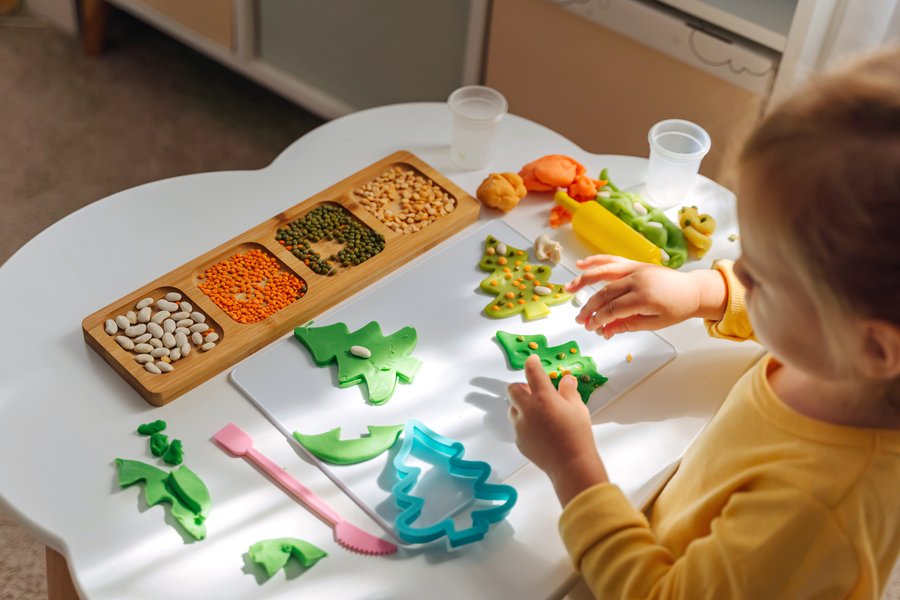
A young child explores materials in a preschool STEM setting, sparking early creativity and sensory learning.
Building Strong Collaboration and Communication Skills
Learning and Achieving Together
Many STEM activities are inherently collaborative, requiring children to work in teams. This provides invaluable opportunities to develop crucial social skills. Students learn to share ideas, listen actively to their peers, provide and receive constructive criticism, negotiate different viewpoints, and work towards a common goal. Effective communication is essential in these settings, as children must articulate their thoughts, explain complex concepts, and document their findings. These experiences build confidence and teach empathy, leadership, and the importance of diverse perspectives in achieving success.
Cultivating Lifelong Curiosity and a Passion for Exploration
The Joy of Discovery
Children are born with an innate sense of curiosity. STEM activities tap into this natural desire to explore, understand, and make sense of the world. By making learning an active, engaging, and often playful process, STEM fosters a positive attitude towards discovery. When children are encouraged to ask "why" and "how," and are given the tools to find their own answers, learning becomes an exciting adventure rather than a chore. This nurtured curiosity can spark a lifelong passion for learning and inquiry, extending far beyond the confines of STEM subjects.
Fostering Resilience and Perseverance
Learning from Setbacks
The scientific method and engineering design process inherently involve trial and error. Not every experiment yields the expected results, and not every design works perfectly on the first try. STEM activities teach children that failure is not an endpoint, but a valuable part of the learning process. Encountering challenges, making mistakes, debugging solutions, and iterating on designs builds resilience and perseverance. Students learn to embrace setbacks as opportunities to learn, adapt, and improve, developing the "grit" necessary to tackle difficult problems in all areas of life.
Visualizing Skill Development Across STEM Stages
The development of these crucial skills through STEM activities can be visualized across different educational stages. While all skills are nurtured throughout, their emphasis and complexity evolve as children grow. The following chart offers an illustrative look at how skills like critical thinking, problem-solving, creativity, collaboration, resilience, curiosity, logical reasoning, and adaptability might be fostered through STEM engagements in early childhood, elementary school, and middle school. Note that these are generalized representations for illustrative purposes.
This radar chart illustrates how different STEM skill sets are nurtured and emphasized across various developmental stages, from playful exploration in early childhood to more complex problem-solving in middle school. Each axis represents a core skill, and the data points indicate a relative level of focus or development for that skill within the specified age group's typical STEM activities.
The Interconnected Web of STEM Benefits
The developmental benefits of STEM activities are not isolated; they form an interconnected web where each skill supports and enhances others. The following mindmap illustrates this interconnectedness, showing how core STEM activities lead to a cascade of skill development, ultimately contributing to a well-rounded, capable individual.
(21st Century Skills)"] id4c["Fine Motor Skills
(Early Years)"] id4d["Spatial Awareness"]
This mindmap showcases how engaging in STEM activities serves as a central catalyst for developing a wide array of interconnected skills. From core cognitive abilities like critical thinking and problem-solving, to personal attributes such as curiosity and resilience, and essential social skills like collaboration and communication, STEM education nurtures a holistic set of competencies vital for lifelong success.
Broader Developmental Impacts
Enhancing 21st-Century and Transferable Skills
Preparing for a Dynamic Future
The skills honed through STEM activities are precisely those identified as "21st-century skills" – abilities crucial for navigating an increasingly complex, technology-driven world. These include digital literacy, adaptability, and the capacity for lifelong learning. Importantly, these are transferable skills, meaning they are valuable not just within STEM fields but across all academic disciplines, career paths, and everyday life situations. Whether a child grows up to be an artist, an entrepreneur, a teacher, or a doctor, the ability to think critically, solve problems creatively, and collaborate effectively will be indispensable.
Early Childhood: Laying the Groundwork
The Importance of Starting Young
It's never too early to introduce children to STEM concepts through play. For toddlers and preschoolers, STEM might look like building with blocks (engineering and spatial awareness), playing with water and sand (physics and sensory exploration), observing insects in the garden (biology and observation skills), or sorting toys by color and shape (early math skills). These age-appropriate, joyful activities not only build foundational STEM understanding but also enhance fine motor skills, spatial reasoning, vocabulary, and a positive STEM identity. Early exposure increases the likelihood that children will approach later, more formal STEM learning with confidence and enthusiasm.

Preschoolers engaging in hands-on play that incorporates early STEM principles like physics and engineering.
Summary of Key Developmental Skills from STEM Activities
The following table provides a concise summary of the key developmental skills children gain from participating in STEM activities, alongside examples of activities that foster these skills:
| Skill Developed | Description | Examples of Activities |
|---|---|---|
| Critical Thinking | Analyzing information objectively, evaluating arguments, and forming reasoned judgments. | Designing experiments, debugging code (even unplugged), analyzing data from observations. |
| Problem-Solving | Identifying issues, developing and testing solutions, and adapting approaches based on outcomes. | Building structures to meet specific criteria, solving logic puzzles, designing solutions to everyday challenges. |
| Creativity & Innovation | Generating novel ideas, experimenting with different approaches, and designing original solutions. | Inventing new games, creating art with technological tools, designing unique models. |
| Collaboration | Working effectively with others, sharing responsibilities, and contributing to a common goal. | Group projects (e.g., building a robot), team-based science challenges, collaborative design tasks. |
| Communication | Articulating ideas clearly, listening to others, and presenting findings effectively. | Explaining an experiment's results, presenting a design, discussing solutions in a group. |
| Curiosity | An innate desire to learn, explore, and ask questions. | Nature walks with observation journals, exploring how things work, open-ended inquiry projects. |
| Resilience & Perseverance | Overcoming setbacks, learning from mistakes, and persisting in the face of challenges. | Redesigning a failed prototype, troubleshooting technical issues, completing multi-step projects. |
| Logical Reasoning | Using logic and reason to form conclusions and make decisions; understanding cause and effect. | Coding activities, sequencing tasks, playing strategy games, following multi-step instructions. |
| Adaptability | Adjusting to new conditions or challenges and being flexible in approach. | Modifying a project based on new information, working with limited resources. |
| Fine Motor Skills & Spatial Awareness | Coordinating small muscle movements and understanding relationships between objects in space (especially crucial in early years). | Building with small blocks or construction toys, manipulating tools, drawing designs, assembling puzzles. |
STEM in Action: Understanding the Benefits
To further illustrate the positive impact of STEM education on children, the following video offers insights into why these activities are crucial for development and how they prepare students for the future. It emphasizes the broad range of skills acquired through engaging, hands-on STEM experiences.
This video discusses the diverse benefits of STEM education for children, highlighting its role in skill development and future readiness.
Frequently Asked Questions (FAQ)
What age is appropriate to start STEM activities with children?
Do STEM activities only benefit children interested in science or math careers?
How can I encourage STEM learning at home without special equipment?
Are STEM and STEAM the same thing?
How do STEM activities support literacy and numeracy?
Conclusion: Equipping Children for Life
In summary, STEM activities and education are far more than just pathways to scientific or technological careers. They are powerful engines for comprehensive child development, fostering a rich array of cognitive, social, and personal skills. By engaging in hands-on, inquiry-based learning, children cultivate critical thinking, innovative problem-solving, creativity, effective collaboration, and unwavering resilience. These are the foundational competencies that empower them to navigate the complexities of the modern world, adapt to change, and become lifelong learners and contributors to society. Investing in STEM experiences is an investment in nurturing capable, curious, and well-rounded individuals prepared for whatever the future may hold.
Recommended Further Exploration
- How can parents integrate simple STEM activities into daily routines for preschoolers?
- What are some examples of low-cost STEM projects for elementary school students?
- How does collaborative problem-solving in STEM prepare students for future teamwork?
- What is the role of failure and iteration in developing resilience through STEM education?
References
Last updated May 21, 2025