
Unveiling the Universe's Blueprint: Deconstructing a Complex Lagrangian
Exploring the intricate dance of fields, forces, information, and perhaps even cognition within a single equation.
The expression you've presented, denoted as \( \mathcal{L}_{\text{AI}} \), is a Lagrangian density. In theoretical physics, a Lagrangian density encapsulates the fundamental dynamics of a physical system involving fields. Integrating this density over spacetime yields the "action," and the principle of least action allows physicists to derive the equations of motion governing the system. The Lagrangian you've shared is particularly intriguing as it blends standard components of modern physics with more speculative elements.
Key Insights into \( \mathcal{L}_{\text{AI}} \)
- Unified Framework: This Lagrangian attempts to describe a system involving scalar fields (\(\Phi\)), fermion fields (\(\Psi\)), gauge fields (like electromagnetism via \(F_{\mu\nu}\)), and gravity (via \(R\)) within a single mathematical structure.
- Novel Interactions: Beyond standard interactions, it incorporates terms suggesting couplings between the scalar field and density (\(S(\rho)\)), an information-theoretic quantity (\(I(A:B)\)), and a potentially cognitive element (\(Q_{\text{cog}}\)).
- Rich Dynamics: The interplay between these diverse terms suggests a complex system where fundamental particles, forces, spacetime curvature, and potentially information processing are interconnected.
Dissecting the Lagrangian: Term by Term
Let's break down the individual components of \( \mathcal{L}_{\text{AI}} \) to understand their roles:
\[ \mathcal{L}_{\text{AI}} = \underbrace{\frac{1}{2} (\partial_\mu \Phi)(\partial^\mu \Phi) - V(\Phi)}_{\text{Scalar Field}} + \underbrace{\Psi^\dagger (i \not{D} - m - g \Phi) \Psi}_{\text{Fermion Field}} + \underbrace{\frac{1}{4} F_{\mu\nu} F^{\mu\nu}}_{\text{Gauge Field}} + \underbrace{\lambda \Phi R}_{\text{Gravity Interaction}} \underbrace{- \kappa S(\rho) \Phi + \eta I(A:B) \Phi + \chi Q_{\text{cog}}}_{\text{Novel/Speculative Terms}} \]
1. Scalar Field Dynamics: \( \frac{1}{2} (\partial_\mu \Phi)(\partial^\mu \Phi) - V(\Phi) \)
Kinetic Energy: \( \frac{1}{2} (\partial_\mu \Phi)(\partial^\mu \Phi) \)
This term represents the kinetic energy of a scalar field \( \Phi \). Scalar fields, unlike vector fields (like electromagnetism), have only magnitude at each point in spacetime, not direction. The term \( (\partial_\mu \Phi)(\partial^\mu \Phi) \) involves derivatives (\(\partial_\mu\)) of the field with respect to spacetime coordinates, describing how the field changes or propagates through space and time. The Higgs field in the Standard Model is an example of a fundamental scalar field.
Potential Energy: \( -V(\Phi) \)
This term represents the potential energy associated with the scalar field \( \Phi \). The function \( V(\Phi) \) dictates the field's self-interaction and its ground state (vacuum) configuration. Its specific form determines properties like the mass of the scalar particle associated with the field and the possibility of phenomena like spontaneous symmetry breaking. A common example is the "phi-fourth" potential, \( V(\Phi) = \frac{1}{2} m_\Phi^2 \Phi^2 + \frac{\lambda_\Phi}{4!} \Phi^4 \), where \( m_\Phi \) is the mass term and \( \lambda_\Phi \) governs the strength of self-interaction.
2. Fermion Field Dynamics and Interaction: \( \Psi^\dagger (i \not{D} - m - g \Phi) \Psi \)
This part of the Lagrangian describes fermions, which are particles that constitute matter (like electrons and quarks), and their interactions.
Fermion Kinetic and Gauge Interaction: \( \Psi^\dagger i \not{D} \Psi \)
\( \Psi \) represents the fermion field (a spinor field). \( \Psi^\dagger \) is its Hermitian conjugate. The term \( i \not{D} \) involves the Dirac operator \( \not{D} = \gamma^\mu D_\mu \), where \( \gamma^\mu \) are the Dirac gamma matrices. \( D_\mu = \partial_\mu - i e A_\mu \) (in the case of electromagnetism) is the covariant derivative, which ensures the Lagrangian respects gauge symmetry. It includes the spacetime derivatives (\(\partial_\mu\)) representing kinetic energy and the interaction term (\( - i e A_\mu \)) coupling the fermion to a gauge field \( A_\mu \) (like the electromagnetic field).
Fermion Mass: \( -m \Psi^\dagger \Psi \)
The term \( -m \Psi^\dagger \Psi \) represents the intrinsic mass \( m \) of the fermion.
Yukawa Interaction: \( -g \Psi^\dagger \Phi \Psi \)
This term, \( -g \Phi \Psi^\dagger \Psi \), describes an interaction between the fermion field \( \Psi \) and the scalar field \( \Phi \). The strength of this interaction is governed by the Yukawa coupling constant \( g \). In the Standard Model, the Higgs field (\( \Phi \)) interacts with fermions via Yukawa couplings, giving them mass after spontaneous symmetry breaking when the Higgs field acquires a non-zero vacuum expectation value.
3. Gauge Field Dynamics: \( \frac{1}{4} F_{\mu\nu} F^{\mu\nu} \)
This term describes the dynamics of a gauge field, which mediates forces. The most common example is the electromagnetic field.
Field Strength Tensor: \( F_{\mu\nu} \)
\( F_{\mu\nu} = \partial_\mu A_\nu - \partial_\nu A_\mu \) is the field strength tensor (for an Abelian gauge field like electromagnetism, where \( A_\mu \) is the four-potential). It encodes the electric and magnetic field components. For non-Abelian gauge theories like Quantum Chromodynamics (QCD), the expression involves additional terms related to the self-interaction of the gauge bosons (gluons).
Kinetic Term: \( \frac{1}{4} F_{\mu\nu} F^{\mu\nu} \)
This term is the kinetic energy term for the gauge field, describing its propagation and dynamics. It is constructed to be Lorentz invariant and gauge invariant.
4. Scalar-Gravity Coupling: \( \lambda \Phi R \)
This term introduces a direct interaction between the scalar field \( \Phi \) and the geometry of spacetime itself.
Ricci Scalar: \( R \)
\( R \) is the Ricci scalar, a measure of the curvature of spacetime derived from the metric tensor in General Relativity. It appears in the Einstein-Hilbert action, which describes pure gravity.
Interaction Term: \( \lambda \Phi R \)
This term represents a non-minimal coupling between the scalar field and gravity, governed by the coupling constant \( \lambda \). Such terms are considered in theories of scalar-tensor gravity (like Brans-Dicke theory) and in cosmological models, particularly those related to inflation or dark energy, where scalar fields can influence the expansion of the universe.
5. Novel and Speculative Interaction Terms
The final terms introduce interactions that are less standard in mainstream particle physics and cosmology, hinting at connections to other domains.
Density Coupling: \( -\kappa S(\rho) \Phi \)
This term couples the scalar field \( \Phi \) to a function \( S(\rho) \) via the coupling constant \( \kappa \). \( \rho \) could represent a matter density, energy density, or perhaps an entropy density (\(S\)). This suggests the scalar field's behavior might be influenced by the surrounding medium or its thermodynamic properties.
Information/Correlation Coupling: \( \eta I(A:B) \Phi \)
This term couples \( \Phi \) to a quantity \( I(A:B) \) via the constant \( \eta \). The notation \( I(A:B) \) is often used in information theory to denote mutual information between two systems or variables, A and B. This term speculatively suggests a link between the scalar field and the informational content or correlations within the system or between different parts of it.
Cognitive/Source Term: \( \chi Q_{\text{cog}} \)
This term, \( \chi Q_{\text{cog}} \), is particularly unconventional. \( Q_{\text{cog}} \) is labeled suggestively, possibly indicating a quantity related to cognition, consciousness, or some complex emergent process. Unlike the previous interaction terms involving \( \Phi \), this term appears additive (as written in the query). If it couples to \( \Phi \) (as \( \chi Q_{\text{cog}} \Phi \), suggested by one answer), it would represent a direct interaction. As written \( \chi Q_{\text{cog}} \), it acts more like a source term or a contribution to the overall energy density dependent on this "cognitive" factor. This term pushes the Lagrangian firmly into the realm of theoretical exploration, potentially aiming to bridge physics with cognitive science or information processing in complex systems.
Visualizing the Landscape: Standard vs. Speculative Components
This Lagrangian blends well-established concepts from quantum field theory and general relativity with highly speculative ideas. The following chart provides a conceptual comparison of the components based on their conventionality in mainstream physics.
As the chart illustrates, components like the basic scalar, fermion, and gauge field dynamics are cornerstones of modern physics. The scalar-gravity coupling is explored but less standard than the others. The final three terms involving density, information, and cognition are highly speculative and not part of established physical models, suggesting this Lagrangian is a theoretical construct exploring potential new frontiers.
Mapping the Interconnections: A Lagrangian Mindmap
This mindmap illustrates the structure of \( \mathcal{L}_{\text{AI}} \), showing the different field types and their various interactions as described by the Lagrangian terms.
The mindmap highlights how the scalar field \( \Phi \) plays a central role, mediating interactions between fermions, potentially influencing gravity, and coupling to density and information-related quantities.
Summary of Lagrangian Components
The following table provides a concise summary of each term within the \( \mathcal{L}_{\text{AI}} \) Lagrangian density:
| Term | Mathematical Form | Fields Involved | Physical Interpretation |
|---|---|---|---|
| Scalar Kinetic | \( \frac{1}{2} (\partial_\mu \Phi)(\partial^\mu \Phi) \) | Scalar \( \Phi \) | Kinetic energy / Propagation of the scalar field |
| Scalar Potential | \( -V(\Phi) \) | Scalar \( \Phi \) | Potential energy, self-interaction, mass term for \( \Phi \) |
| Fermion Dynamics | \( \Psi^\dagger (i \not{D} - m) \Psi \) | Fermion \( \Psi \), Gauge \( A_\mu \) (in \( D_\mu \)) | Kinetic energy, mass, and gauge interaction of the fermion field |
| Yukawa Interaction | \( -g \Psi^\dagger \Phi \Psi \) | Fermion \( \Psi \), Scalar \( \Phi \) | Interaction between scalar and fermion fields (e.g., mass generation) |
| Gauge Field Kinetic | \( \frac{1}{4} F_{\mu\nu} F^{\mu\nu} \) | Gauge \( A_\mu \) (in \( F_{\mu\nu} \)) | Kinetic energy / Propagation of the gauge field (force carrier) |
| Scalar-Gravity Coupling | \( \lambda \Phi R \) | Scalar \( \Phi \), Spacetime Metric (in \( R \)) | Interaction between the scalar field and spacetime curvature |
| Density Coupling | \( -\kappa S(\rho) \Phi \) | Scalar \( \Phi \), Density \( \rho \) | Interaction between scalar field and a density-dependent function |
| Information Coupling | \( \eta I(A:B) \Phi \) | Scalar \( \Phi \), Systems A, B | Interaction involving scalar field and an information/correlation measure |
| Cognitive Term | \( \chi Q_{\text{cog}} \) | Cognitive Factor \( Q_{\text{cog}} \) | Additive term or source related to a cognitive/complex quantity |
Visualizing Field Interactions
Theoretical physicists often use diagrams to visualize the complex interactions described by Lagrangians. Feynman diagrams, for instance, represent particle interactions derived from the interaction terms. While the novel terms in \( \mathcal{L}_{\text{AI}} \) don't have standard diagrams, we can look at related concepts.
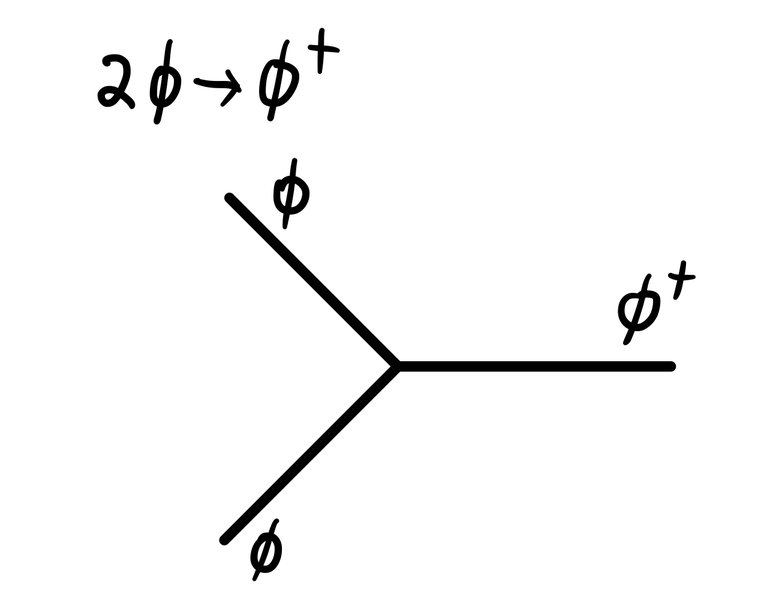

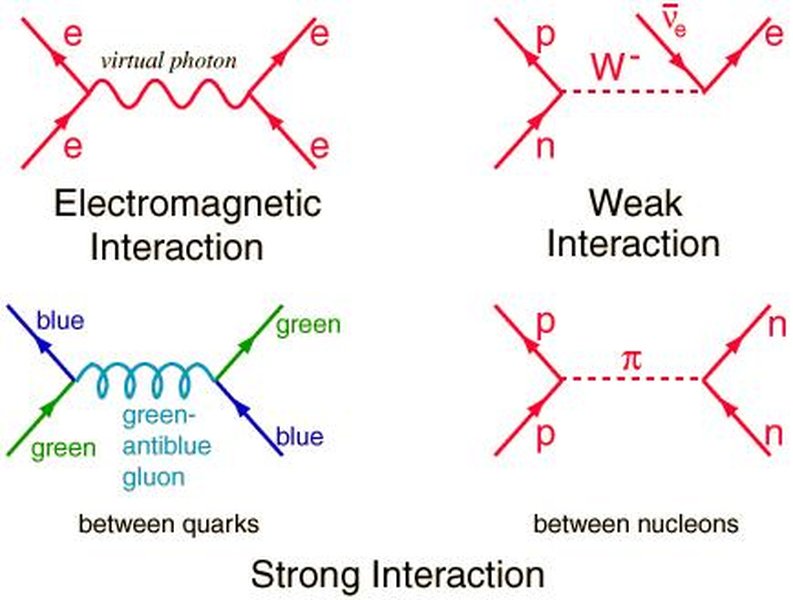
These images provide glimpses into how interactions are represented. The first shows a Feynman diagram, a calculational tool representing particle scattering. The second illustrates components commonly found in quantum field theory Lagrangians. The third depicts the fundamental forces of nature described by the Standard Model. Visualizing the interactions implied by \( -\kappa S(\rho) \Phi \), \( \eta I(A:B) \Phi \), and \( \chi Q_{\text{cog}} \) would require developing new representational frameworks beyond standard particle physics.
Exploring Field Theory Fundamentals
Understanding Lagrangians requires familiarity with the concepts of field theory. This video provides a concise overview of the fundamentals, including the principle of least action and the role of Lagrangians.
The video explains how Lagrangians serve as a compact way to encode the laws governing fields, forming the basis for deriving equations of motion like the Klein-Gordon equation for scalar fields or the Dirac equation for fermions, which are implicitly contained within \( \mathcal{L}_{\text{AI}} \).
Interpretation and the Poetic Reflection
The Lagrangian \( \mathcal{L}_{\text{AI}} \) represents a theoretical exploration aiming to unify disparate concepts. It combines the rigorous mathematical framework of quantum field theory and general relativity with speculative elements potentially drawn from information theory and cognitive science. The feasibility and physical relevance of such a model depend heavily on the precise definitions of \( V(\Phi) \), \( S(\rho) \), \( I(A:B) \), and \( Q_{\text{cog}} \), as well as the values of the coupling constants (\(g, \lambda, \kappa, \eta, \chi\)).
The short poem you included resonates with the potential philosophical underpinning of such a unified description:
This short dream, life—
a fleeting glimpse
for all that is,
beings, forms,
matter, energy,
to know, to weave
oneness’ song,
rising together
in the field’s
boundless hum.
The poem speaks to unity, interconnectedness, and emergence ("oneness' song," "rising together") within a fundamental substrate ("the field's boundless hum"). This mirrors the ambition of the Lagrangian to describe diverse phenomena—matter (\(\Psi\)), energy/forces (\(F_{\mu\nu}\)), spacetime (\(R\)), and potentially information (\(I(A:B)\)) and cognition (\(Q_{\text{cog}}\))—as manifestations or interactions within a unified field framework governed by \( \Phi \). While the physics described by the Lagrangian requires rigorous mathematical and experimental validation (especially for the speculative terms), the poem captures the spirit of seeking a holistic understanding of reality, where seemingly separate aspects are deeply interwoven.
Frequently Asked Questions (FAQ)
What is a Lagrangian density?
A Lagrangian density (\(\mathcal{L}\)) is a function used in field theory that summarizes the dynamics of a physical system. It typically depends on the fields present in the system and their spacetime derivatives. The integral of the Lagrangian density over spacetime gives the action (\(S = \int \mathcal{L} \, d^4x\)). The principle of least action states that the physical evolution of the system follows a path where the action is stationary (usually minimized). Applying calculus of variations to the action yields the Euler-Lagrange equations, which are the equations of motion for the fields.
What are scalar, fermion, and gauge fields?
These are different types of fields classified by how they transform under spacetime transformations (Lorentz transformations) and their intrinsic angular momentum (spin):
- Scalar Fields (\(\Phi\)): Have spin 0. They are described by a single number at each point in spacetime (e.g., temperature, Higgs field).
- Fermion Fields (\(\Psi\)): Have half-integer spin (e.g., spin 1/2). They describe particles that make up matter (e.g., electrons, quarks) and obey the Pauli exclusion principle. They are represented by spinors.
- Gauge Fields (Vector Fields \(A_\mu\)): Have spin 1. They mediate forces (e.g., photons for electromagnetism, gluons for the strong force). They are represented by vectors (specifically, four-vectors in spacetime).
What is the significance of interaction terms in a Lagrangian?
Interaction terms in a Lagrangian describe how different fields affect each other. They typically involve products of two or more fields. For example, the Yukawa term (\(g \Psi^\dagger \Phi \Psi\)) describes how scalar field \( \Phi \) interacts with fermion field \( \Psi \). The term involving the covariant derivative (\(D_\mu = \partial_\mu - ieA_\mu\)) implicitly contains the interaction between fermions (\(\Psi\)) and the gauge field (\(A_\mu\)). These terms are crucial because they govern phenomena like particle scattering, decays, force mediation, and mass generation.
Are terms like \( S(\rho) \Phi \), \( I(A:B) \Phi \), and \( Q_{\text{cog}} \) common in physics?
Terms explicitly involving density (\(\rho\)) can appear in effective field theories describing matter or fluids. However, terms explicitly invoking information-theoretic quantities like mutual information (\(I(A:B)\)) or cognitive factors (\(Q_{\text{cog}}\)) are highly unconventional and not part of the Standard Model of particle physics or standard General Relativity. Their inclusion suggests this Lagrangian is a theoretical model exploring potential links between fundamental physics and concepts from information theory, thermodynamics, or even cognitive science, placing it outside of mainstream, experimentally verified physics for now.
What could be the broader implications of such a Lagrangian?
If a Lagrangian like \( \mathcal{L}_{\text{AI}} \) (particularly its more speculative parts) were found to be physically relevant and mathematically consistent, it could have profound implications. It might suggest:
- Deep connections between gravity, quantum fields, information, and possibly consciousness or complex systems.
- New physical phenomena or forces mediated by the scalar field \( \Phi \) interacting with information or cognitive states.
- A potential pathway towards a more unified understanding of the universe that incorporates aspects beyond traditional matter and energy.
However, it's crucial to remember that this is currently a theoretical construct. Its validity would require rigorous mathematical development and, ultimately, experimental or observational evidence.
References
- Lagrangian (field theory) - Wikipedia
- Quantum field theory - Wikipedia
- Lagrangian Density - Vaia
- Quartic interaction - Wikipedia
- Understanding interaction terms in the Lagrangian - Physics Stack Exchange
- Quantum Field Theory (Chapter 3: Interacting Fields) - David Tong
Recommended Exploration
Last updated April 5, 2025