
Unlocking the Quantum Realm: How Does Quantum Computing Actually Work?
Explore the revolutionary technology leveraging quantum mechanics to redefine computation.
Quantum computing represents a paradigm shift in information processing, moving beyond the classical bits of today's computers to harness the peculiar rules of quantum mechanics. This approach promises to tackle complex problems currently intractable for even the most powerful supercomputers.
Key Insights into Quantum Computing
Understanding the Fundamentals
- Qubits are the Foundation: Unlike classical bits (0 or 1), quantum bits (qubits) can exist as 0, 1, or a combination of both simultaneously due to superposition.
- Quantum Phenomena Drive Power: Principles like superposition and entanglement allow quantum computers to explore vast numbers of possibilities concurrently, offering potential exponential speedups for specific tasks.
- Transformative Potential: Quantum computing could revolutionize fields like medicine, materials science, cryptography, and artificial intelligence by solving problems related to simulation, optimization, and pattern recognition.
Delving into the Quantum Mechanics of Computation
The Building Blocks: Qubits
The fundamental difference between classical and quantum computing lies in their basic unit of information. Classical computers use bits, which represent information as either a 0 or a 1. They are like light switches – either on or off.
Quantum computers, however, use quantum bits, or qubits. A qubit is based on quantum mechanical systems, such as the spin of an electron or the polarization of a photon. Crucially, a qubit can represent 0, 1, or, thanks to superposition, a complex combination of both states simultaneously.
Superposition: The Power of 'Both'
Superposition is one of the core principles that gives quantum computers their power. It allows a qubit to exist in multiple states at once. Think of a spinning coin: while it's in the air, it's neither definitively heads nor tails but exists in a superposition of both possibilities. Only when it lands (or is measured) does it collapse into a single, definite state (heads or tails).
Similarly, a qubit remains in a superposition of 0 and 1 until it is measured. This property enables quantum computers to perform many calculations in parallel. A system with 'n' qubits can represent \(2^n\) states simultaneously. For example, 2 qubits can represent 4 states (00, 01, 10, 11) at the same time, 3 qubits can represent 8 states, and so on. This exponential scaling allows quantum computers to handle datasets and explore solution spaces far larger than classical computers could manage.
Entanglement: The 'Spooky' Connection
Entanglement is another counter-intuitive quantum phenomenon crucial for quantum computing. When qubits become entangled, their fates are linked, regardless of the physical distance separating them. Measuring the state of one entangled qubit instantaneously influences the state of the other(s). Albert Einstein famously called this "spooky action at a distance."
Entanglement allows quantum computers to perform highly correlated computations. By linking qubits together, complex relationships within data can be processed efficiently, dramatically amplifying the computer's power for certain types of problems, particularly in simulation and optimization.
Quantum Gates and Circuits: Orchestrating Qubits
Similar to how classical computers use logic gates (like AND, OR, NOT) to manipulate bits, quantum computers use quantum gates to manipulate the quantum states of qubits. These gates perform operations like rotating the state of a qubit or entangling multiple qubits.
A sequence of quantum gates applied to a set of qubits forms a quantum circuit, which executes a specific quantum algorithm. Designing these algorithms requires a deep understanding of quantum mechanics to leverage superposition and entanglement effectively.
Probabilistic Nature: Getting the Answer
Due to superposition, the outcome of a quantum computation is inherently probabilistic. When qubits are measured at the end of a calculation, their superposition collapses into a definite classical state (0 or 1). The result isn't always a single, guaranteed answer but rather a probability distribution over possible outcomes.
Quantum algorithms are cleverly designed so that the probability of measuring the correct answer is significantly higher than incorrect ones. Often, the computation needs to be run multiple times to build confidence in the most probable solution.
Quantum vs. Classical Computing: A Tale of Two Paradigms
Fundamental Differences
The operational principles and strengths of quantum and classical computers differ significantly. Classical computers excel at tasks that involve sequential processing and definite logic, forming the backbone of our current digital world. Quantum computers, while not intended to replace classical ones entirely, offer a new approach for specific, complex problem types that are currently intractable.
The table below summarizes the key distinctions:
| Feature | Classical Computing | Quantum Computing |
|---|---|---|
| Basic Unit | Bit | Qubit |
| State Representation | 0 or 1 (definite state) | Superposition (0, 1, or both simultaneously) |
| Core Principles | Boolean Algebra, Logic Gates | Quantum Mechanics (Superposition, Entanglement) |
| Processing Approach | Sequential (mostly) | Parallel (exploiting superposition) |
| Nature of Output | Deterministic (usually) | Probabilistic |
| Best Suited For | Everyday tasks, well-defined logic, large data storage | Complex simulations, optimization problems, factorization, specific search problems |
Visualizing Quantum Concepts
Interconnected Ideas: A Mindmap of Quantum Computing
To grasp the relationships between the core ideas in quantum computing, consider the following mindmap. It illustrates how fundamental quantum principles like qubits, superposition, and entanglement enable the unique operational methods and potential applications of this technology, while also highlighting the inherent challenges.
(Quantum Bits)"] id1b["Superposition
(0 and 1 Simultaneously)"] id1c["Entanglement
(Correlated States)"] id2["Operation"] id2a["Quantum Gates"] id2b["Quantum Circuits"] id2c["Probabilistic Outcomes"] id2d["Quantum Algorithms
(e.g., Shor's, Grover's)"] id3["Potential Applications"] id3a["Cryptography
(Code Breaking & Security)"] id3b["Simulation
(Drug Discovery, Materials Science)"] id3c["Optimization
(Logistics, Finance)"] id3d["AI & Machine Learning"] id4["Challenges"] id4a["Decoherence
(Loss of Quantum State)"] id4b["Qubit Stability & Quality"] id4c["Scalability
(Increasing Qubit Count)"] id4d["Error Correction"] id5["Comparison"] id5a["vs. Classical Computing"] id5aa["Different Basic Unit (Bit vs. Qubit)"] id5ab["Different Processing (Sequential vs. Parallel)"]
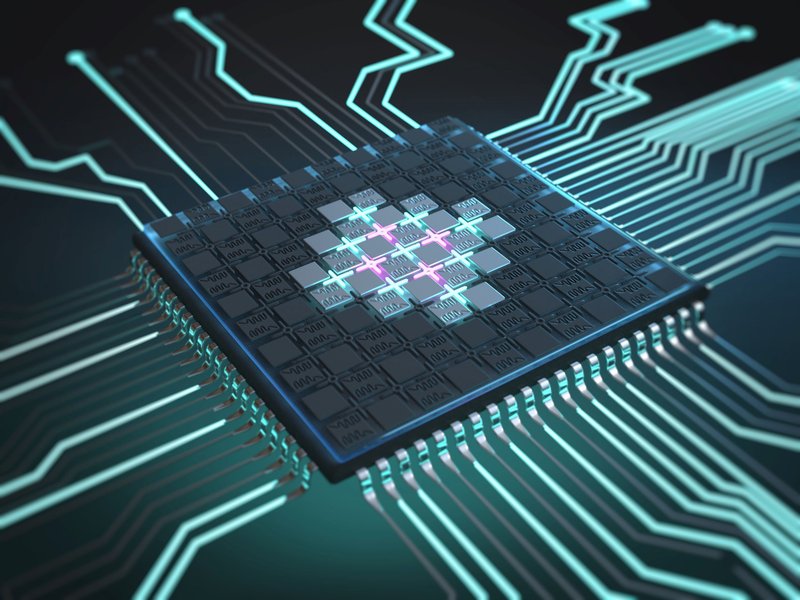
Visualization of a quantum processor component, showcasing the intricate structures needed to control superconducting qubits.
The Promise and Potential: Applications of Quantum Computing
Where Quantum Could Make a Difference
While still in nascent stages, quantum computing holds the potential to revolutionize numerous fields by tackling problems currently beyond the reach of classical computation:
- Cryptography: Quantum computers running Shor's algorithm could theoretically break many of the encryption standards currently used to protect online data. Conversely, quantum principles can also be used to develop new, quantum-resistant cryptography methods.
- Materials Science and Drug Discovery: Simulating the behavior of molecules and materials at the quantum level is incredibly complex for classical computers. Quantum computers could accurately model molecular interactions, accelerating the discovery of new materials, catalysts, and pharmaceuticals.
- Optimization Problems: Finding the optimal solution among a vast number of possibilities is common in logistics (e.g., route planning), finance (e.g., portfolio optimization), and manufacturing. Quantum algorithms like Grover's offer potential speedups for certain optimization and search tasks.
- Artificial Intelligence and Machine Learning: Quantum algorithms could enhance machine learning by improving pattern recognition, classification, and data analysis, potentially leading to more powerful AI systems.
- Financial Modeling: Quantum computers might improve complex financial modeling, risk analysis, and derivative pricing.
Projected Impact Across Industries
The potential impact of quantum computing varies across different sectors. The radar chart below provides an opinionated perspective on the anticipated disruptive potential in several key areas, based on the capabilities discussed. A higher score indicates a greater potential for fundamental change driven by quantum advancements.
This chart suggests a high potential impact in areas like cryptography and fundamental simulation, where quantum mechanics plays a direct role. While challenges remain across the board, the potential rewards continue to drive significant research and development.
Explaining the Fundamentals Visually
Quantum Physics Meets Computing
Understanding how quantum computers operate requires bridging the gap between abstract quantum physics concepts and computational tasks. The following video provides an explanation grounded in quantum physics principles, illustrating how phenomena like superposition are harnessed for computation.
As the video explains, quantum computers aren't just faster versions of classical machines; they operate on entirely different principles, leveraging the unique behaviors of matter and energy at the quantum scale to perform calculations in novel ways.
Challenges on the Quantum Frontier
Hurdles to Building Practical Quantum Computers
Despite the immense potential, significant technical challenges must be overcome to build large-scale, fault-tolerant quantum computers:
- Decoherence: Qubits are extremely sensitive to their environment. Interactions with heat, vibrations, or electromagnetic fields can cause them to lose their quantum state (superposition and entanglement) in a process called decoherence. Maintaining coherence long enough to perform complex computations is a primary obstacle. This often requires sophisticated cooling systems (near absolute zero) and shielding.
- Qubit Stability and Quality: Creating high-quality qubits that are stable, controllable, and interact reliably is difficult. Different physical implementations (superconducting circuits, trapped ions, photons, etc.) each have their own advantages and drawbacks regarding stability and scalability.
- Scalability: Increasing the number of high-quality, interconnected qubits in a system is a major engineering challenge. Current quantum computers have dozens to hundreds of qubits, but many proposed applications require thousands or even millions.
- Error Correction: Due to decoherence and imperfect quantum gate operations, errors are common in quantum computations. Developing effective quantum error correction codes, which require significant qubit overhead, is essential for reliable results.
Overcoming these hurdles is the focus of intense research and development efforts by academic institutions and technology companies worldwide.
Frequently Asked Questions (FAQ)
Common Queries About Quantum Computing
What exactly is a qubit?
A qubit (quantum bit) is the basic unit of quantum information. Unlike a classical bit, which must be either 0 or 1, a qubit can be 0, 1, or a superposition of both states simultaneously. This ability stems from quantum mechanics and allows quantum computers to store and process vastly more information than classical bits.
How does superposition help quantum computers?
Superposition allows qubits to represent multiple values at the same time. A quantum computer with 'n' qubits can explore \(2^n\) possibilities simultaneously. This inherent parallelism enables quantum computers to perform certain calculations—like searching large databases or factoring large numbers—potentially exponentially faster than classical computers, which check possibilities one by one or in smaller parallel batches.
What is quantum entanglement?
Entanglement is a quantum mechanical phenomenon where two or more qubits become linked in such a way that they share the same fate, regardless of the distance separating them. Measuring the state of one entangled qubit instantly reveals information about the state of the other(s). This deep connection allows for powerful correlations and information processing capabilities within a quantum computer.
Are quantum computers always faster than classical computers?
No. Quantum computers are not universally faster. They are designed to excel at specific types of problems where quantum phenomena like superposition and entanglement provide an advantage, such as factoring large numbers (Shor's algorithm) or simulating quantum systems. For many everyday tasks, like word processing or browsing the internet, classical computers remain more efficient and practical.
What are the biggest challenges in building quantum computers?
The main challenges include maintaining qubit coherence (preventing decoherence from environmental noise), scaling up the number of high-quality qubits, controlling qubits precisely, and implementing effective quantum error correction schemes to ensure reliable computations. These are significant engineering and physics hurdles.
When can we expect widespread use of quantum computers?
It's difficult to predict precisely. While quantum systems are accessible today via the cloud for research and specific tasks, large-scale, fault-tolerant quantum computers capable of solving major real-world problems are likely still years, possibly decades, away. Progress is rapid, but significant breakthroughs in hardware stability, scalability, and error correction are needed for widespread practical application beyond specialized research environments.
Recommended Reading
Explore Further
- How does Shor's algorithm break encryption?
- What are the different types of qubits being developed?
- Explore the latest breakthroughs in quantum hardware.
- Learn about quantum machine learning algorithms.
References
Sources Consulted

Last updated May 4, 2025