
Unlock Programmatic Power: Why Choose the Leonardo AI API Over the Web Plan?
Dive into the key differences between API access and the user-friendly web interface for AI image generation.
Leonardo AI offers powerful tools for generating images using artificial intelligence, accessible through both a user-friendly web/mobile application and a versatile Application Programming Interface (API). While the web-based plans provide an intuitive platform for interactive creation, the API plan caters to a different set of needs, primarily focused on integration, automation, and scalability. Understanding the distinct advantages of the API is crucial for developers, businesses, and advanced users looking to leverage Leonardo AI's capabilities programmatically. This guide outlines the core reasons why someone would opt for the Leonardo API plan instead of a standard web-based subscription, based on information available as of May 3, 2025.
Key Highlights: API vs. Web Plan
- Programmatic Integration: The API allows seamless embedding of Leonardo AI's generation features directly into your own software, websites, or custom applications.
- Automation & Scalability: Enable automated image creation workflows for high-volume tasks, handling numerous requests efficiently without manual intervention.
- Flexibility & Control: Gain granular control over generation parameters, access advanced features programmatically, and benefit from flexible API credit usage that doesn't expire.
The Core Distinction: Programmatic Power vs. User Interface
The fundamental difference lies in how you interact with Leonardo AI's services. The web plan is centered around a graphical user interface (GUI), while the API plan offers programmatic access.
API Plan: Tailored for Developers and Businesses
The Leonardo API plan is specifically designed for users who need to integrate AI generation capabilities into other systems or automate content creation processes.
Seamless Integration
The API provides RESTful endpoints, allowing developers to connect Leonardo AI's features with virtually any application or service. This means you can build custom tools, enhance existing software, or create unique user experiences powered by Leonardo AI. Examples include:
- Integrating image generation into game development pipelines for asset creation.
- Adding AI-powered design tools to e-commerce platforms for product visualization.
- Building automated content creation systems for marketing campaigns.
- Developing custom plugins or standalone applications leveraging Leonardo's models.
This level of integration is impossible with the web-based plans, which confine usage to the official Leonardo AI website or mobile app.
Workflow Automation
A major advantage of the API is the ability to automate image generation. You can set up systems where images are created automatically based on specific triggers, data inputs, or scheduled tasks, eliminating the need for manual prompting and clicking. This is invaluable for:
- Bulk generating images based on templates or data feeds.
- Creating real-time visual content in response to user actions in an app.
- Automating A/B testing for visual creatives in marketing.
The API also supports features like webhook callbacks. This allows your application to receive notifications automatically when an image generation task is complete, streamlining complex workflows by removing the need to constantly check (poll) for results.
Web-Based Plan: Designed for Individuals and Interactive Creation
The web-based plans (like Free, Apprentice, Artisan, Maestro) are ideal for users who prefer working within a visual interface.
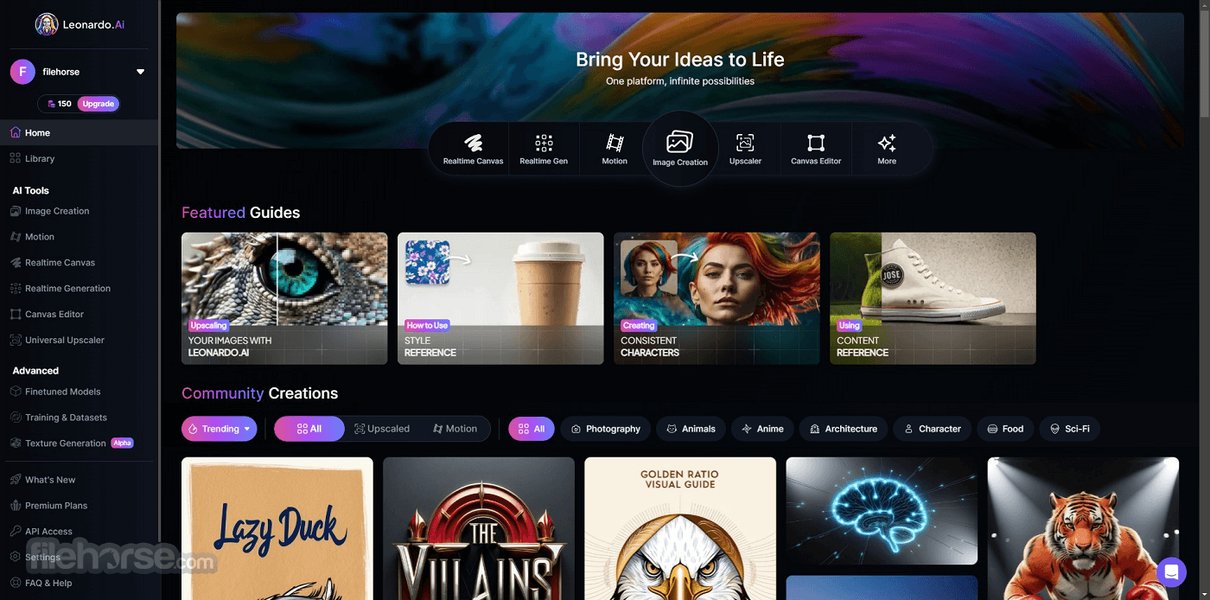
The Leonardo AI web interface provides a user-friendly environment for manual image generation and experimentation.
User-Friendly Interface
The primary strength of the web plan is its ease of use. Users can type prompts, adjust settings using sliders and menus, browse generated images, and manage their creations through an intuitive graphical interface without needing any coding knowledge.
Hands-On Experimentation
It's well-suited for artists, designers, hobbyists, and anyone who wants to explore AI image generation interactively. The immediate visual feedback loop helps in refining prompts and understanding the capabilities of different models and features.
Unlocking Advanced Capabilities and Scalability
Beyond basic access, the API plan offers significant advantages in terms of performance, control, and the ability to handle demanding tasks.
Handling High-Volume Needs
The API is built to manage large-scale generation requirements far more effectively than the manual web interface.
Scalable Architecture
API plans often support concurrent generations, meaning multiple image requests can be processed simultaneously. For example, the API Standard plan allows up to 5 concurrent generations. This significantly speeds up processes when dealing with large batches of images, making it suitable for businesses with substantial content needs.
Efficiency for Large Projects
For applications requiring hundreds or thousands of images, such as generating assets for games, populating product catalogs, or creating personalized marketing visuals, the API provides a scalable and cost-effective solution that manual web-based generation cannot match.
Granular Control and Customization
The API often exposes more detailed parameters and features than are readily available or easily controlled through the web interface.
Fine-Tuning Generation
Developers can programmatically adjust numerous settings for precise control over the output. This includes managing custom-trained models or elements, generating variations, and implementing complex workflows like programmatic inpainting or outpainting via the Canvas features.
Access to Specialized Features
Certain advanced functionalities, or specific combinations thereof (like using Alchemy with high-resolution features), might be more accessible or offer finer control via the API. This allows for sophisticated applications in fields like architecture, animation, and design where precise outputs are crucial.
Comparative Overview: API vs. Web Plan Attributes
This chart provides a visual comparison of the Leonardo AI API Plan versus the Web-Based Plan across several key attributes. Scores are subjective estimations (on a scale typically from 2 to 10, where higher is better/more) reflecting the general strengths of each approach.
As the chart illustrates, the API excels in integration, automation, scalability, and customization, making it ideal for technical applications. The Web Plan scores higher on ease of use and direct real-time interaction through its interface, favouring individual creators.
Understanding the Pricing and Credit Differences
Leonardo AI utilizes distinct systems for billing usage between its API and web application, which impacts cost management and flexibility.
API Credits vs. Web App Tokens
It's crucial to understand that API plans and web-based plans operate on separate consumption models.
The API Credit System
API usage is measured in API Credits. Each API call (e.g., generating an image) consumes a certain number of credits, which can vary based on factors like image resolution, generation steps, and the use of specific features (like Alchemy). A significant advantage highlighted is that API Credits typically do not expire, offering greater flexibility for budget planning and usage over time. You purchase credits through dedicated API subscription plans.
The Web App Token System
The web application uses Tokens for generating images and using features within the interface. The number of tokens consumed per action can differ from the API credit cost for a similar operation. Web app subscription plans (Free, Apprentice, Artisan, Maestro) provide a monthly allotment of tokens, which generally do expire at the end of each billing cycle or if the subscription lapses. An API subscription does not grant tokens for the web app, and vice versa.
Tailored API Plans and Cost Management
The API plans are structured to accommodate different levels of usage and provide tools for managing expenses.
Tiered Structure and Discounts
Leonardo AI offers several API subscription tiers, such as Basic, Standard, and Pro, each providing a different volume of API credits per month at varying price points (e.g., Basic ~3,500 credits, Standard ~25,000 credits). Higher tiers often come with volume discounts on credits, making the API potentially more cost-effective for heavy users compared to purchasing equivalent generation capacity via web app tokens. Custom enterprise plans may also be available for unique, large-scale needs.
Budgeting Tools
To help manage costs, Leonardo AI provides resources like a Pricing Calculator within the web app interface. This tool allows users to estimate the API credit cost for different generation configurations before making API calls. Combined with non-expiring credits, this enables more predictable and efficient budget management for ongoing projects or business operations.
Feature Comparison: API Plan vs. Web-Based Plan
This table summarizes the key differences between the Leonardo AI API plan and the standard web-based plans:
| Feature | API Plan | Web-Based Plan |
|---|---|---|
| Access Method | Programmatic (via code, HTTP requests) | Graphical User Interface (Web Browser, Mobile App) |
| Primary Use Case | Integration, Automation, Scaled Generation | Interactive Creation, Experimentation, Manual Use |
| Automation | High (Designed for automated workflows) | Low (Requires manual user interaction) |
| Integration | Yes (Seamless integration into external apps/systems) | No (Limited to use within Leonardo AI platform) |
| Scalability | High (Supports concurrent requests, bulk generation) | Low (Limited by manual operation speed) |
| Pricing Model | Subscription tiers based on API Credits | Subscription tiers based on Tokens |
| Credit/Token Expiry | API Credits generally do not expire | Tokens typically expire monthly |
| Customization | High (Granular control over parameters, custom models) | Moderate (Interface-based settings) |
| Advanced Features Access | Programmatic access to features like Alchemy, ControlNet, Webhooks | UI-based access to available features |
| Target User | Developers, Businesses, Tech-savvy Users | Artists, Designers, Casual Users, Hobbyists |
Decision Mindmap: Choosing Your Leonardo AI Plan
This mindmap helps visualize the key factors to consider when deciding between the Leonardo AI API and Web-Based plans based on your specific needs and goals.
(Programmatic Access)"] Int["Integration Needed?
(Embed in Apps/Workflows)"] Auto["Automation Required?
(High Volume/System Triggered)"] Scale["Scalability Focus?
(Bulk Generation/Concurrent Use)"] Dev["Technical User?
(Developer/Business Focus)"] Adv["Advanced Control?
(Fine-tuning/Webhooks)"] CostAPI["Budget Flexibility?
(Non-expiring Credits)"] Web["Web Plan
(User Interface)"] UI["Prefer UI?
(Interactive Creation)"] Manual["Manual Generation?
(Hands-on/Experimentation)"] Artist["Creative User?
(Artist/Designer/Hobbyist)"] Simple["Simplicity Needed?
(No Coding Required)"] Explore["Feature Exploration?
(Visual Feedback)"] CostWeb["Monthly Usage?
(Expiring Tokens)"]
Consider your primary objectives: If integration, automation, scalability, and fine-grained control are paramount, the API plan is likely the better choice. If you prioritize ease of use, interactive experimentation, and don't require external integration, a web-based plan will be more suitable.
Comparing AI Generation APIs
Choosing the right API often involves comparing options. This video discusses considerations when comparing different AI image generation APIs, which can provide valuable context when evaluating Leonardo AI's API against alternatives or understanding the API landscape in general.
The discussion covers aspects relevant to developers building applications that incorporate AI image generation, touching upon factors like performance, features, and integration methods, which align with the reasons for choosing an API plan like Leonardo's.
Frequently Asked Questions (FAQ)
Do I need a web-based subscription to use the Leonardo API?
No, you do not need a web-based plan (like Apprentice, Artisan, or Maestro) to use the Leonardo API. The API plans are separate subscriptions specifically for accessing the API endpoints. You subscribe directly to an API plan (e.g., Basic, Standard, Pro) to get API credits and an API key.
What are the main benefits of using the API over the web interface?
The main benefits are:
- Integration: Embed Leonardo AI into your own applications and workflows.
- Automation: Automate image generation processes without manual intervention.
- Scalability: Efficiently handle large volumes of image generation requests.
- Customization: Gain more granular control over generation parameters and access advanced features programmatically.
- Flexibility: Use non-expiring API credits for better budget management over time.
Can I automate image generation with a web-based plan?
No, the standard web-based plans are designed for manual use through the Leonardo AI website or mobile app. They do not provide the necessary programmatic access (API keys) required for automation or integration into external systems. Automation is a key feature enabled by the API plans.
Are API credits and web app tokens the same thing?
No, they are separate. API plans use API Credits for programmatic calls, and these credits generally do not expire. Web-based plans use Tokens for actions within the web/mobile interface, and these tokens typically expire monthly. Subscribing to one type of plan does not grant credits/tokens for the other.
Is the API plan more expensive than the web-based plans?
The cost depends on your usage volume and needs. API plans have different tiers starting from a relatively low price point (e.g., Basic plan). While higher API tiers have a higher monthly cost, they offer a larger volume of credits, potentially at a lower cost per credit due to discounts. For high-volume, automated generation, the API can be more cost-effective than attempting equivalent output manually via web app tokens. The non-expiring nature of API credits also adds value.
Recommended
- How do I get started with the Leonardo AI API?
- What are the specific features available through the Leonardo API?
- Compare Leonardo AI API pricing plans.
- Examples of applications built using the Leonardo AI API.
References
Last updated May 3, 2025