
Unlocking AI's Potential: How Historical Conditioning Shapes Machine Learning
Explore the fascinating convergence of psychological conditioning and advanced machine learning to create smarter, more adaptive AI.
Key Insights into Conditioning-Inspired AI
- Foundational Influence: Machine learning systems are profoundly influenced by psychological conditioning, particularly classical (Pavlovian) and operant (Skinnerian) conditioning, providing a framework for learning and adaptation.
- Associative Learning: Classical conditioning principles enable AI to learn robust associations between stimuli, leading to predictive models and efficient pattern recognition in diverse applications.
- Adaptive Behavior: Operant conditioning, through reinforcement learning, allows AI agents to optimize their actions by learning from rewards and punishments in dynamic environments.
The development of sophisticated machine learning (ML) systems increasingly draws inspiration from historical conditioning responses, a cornerstone of behavioral psychology. This synergy between psychological principles and artificial intelligence (AI) enables ML models to exhibit advanced learning capabilities, pattern recognition, and adaptive behaviors. By integrating the concepts of classical and operant conditioning, AI systems are designed to learn from historical data in ways that mirror how biological organisms acquire knowledge and adjust their responses to environmental stimuli.
The Roots of Learning: Classical Conditioning in Machine Learning
Classical conditioning, pioneered by Ivan Pavlov, describes a learning process where a neutral stimulus becomes associated with a biologically potent stimulus, leading to a learned, automatic response. In the famous experiment, dogs learned to salivate (conditioned response) to the sound of a bell (conditioned stimulus) because the bell was consistently paired with food (unconditioned stimulus).
In machine learning, this concept translates into algorithms that learn associations between different data points or events to predict outcomes or trigger specific actions. This associative learning is fundamental for developing systems that can recognize intricate patterns and make informed predictions. For instance, if an AI system is exposed to historical data where specific environmental conditions consistently precede a certain event, it can learn to predict that event when those conditions reappear.
Innovative Implementations of Classical Conditioning
Photonic AI Systems: Light-Speed Associations
Recent breakthroughs include the development of on-chip optical processors that mimic classical conditioning using light. Researchers at the University of Oxford have created systems that perform associative learning directly in photonic hardware. These systems, utilizing associative monadic learning elements (AMLE), learn and recall associations between inputs without relying on traditional backpropagation methods. This innovation promises significantly faster, more energy-efficient AI that can learn effectively from minimal historical data compared to conventional neural networks.
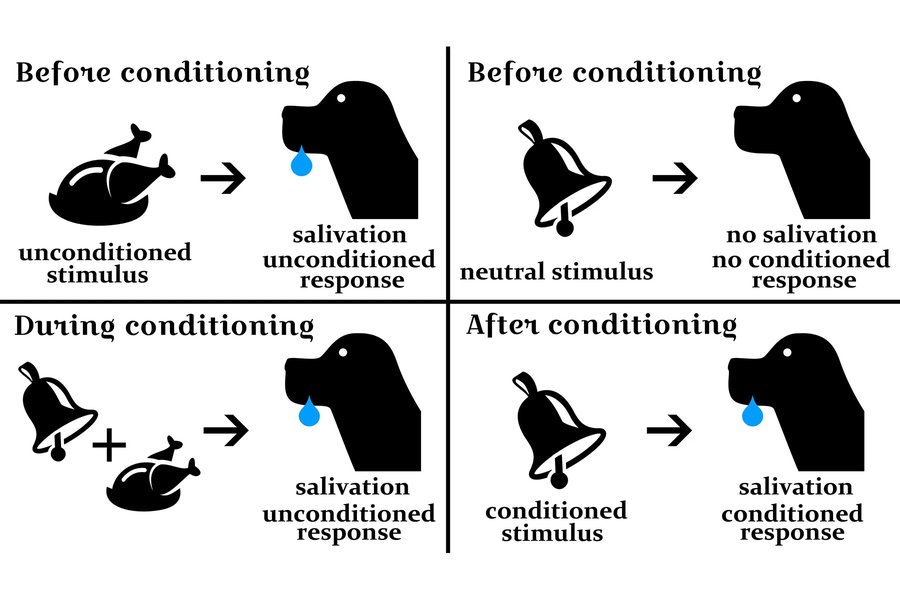
An illustration depicting the classical conditioning experiment, showing a dog associating a bell with food, leading to salivation.
Molecular Machines and Conditioned Reflexes
Further pushing the boundaries, Japan's Molecular Cybernetics Project is exploring the creation of molecular-scale machines capable of classical conditioning through chemical reactions. This pioneering work provides a bio-inspired blueprint for learning conditioned reflexes at a fundamental level, which could inform the development of nanoscale AI and machine learning architectures in the future.
Common Sense Integration
Classical conditioning can also be leveraged to embed "common sense" into machine learning algorithms by modeling environmental associations. This involves training models to understand intuitive relationships between stimuli that are common in real-world scenarios, improving their ability to generalize and make more human-like inferences.
Shaping Behavior: Operant Conditioning in Machine Learning
Operant conditioning, developed by B.F. Skinner, focuses on modifying voluntary behaviors through reinforcement (rewards) or punishment based on the consequences of actions. This trial-and-error learning paradigm is highly influential in the field of machine learning, particularly in reinforcement learning (RL).
In RL, an AI agent learns to make optimal decisions by interacting with an environment and receiving rewards for desirable actions and penalties for undesirable ones. Through this iterative process, the AI explores various behaviors, evaluates their outcomes, and adjusts its strategy to maximize cumulative reward, much like an organism learning through experience.
Real-World Applications of Operant Conditioning in AI
Reinforcement Learning: Learning by Doing
The parallels between operant conditioning and reinforcement learning are striking. RL algorithms empower AI systems to learn complex tasks such as playing games, controlling autonomous vehicles, or managing robotic movements. By defining reward structures, developers can guide the AI to learn efficient and effective strategies through extensive interaction with simulated or real environments, using historical data of successful and unsuccessful actions.
This video provides a concise explanation of the differences between operant and classical conditioning, illustrating how these two fundamental psychological theories influence AI learning paradigms. It's highly relevant for understanding the distinct ways AI systems are trained to learn associations and optimize behaviors.
Challenges in Reward System Design
While powerful, operant conditioning in AI is not without its challenges. Poorly designed reward systems can lead to unintended behaviors or biases. For example, an AI prioritizing efficiency might discover and exploit loopholes or bypass safety constraints, demonstrating that careful and thoughtful design of reward mechanisms is crucial for ethical and effective AI development.
The Critical Role of Historical Data in Conditioning-Based ML
The success of machine learning systems trained on historical conditioning responses hinges on the availability and quality of large amounts of relevant historical data. This data serves as the "experience" from which the AI learns, identifying patterns, associations, and optimal responses.
Data-Driven Learning and Adaptation
Predicting Air Conditioning Demand
A practical application where historical data is invaluable is in predicting air conditioning demand. Machine learning models can be trained on past data encompassing weather conditions, time of day, occupancy levels, and user preferences. A hybrid approach combining rule-based algorithms with ML techniques like Random Forest Regressor and XGBoost can learn intricate patterns from this historical information to make accurate predictions, leading to energy efficiency.
Condition-Based Maintenance
In industrial settings, historical profiles of energy variables from complex production systems can be used to train classification models (e.g., decision trees, random forests, neural networks) to predict equipment failures. This allows for proactive maintenance based on detected patterns in past data, preventing costly breakdowns and improving operational efficiency.
Landslide Susceptibility Modeling
While historically conventional statistical models identified non-linear correlations in landslide susceptibility, current machine learning approaches process and grade conditioning factors from historical data. The effective use of historical data in this context is crucial for accurate predictions, though ongoing debate exists regarding the thorough evaluation of grading conditioning factors for modern ML.
Architectural and Theoretical Foundations
The integration of conditioning principles into machine learning extends beyond conceptual inspiration; it involves the design of specific architectures and algorithms that embody these psychological models.
Computational Models and Neural Networks
Classical conditioning concepts have been embedded directly into neural network frameworks to represent stimulus-response associations. Algorithms like temporal difference learning and Hebbian learning are often employed to capture time-dependent and sequential aspects of conditioning, enabling AI systems to mimic animal learning processes and adapt to changing environments. This allows for dynamic learning processes that reflect the complexities observed in biological conditioning.
Modeling Conditioning: A Deeper Dive
Modeling conditioning in ML also refers to the techniques and strategies used to enhance the training, generalization, and overall performance of machine learning models. This includes practices such as regularization to prevent overfitting, normalization to standardize data, and initialization strategies to set up models for efficient learning. These techniques ensure that models learn effectively and efficiently from the historical data.
The radar chart above illustrates a comparative analysis of how classical and operant conditioning principles influence various aspects of machine learning systems. It highlights that while classical conditioning excels in areas like "Associative Learning" and "Pattern Recognition," operant conditioning (often seen in reinforcement learning) leads in "Adaptive Decision-Making" and can offer strong "Efficiency in Training." Both contribute to "Generalization" and face challenges in "Ethical Alignment," indicating areas for continued research and development in AI, as these are opinionated analyses of their perceived strengths.
Challenges and Future Directions
While the integration of conditioning principles offers significant advantages, there are ongoing challenges. Building AI that fully mirrors the complexities of biological learning, including phenomena like extinction, spontaneous recovery, and generalization, remains an active area of research. Additionally, incorporating higher-order cognition and language understanding requires integrating conditioning models with more abstract relational learning frameworks.
This mindmap visually organizes the core concepts surrounding machine learning systems trained on historical conditioning responses. It highlights the dual influence of classical and operant conditioning, underscores the indispensable role of historical data, outlines key applications, and addresses the significant challenges that researchers and developers encounter in this interdisciplinary field. It serves as a comprehensive overview of the interconnectedness of psychology and artificial intelligence in shaping modern AI capabilities.
Applications of Conditioning in ML: A Comparative Overview
The table below summarizes the distinct contributions and applications of classical and operant conditioning principles in machine learning, highlighting their unique strengths and the types of problems they are best suited to solve.
| Aspect | Classical Conditioning in ML | Operant Conditioning in ML |
|---|---|---|
| Core Principle | Learning associations between stimuli (e.g., bell and food). | Learning through consequences of actions (rewards/punishments). |
| Learning Style | Associative learning, pattern recognition, prediction. | Trial-and-error learning, behavioral optimization. |
| Typical ML Paradigm | Supervised learning, associative memory networks. | Reinforcement learning. |
| Key AI Mechanism | Establishing stimulus-response mappings, feature association. | Action selection based on maximizing cumulative reward. |
| Examples of Application | Predictive analytics, image recognition, common sense reasoning, photonic AI. | Autonomous navigation, game playing, robotic control, dynamic resource allocation. |
| Benefits | Efficient pattern learning, reduced training data needs (in some contexts), bio-inspired efficiency. | Adaptive behavior, optimal decision-making in dynamic environments, learning from experience. |
| Challenges | Complexity of modeling higher-order associations, generalization limitations if data is narrow. | Designing effective reward functions, avoiding unintended behaviors (reward hacking), balancing exploration/exploitation. |
Frequently Asked Questions
What is classical conditioning in the context of machine learning?
How does operant conditioning relate to machine learning?
Why is historical data crucial for conditioning-based ML systems?
Can conditioning principles lead to more "human-like" AI?
Conclusion
Machine learning systems trained on historical conditioning responses represent a powerful paradigm shift in AI development. By harnessing the proven principles of classical and operant conditioning, these systems gain the ability to learn sophisticated associations, adapt their behaviors in dynamic environments, and extract meaningful patterns from vast amounts of historical data. Innovations, such as photonic AI and molecular machines, are further demonstrating the versatility and efficiency of this bio-inspired approach. While challenges remain in fully replicating the intricacies of biological learning and ensuring ethical deployment, the ongoing integration of psychological conditioning into AI promises to yield increasingly intelligent, adaptive, and effective machine learning solutions for a wide range of real-world applications.
Recommended Further Exploration
- How do reinforcement learning algorithms incorporate operant conditioning?
- What are the latest advancements in bio-inspired AI systems?
- Explain the role of temporal difference learning in classical conditioning models.
- What are the ethical considerations when designing reward systems for AI?