
Understanding Markov Decision Processes
A Comprehensive Analysis of the Markov Property in MDPs
Key Takeaways
- The Markov property ensures that future states depend only on the current state and action.
- Option 2 accurately reflects the conditional independence required in MDPs.
- Understanding MDPs is essential for modeling and solving decision-making problems in various fields.
Introduction to Markov Decision Processes
Markov Decision Processes (MDPs) are a fundamental framework used in the field of reinforcement learning and decision-making. They provide a mathematical model for decision-making situations where outcomes are partly random and partly under the control of a decision-maker. MDPs are widely used in areas such as robotics, economics, and artificial intelligence to model and solve complex problems that involve sequential decisions.
What is a Markov Decision Process?
An MDP is defined by a tuple (S, A, P, R, γ), where:
- S is a finite set of states.
- A is a finite set of actions.
- P is the state transition probability matrix, where P(st+1 | st, at) represents the probability of transitioning to state st+1 from state st after taking action at.
- R is the reward function, giving the immediate reward received after transitioning from state st to state st+1 due to action at.
- γ is the discount factor, representing the difference in importance between immediate and future rewards.
The Markov Property
The Markov property is the cornerstone of MDPs. It stipulates that the future state and reward depend solely on the current state and action, not on the sequence of events that preceded them. Formally, this is expressed as:
$$ \Pr(s_{t+1}, r_{t+1} | s_t, a_t, s_{t-1}, a_{t-1}, \ldots, s_0, a_0) = \Pr(s_{t+1}, r_{t+1} | s_t, a_t) )$$
This equation highlights that given the current state st and action at, the probability of transitioning to the next state st+1 and receiving reward rt+1 is independent of the prior states and actions.
Analyzing the Probability Statements in MDPs
Evaluating the Options
Option 1: Pr(st+1, rt+1 | st, at) = Pr(st+1, rt+1)
This statement suggests that the transition to st+1 and reward rt+1 are independent of the current state st and action at. However, in MDPs, the next state and reward are indeed dependent on the current state and action. Therefore, this option violates the Markov property and is incorrect.
Option 2: Pr(st+1, rt+1 | st, at, st−1, at−1,...,s0,a0) = Pr(st+1, rt+1 | st, at)
This option accurately reflects the Markov property. It asserts that the probability of transitioning to the next state and receiving a reward depends only on the current state and action, and is conditionally independent of all previous states and actions. This independence is fundamental to MDPs, making Option 2 the correct choice.
Option 3: Pr(st+1, rt+1 | st, at) = Pr(st+1, rt+1 | s0, a0)
This statement incorrectly implies that the transition probability depends on the initial state and action (s0, a0) rather than the current state and action. Such dependency contradicts the Markov property, rendering this option invalid.
Option 4: Pr(st+1, rt+1 | st, at) = Pr(st, rt | st−1, at−1)
This option presents an illogical equivalence by equating the probability of transitioning to the next state and reward given the current state and action with the probability of the current state and reward given the previous state and action. This does not align with the Markov property, making it an incorrect statement.
Conclusion on the Correct Choice
Among the options provided, only Option 2 correctly embodies the Markov property essential to MDPs. It succinctly captures the conditional independence of future states and rewards from past states and actions, given the present state and action.
Implications of the Markov Property in MDPs
The Markov property simplifies the process of modeling and solving decision-making problems by reducing the dependency on the entire history of states and actions. This property allows for the formulation of algorithms that can efficiently find optimal policies without considering the complexity of past events.
Applications of MDPs
MDPs are employed in various domains due to their versatility in modeling sequential decision-making processes. Some notable applications include:
- Robotics: For path planning and autonomous navigation.
- Economics: In modeling market behaviors and strategic interactions.
- Artificial Intelligence: Particularly in reinforcement learning for training agents.
- Healthcare: For treatment planning and resource allocation.
Solving MDPs
Various algorithms have been developed to find optimal policies in MDPs, including:
- Value Iteration: Iteratively updates the value of each state until convergence.
- Policy Iteration: Alternates between policy evaluation and policy improvement.
- Q-Learning: A model-free reinforcement learning algorithm that learns the value of actions.
Value Iteration Algorithm
Value iteration is a dynamic programming approach where the value function is updated iteratively based on the Bellman equation until it converges to the optimal value function.
# Example of Value Iteration in Python
def value_iteration(states, actions, transition_probabilities, rewards, gamma, theta):
    V = {s: 0 for s in states}
    while True:
        delta = 0
        for s in states:
            v = V[s]
            V[s] = max(sum(transition_probabilities(s, a, s_prime) *
                         (rewards(s, a, s_prime) + gamma * V[s_prime]) for s_prime in states)
                       for a in actions)
            delta = max(delta, abs(v - V[s]))
        if delta < theta:
            break
    return V
Advantages and Limitations of MDPs
Advantages
- Structured Framework: Provides a clear mathematical foundation for modeling decision-making.
- Flexibility: Can be adapted to various domains and problem complexities.
- Optimality: Guarantees finding an optimal policy under the Markov property.
Limitations
- State Space Size: Large state spaces can lead to computational challenges.
- Assumption of Markov Property: Not all real-world problems satisfy the strict independence requirements.
- Requires Accurate Models: Dependence on accurate state transition and reward models which may be difficult to obtain.
Overcoming Limitations
To address the limitations associated with MDPs, several approaches and extensions have been developed:
- Function Approximation: Utilizes function approximators like neural networks to handle large state spaces.
- Partially Observable MDPs (POMDPs): Extends MDPs to scenarios where the agent has incomplete information about the state.
- Hierarchical MDPs: Breaks down complex tasks into simpler sub-tasks to manage complexity.
Practical Example of an MDP
Robot Navigation
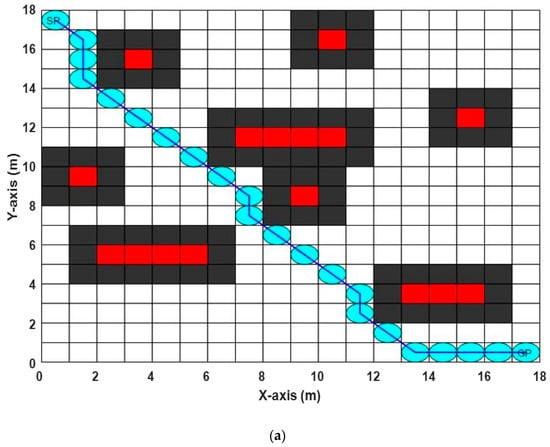
Consider a robot navigating through a grid to reach a target location. Each grid cell represents a state, and the possible movements (up, down, left, right) represent actions. The robot receives rewards based on its movement:
-
Reaching the target: High positive reward.
-
Hitting an obstacle: Negative reward.
-
Each movement: Small negative reward to encourage shorter paths.
MDP Components
| Component | Description |
|---|---|
| States (S) | All possible grid cells. |
| Actions (A) | Move up, down, left, right. |
| Transition Probabilities (P) | Deterministic or probabilistic movements based on action. |
| Rewards (R) | Positive for reaching target, negative for obstacles and movements. |
| Discount Factor (γ) | Typically set close to 1 to consider future rewards. |
Using value iteration or policy iteration, the robot can compute the optimal policy that dictates the best action to take from each state to maximize cumulative rewards.
Conclusion
Markov Decision Processes provide a robust framework for modeling and solving decision-making problems where outcomes are uncertain and sequential. The Markov property is fundamental to MDPs, ensuring that future states and rewards depend only on the current state and action, thus simplifying the analysis and computation of optimal policies. Understanding the correct application of the Markov property, as highlighted in the analysis of the provided probability statements, is crucial for effectively leveraging MDPs in various domains.
References
Last updated February 12, 2025