
Unlocking MCP: From Microscopic Amplifiers to AI's Next Frontier – What Does It All Mean?
Delve into the dual nature of "MCP," exploring both particle detection technology and a new protocol for AI integration.
The acronym "MCP" can be a source of confusion as it refers to two distinct and fascinating technologies in completely different fields. Understanding which "MCP" is being discussed is crucial. This explanation will provide a detailed look at both: the Microchannel Plate, a sophisticated device for detecting and amplifying minute signals, and the Model Context Protocol, an emerging standard for enhancing Artificial Intelligence capabilities.
Key Highlights: Understanding the Two MCPs
- Microchannel Plates (MCPs) are physical devices that act as high-gain electron multipliers, crucial for detecting faint signals like single photons or particles in scientific instruments and night vision technology.
- Model Context Protocol (MCP) is an open-source software standard designed to allow Large Language Models (LLMs) to securely and effectively interact with external data sources, tools, and APIs, expanding their real-world applicability.
- While both are termed "MCP," their functions, underlying principles, and applications are entirely separate, one rooted in physics and engineering, the other in artificial intelligence and software architecture.
Unveiling the Microchannel Plate: A Window into the Microscopic World
What Exactly is a Microchannel Plate?
A Microchannel Plate (MCP) is a compact, solid-state device designed to detect and amplify extremely weak signals, such as individual electrons, ions, elementary particles, or photons (particularly in the ultraviolet, EUV, and soft X-ray spectra). It functions as a high-gain, high-speed amplifier with excellent spatial and temporal resolution. Think of it as a specialized "lens" that doesn't just focus light but dramatically boosts the intensity of particle or high-energy light signals, making the invisible detectable.
The Intricate Architecture: How an MCP is Built
An MCP's remarkable capabilities stem from its unique structure, typically a thin plate or disk.
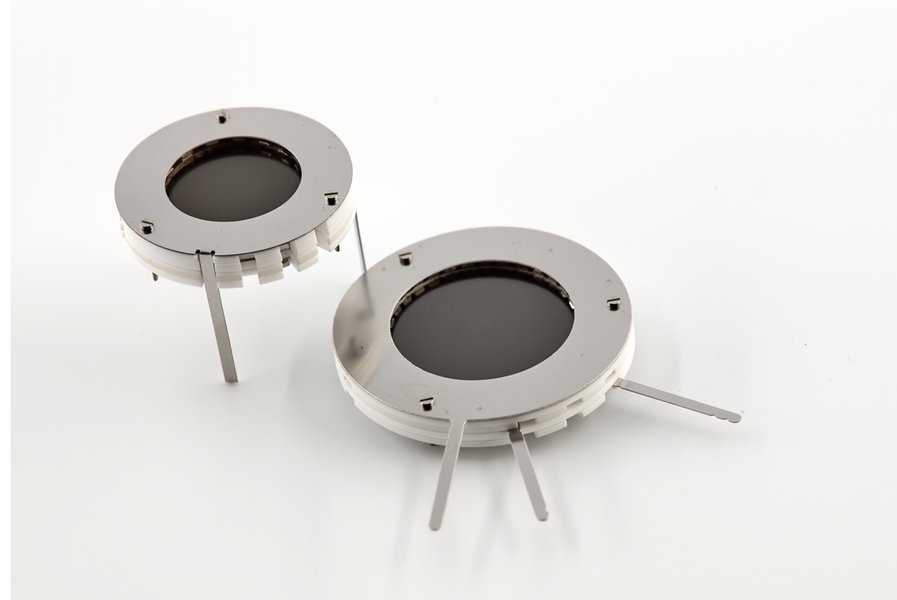
An assembly showing Microchannel Plates, highlighting their stacked configuration.
Core Materials and Dimensions
MCPs are usually crafted from a resistive material, often a special type of lead silicate glass. This glass is processed (e.g., through hydrogen firing) to make its surface slightly conductive, a key property for its operation. The plate itself is thin, generally ranging from 0.5 to 2 millimeters in thickness, with active areas that can vary from a few millimeters to over 10 centimeters in diameter.
The Microchannel Array
The heart of an MCP is a vast array of microscopic, parallel tubes or channels – the "microchannels." There can be millions of these channels, each typically 5 to 25 micrometers in diameter. These channels extend from one face of the plate to the other and are often arranged in a dense hexagonal pattern. Crucially, the channels are not perfectly perpendicular to the plate's surface but are tilted at a slight angle, usually between 8 to 13 degrees. This angle is vital, ensuring that particles entering a channel are likely to strike the channel wall rather than passing straight through.
Electrodes and Coatings
Both the front (input) and back (output) faces of the MCP are coated with a thin metallic film (e.g., nichrome or Inconel). These coatings serve as electrodes. A high voltage, typically around 1000 volts per plate, is applied between these electrodes, creating a strong electric field along the length of each microchannel.
The Amplification Marvel: How MCPs Work
The operation of an MCP hinges on the principle of secondary electron emission within each of its numerous microchannels, which act as independent, continuous-dynode electron multipliers.
The Initial Spark: Particle/Photon Interaction
When an incident particle (like an electron or ion) or a high-energy photon (UV or X-ray) enters a microchannel, its angled trajectory ensures it collides with the inner wall of the channel.
The Cascade Begins: Secondary Electron Emission
The material lining the channel wall has a high secondary electron yield. Upon impact by the incident particle/photon (if it has sufficient energy), several "secondary" electrons are dislodged and emitted from the wall material.
Multiplying the Signal: The Electron Avalanche
These newly freed secondary electrons are then accelerated down the channel by the strong electric field. As they gain energy and travel, they, in turn, strike the channel wall further along its length. Each of these impacts generates yet more secondary electrons. This process repeats multiple times, creating a cascading avalanche of electrons. A single initial event can thus be multiplied into a cloud containing thousands or even millions of electrons by the time it reaches the end of the channel.
Capturing the Amplified Signal
The significantly amplified cloud of electrons exits the microchannel from the output face of the MCP. This electron pulse can then be detected and processed in various ways depending on the application:
- It can strike a phosphor screen, causing it to glow and create a visible image (as in night vision devices).
- It can be collected by various types of anodes (e.g., metal anodes, resistive anodes, wedge-and-strip anodes, or delay-line readouts) for electronic signal processing, allowing for counting, timing, or position sensing of the original event.
Pushing the Limits: Enhancing MCP Performance
Stacked Configurations
To achieve even higher signal amplification (gain), two or more MCPs can be stacked in series. Common configurations include:
- Chevron (V-stack): Two MCPs are stacked with their channel bias angles oriented in opposite directions. This prevents ion feedback (positive ions created in the channels from traveling back up and causing spurious signals) and significantly increases gain. Gains of 106 to 107 are achievable.
- Z-stack: Three MCPs are stacked, offering even higher gains (up to 108 or more) and further improved ion feedback suppression.
This video provides an overview of Microchannel Plate manufacturing and operation, illustrating how these devices function to amplify signals.
Where MCPs Shine: Key Applications
The high gain, excellent spatial resolution (preserving the location of the input signal), and fast temporal response (quick reaction time) of MCPs make them invaluable in a wide array of fields.
| Application Area | Specific Uses of MCPs |
|---|---|
| Image Intensification | Night vision goggles, low-light level cameras, surveillance systems. |
| Particle Detection | Detecting electrons, ions, neutrons, and other charged particles in physics experiments (e.g., mass spectrometers, surface science instruments). |
| Space Science & Astronomy | Detectors for UV, EUV, and X-ray telescopes; instruments for studying planetary atmospheres and solar wind. |
| Spectroscopy | Enhancing sensitivity in various spectrometers (optical, UV, X-ray) by amplifying weak spectral signals. |
| Electron Microscopy | Used in some types of electron microscopes for efficient electron detection. |
| Time-of-Flight (TOF) Systems | In mass spectrometry and particle identification, leveraging their short transit time spread for precise timing measurements. |
| Medical Imaging | Experimental and specialized medical imaging devices requiring high sensitivity. |
This table highlights the versatility of Microchannel Plates across various scientific and technological domains where the detection and amplification of faint signals are paramount.
Key Performance Characteristics of Microchannel Plates
The effectiveness of a Microchannel Plate is determined by several key performance metrics. The radar chart below illustrates typical relative performance levels for different aspects of MCP technology. These are qualitative representations: 'Detection Sensitivity' refers to the efficiency of detecting incoming particles/photons; 'Spatial Precision' indicates the ability to resolve fine details; 'Temporal Speed' reflects how quickly the MCP can respond to an event; 'Gain Factor' is the degree of signal amplification; and 'Durability' relates to operational lifespan under typical conditions.
Higher values on this chart generally indicate better performance. For instance, a higher 'Gain Factor' means more amplification, and higher 'Temporal Speed' means faster response.
Understanding the Boundaries: Limitations of MCPs
Despite their significant advantages, MCPs have certain limitations:
- Saturation Effects: At very high input signal rates or high output currents (typically when the output current approaches a few percent of the strip current flowing through the MCP material), the gain can decrease, and the response becomes non-linear. This is known as saturation.
- Noise: Intrinsic noise sources, such as thermionic emission from the channel walls or statistical fluctuations in the multiplication process, can affect the signal-to-noise ratio, particularly for very weak signals.
- Count Rate Limitations: Each channel requires a finite time to recover after an electron avalanche. If particles arrive too frequently in the same channel or local area, the MCP may not be able to process them all efficiently, leading to dead time or reduced gain.
- Lifespan: Over prolonged use, especially at high output currents, the secondary emissive properties of the channel walls can degrade, leading to a gradual decrease in gain. This is often characterized by the total extracted charge per unit area.
- Ion Feedback: In single MCPs, positive ions generated by electron collisions with residual gas molecules or the channel walls can be accelerated back towards the input, causing spurious secondary events. Stacked configurations like chevron or Z-stacks are used to mitigate this.
- Vacuum Requirement: MCPs must typically operate in a high-vacuum environment to prevent electrical discharge and to ensure a long mean free path for electrons.
The Model Context Protocol: Bridging AI with the World
What is the Model Context Protocol?
Shifting gears entirely, the Model Context Protocol (MCP) is an open standard designed to revolutionize how Large Language Models (LLMs) and other AI systems interact with external data sources, tools, and services. It aims to provide a universal, secure, and efficient way for AI to access dynamic, real-world information and capabilities that go beyond their static training data. Essentially, MCP acts as a standardized communication layer, enabling AI to become more versatile, knowledgeable, and actionable.
Core Principles of the Model Context Protocol
The Model Context Protocol is built upon several key ideas to ensure robust and trustworthy AI interactions.
Universal Connectivity: The "AI USB Port"
MCP strives to be a universal interface, much like a USB port for hardware. It allows an AI model (acting as an MCP host or client) to connect to a variety of external systems, referred to as MCP servers. These servers can expose diverse functionalities, such as:
- Access to cloud storage (e.g., Google Drive, Dropbox)
- Interaction with databases (e.g., PostgreSQL, MySQL)
- Execution of APIs (e.g., weather services, financial data feeds)
- Integration with automation workflows (e.g., GitHub actions, Zapier)
Structured Context Management
Instead of simply feeding large, unstructured blocks of text into an LLM's prompt (a common approach in basic Retrieval-Augmented Generation, or RAG), MCP organizes interactions and contextual information using three primary primitives:
- Tools: These are executable functions that the AI can invoke. A tool might be an API call to fetch current stock prices, a database query to retrieve customer information, or a script to perform a specific computation.
- Resources: These represent structured streams of data that the AI can access and reason over. Examples include files, logs, real-time sensor data, or the output from an API.
- Prompts: These are reusable, standardized templates that provide instructions or frameworks for common tasks or workflows. They can guide the AI in how to use specific tools or interpret certain resources effectively.
Security and Privacy by Design
A cornerstone of the Model Context Protocol is its emphasis on security and user control, often described as "local-first" security:
- Explicit User Consent: The AI model requires explicit permission from the user before it can access any tool or resource via an MCP server.
- Local Server Preference: MCP servers can often run locally on a user's machine or within their private network. This ensures that sensitive data does not need to leave the user's environment unless they specifically authorize an action that requires it.
- Enhanced Trust: By prioritizing user control and data locality, MCP aims to build greater trust, which is especially important when dealing with confidential or proprietary information.
The MCP in Action: Operational Workflow
The Model Context Protocol facilitates a dynamic interaction between an AI model and external systems. The following mindmap illustrates the typical operational flow:
Workflow Steps Explained:
- Connection and Capability Discovery: The AI model (MCP host) connects to one or more MCP servers. It then queries these servers to discover the available tools, resources, and prompt templates they offer.
- Context Augmentation: When a user submits a query, the AI model, guided by the discovered capabilities, can fetch relevant information from the connected MCP servers. This enriches the AI's context with up-to-date, structured external data.
- Tool Selection and Execution: Based on the user's query and the augmented context, the AI model may decide to use one or more available tools. It sends an execution request to the appropriate MCP server, which performs the action (e.g., runs a script, queries a database) and returns the results.
- Response Generation: The AI model incorporates the data retrieved through context augmentation and the results from any executed tools into its final response, providing a more accurate, context-aware, and capable answer to the user.
Potential and Significance
The Model Context Protocol holds the potential to significantly enhance the capabilities of AI systems. By enabling seamless and secure access to external information and actions, MCP can help LLMs overcome limitations related to outdated knowledge, lack of real-world grounding, and inability to perform concrete tasks. This could lead to more powerful AI assistants, more effective automation, and AI applications that are more deeply integrated into various workflows and data ecosystems.
Frequently Asked Questions (FAQ)
What is the main difference between a Microchannel Plate and the Model Context Protocol?
The difference is fundamental:
- A Microchannel Plate (MCP) is a physical hardware component, a detector that amplifies signals from particles or photons. It's used in scientific instruments, night vision, etc. Its domain is physics and engineering.
- The Model Context Protocol (MCP) is a software standard or protocol that defines how AI models (like LLMs) can connect to and use external data sources and tools. Its domain is artificial intelligence and software interoperability.
How does the angled nature of channels in a Microchannel Plate help?
The slight angle (typically 8-13 degrees) of the microchannels relative to the plate's surface is crucial. It ensures that an incident particle or photon entering a channel is highly likely to strike the channel wall near the entrance, rather than passing straight through. This initial collision is necessary to start the secondary electron emission process, which is the basis for the signal amplification. Without this angle, many incident particles might not interact with the channel walls, significantly reducing the MCP's detection efficiency.
Is the Model Context Protocol already widely used in AI applications?
The Model Context Protocol (MCP) is a relatively new and emerging open standard. While it's gaining attention and support within the AI development community, it is not yet as widely adopted as some more established technologies. Its goal is to provide a common framework, and like many open standards, its widespread use will depend on broader community adoption, development of tools and servers supporting the protocol, and integration into popular AI platforms and applications. It represents a forward-looking approach to AI interoperability.
Can a Microchannel Plate detect visible light?
Standard Microchannel Plates are generally not very sensitive to visible light photons directly. Their primary sensitivity lies in detecting charged particles (electrons, ions) and higher-energy photons such as ultraviolet (UV), extreme ultraviolet (EUV), and soft X-rays. This is because visible light photons typically do not have enough energy to efficiently cause secondary electron emission from the channel wall material. However, MCPs are often used in image intensifier tubes where a photocathode is placed before the MCP. This photocathode converts visible light photons into electrons, which are then amplified by the MCP. So, indirectly, MCPs are crucial components in systems that detect visible light.
Recommended Further Exploration
To deepen your understanding of these technologies, consider exploring these related queries:
- How do Chevron and Z-stack MCP configurations specifically improve gain and reduce noise in particle detection?
- What are some practical examples or case studies demonstrating the Model Context Protocol enhancing AI capabilities?
- What specific material properties make lead silicate glass suitable for secondary electron emission in Microchannel Plates?
- What are the detailed security mechanisms within the Model Context Protocol that protect sensitive data when AI interacts with external systems?
References
Last updated May 14, 2025