

Key Insights into Simple Harmonic Motion (SHM)
- Defining SHM: Simple Harmonic Motion is a specific type of periodic motion characterized by a restoring force directly proportional to the displacement from equilibrium and acting in the opposite direction, leading to sinusoidal oscillations.
- Spring-Mass Systems: The oscillation of a mass attached to a spring is a prime example of SHM, where the period is determined by the mass and the spring's stiffness (Hooke's Law: \(F = -kx\)).
- Simple Pendulums: For small angular displacements, a simple pendulum also exhibits SHM, with its period depending on the pendulum's length and gravitational acceleration, independent of its mass.
Simple Harmonic Motion (SHM) is a fundamental concept in physics, describing a specific type of oscillatory motion that appears in numerous natural phenomena and engineered systems. It's characterized by a restoring force that is directly proportional to the displacement from an equilibrium position and always acts to bring the object back to that equilibrium. This proportionality is key, leading to the characteristic sinusoidal (wave-like) motion over time. Understanding SHM is crucial not only for grasping foundational physics principles but also for analyzing diverse applications, from the ticking of a clock to the vibrations of a guitar string.
The Essence of Simple Harmonic Motion
At its core, Simple Harmonic Motion is defined by a restoring force, which always pushes or pulls an oscillating object back towards its central, equilibrium position. This force's magnitude is directly proportional to how far the object is displaced from that equilibrium, and its direction is always opposite to the displacement. Mathematically, this relationship is often expressed by Hooke's Law: \( F = -kx \), where \( F \) is the restoring force, \( k \) is a constant (the spring constant for a spring, or a related factor for other systems), and \( x \) is the displacement from equilibrium. The negative sign indicates the force acts opposite to the displacement.
The acceleration of an object undergoing SHM is also proportional to its displacement but in the opposite direction. This leads to a distinct sinusoidal pattern for displacement, velocity, and acceleration over time. Key characteristics that define SHM include:
- Period (\(T\)): The time required for one complete oscillation or cycle.
- Frequency (\(f\)): The number of oscillations per unit time (\(f = 1/T\)).
- Amplitude (\(A\)): The maximum displacement from the equilibrium position. For ideal SHM, this remains constant.
- Energy Transformation: Energy continuously oscillates between kinetic energy (energy of motion) and potential energy (stored energy, e.g., in a stretched spring or lifted pendulum bob). In an ideal system without damping, the total mechanical energy remains constant.
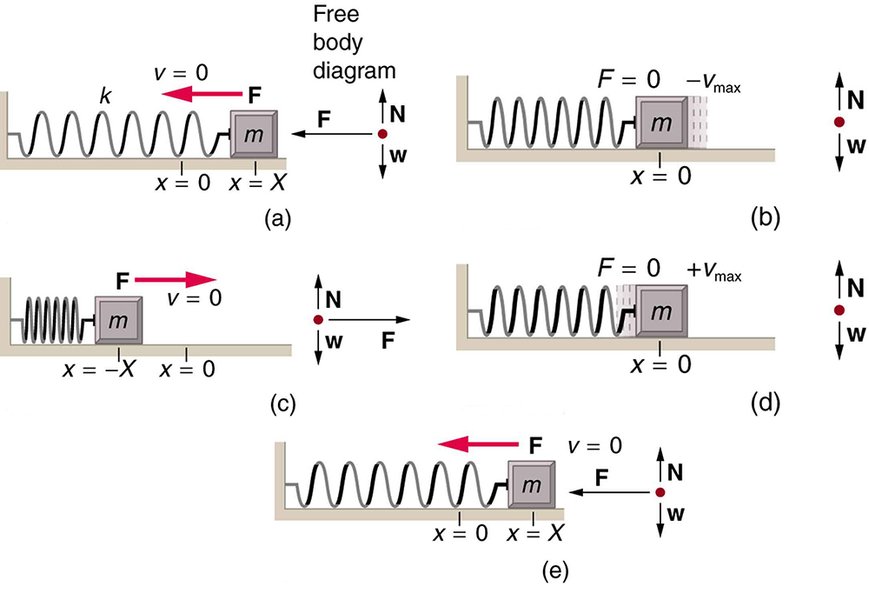
Illustration of displacement, velocity, and acceleration in Simple Harmonic Motion over time.
Spring-Mass System: A Classic SHM Model
One of the most intuitive and widely studied examples of SHM is a mass attached to a spring. When a mass is connected to a spring and displaced from its equilibrium position, the spring exerts a restoring force that endeavors to pull the mass back to its original resting state. This force, as governed by Hooke's Law, is directly proportional to the displacement. The resulting motion is a perfect demonstration of SHM.
Dynamics of the Spring-Mass System
- Restoring Force: \( F = -kx \), where \( k \) is the spring constant (a measure of the spring's stiffness). A larger \( k \) means a stiffer spring.
- Period of Oscillation: The time it takes for one complete oscillation is given by the formula \( T = 2\pi \sqrt{\frac{m}{k}} \). This equation highlights that the period increases with increasing mass (\(m\)) and decreases with increasing spring stiffness (\(k\)). Notably, the period is independent of the amplitude of oscillation, assuming ideal conditions.
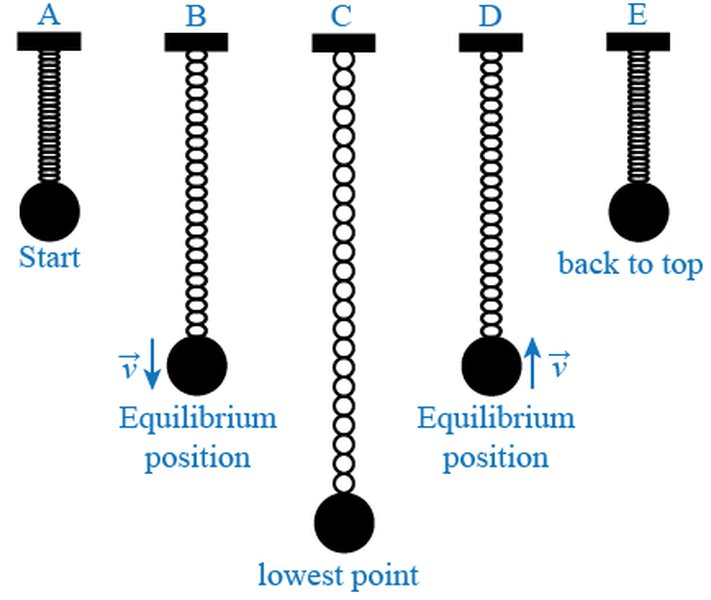
- Energy Exchange: As the mass oscillates, energy is continuously transformed between elastic potential energy (stored in the stretched or compressed spring) and kinetic energy (of the moving mass). At maximum displacement, potential energy is maximal, and kinetic energy is zero. At the equilibrium position, kinetic energy is maximal, and potential energy is zero.

A mass oscillating on a spring, illustrating a key example of Simple Harmonic Motion.
Even when a spring-mass system is oriented vertically, undergoing the influence of gravity, its oscillatory motion about the new equilibrium position remains SHM with the same period \( T = 2\pi \sqrt{\frac{m}{k}} \). Gravity simply shifts the equilibrium point downwards but does not alter the oscillation frequency or period.
Simple Pendulum: The Rhythmic Swing
A simple pendulum, consisting of a small mass (bob) suspended by a light, inextensible string from a fixed point, is another classic illustration of SHM. While its motion is not perfectly harmonic for large swings, for small angular displacements (typically less than about 15 degrees), its behavior closely approximates SHM.
Understanding Pendulum Dynamics
- Restoring Force: The restoring force for a simple pendulum is the component of gravity acting tangent to the arc of motion, pulling the bob back towards the equilibrium position. For small angles, this force is approximately proportional to the angular displacement.
- Period of Oscillation: For small angles, the period of a simple pendulum is given by \( T = 2\pi \sqrt{\frac{L}{g}} \), where \( L \) is the length of the pendulum and \( g \) is the acceleration due to gravity. This formula shows that the period depends only on the length of the pendulum and the local gravitational acceleration, not on the mass of the bob or the amplitude (for small swings). This independence from mass is a crucial distinction from the spring-mass system.
- Energy Exchange: Similar to the spring-mass system, the pendulum continuously exchanges gravitational potential energy (highest at the maximum displacement) and kinetic energy (highest at the equilibrium position).
A simple pendulum demonstrating oscillatory motion.
The video below provides an excellent visual explanation of how a pendulum can be treated as a simple harmonic oscillator and discusses the factors that influence its period.
This video, titled "Pendulums | Oscillations and mechanical waves | Physics...", comprehensively explains the principles governing pendulum motion as a simple harmonic oscillator. It delves into the factors affecting the pendulum's period and provides valuable insights into its behavior. Understanding these fundamental concepts is essential for appreciating how physics models simplify complex systems to make them predictable and understandable.
Comparing Spring-Mass Systems and Simple Pendulums in SHM
While both spring-mass systems and simple pendulums are canonical examples of Simple Harmonic Motion, they exhibit distinct dependencies and characteristics. The following table summarizes their key differences and similarities.
| Characteristic | Spring-Mass System | Simple Pendulum (Small Angles) |
|---|---|---|
| Restoring Force | Spring force proportional to displacement (\(F = -kx\)) | Component of gravity proportional to angular displacement (\(F \approx -mg\theta\)) |
| Period (\(T\)) Formula | \( T = 2\pi \sqrt{\frac{m}{k}} \) | \( T = 2\pi \sqrt{\frac{L}{g}} \) |
| Factors Affecting Period | Mass (\(m\)) and Spring Constant (\(k\)) | Length (\(L\)) and Acceleration due to Gravity (\(g\)) |
| Dependence on Mass | Depends on mass (\(m\)) | Independent of mass of the bob (for ideal simple pendulum) |
| Dependence on Amplitude | Independent of amplitude (ideal) | Independent of amplitude (for small angles only) |
| Primary Energy Form | Elastic Potential Energy | Gravitational Potential Energy |
| Key Physical Law | Hooke's Law | Approximation from Newton's Second Law for rotational motion |
Beyond Ideal SHM: Real-World Considerations
While ideal SHM models provide a strong foundation, real-world oscillatory systems are often subject to additional factors that modify their behavior. The most common of these is damping, which refers to any effect that dissipates energy from the oscillating system, causing the amplitude of oscillations to gradually decrease over time. Examples of damping forces include air resistance, friction, and internal resistance within the spring material.
Another important consideration, especially for pendulums, is the small-angle approximation. As the angular displacement of a pendulum increases, its motion deviates from true SHM. For larger angles, the restoring force is no longer directly proportional to the displacement, leading to a period that slightly increases with amplitude. Advanced systems, such as the spring-pendulum (elastic pendulum), introduce even more complexity by coupling multiple oscillatory behaviors, which can sometimes lead to fascinating regular or even chaotic dynamics.
The mindmap above provides a structured overview of Simple Harmonic Motion, detailing its core characteristics, key examples (spring-mass systems and simple pendulums), and the factors that influence them. It also touches upon real-world considerations like damping and non-linear effects, illustrating the scope of SHM from idealized models to more complex behaviors.
FAQ about Simple Harmonic Motion
What is the primary condition for a system to exhibit Simple Harmonic Motion?
Does the mass of a simple pendulum affect its period?
What happens to the total mechanical energy in an ideal SHM system?
Why is the small-angle approximation important for simple pendulums?
How does damping affect Simple Harmonic Motion?
Conclusion: The Ubiquity of SHM
Simple Harmonic Motion is a powerful concept that unifies the behavior of seemingly disparate physical systems. From the rhythmic sway of a simple pendulum to the precise vibrations of a spring-mass system, the underlying principle of a proportional restoring force leads to the elegant sinusoidal oscillations characteristic of SHM. While ideal models simplify reality, they provide an indispensable framework for understanding more complex real-world phenomena, paving the way for advancements in fields ranging from timekeeping to structural engineering. The study of SHM is not just an academic exercise; it's an exploration into the fundamental rhythms that govern our physical universe.
Recommended Further Exploration
- How do real-world forces alter the pure rhythm of SHM?
- What happens when multiple harmonic systems interact?
- Dive deeper into the continuous energy dance within simple harmonic motion.
- Discover the surprising everyday applications of SHM principles.