
Unlocking Sortter.fi's Potential: Mastering LLM SEO for Deeper User Engagement
Discover how to transform Sortter.fi's content into a rich, contextual resource that captivates users and AI alike, driving relevance for complex financial queries.
To align Sortter.fi with advanced Large Language Model (LLM) SEO principles, the goal is to evolve content from being merely transactional to deeply informational and contextually rich. This involves creating material that an AI can readily process, understand in its nuances, and deem highly relevant for answering complex user queries about finance in Finland. As of May 7, 2025, this means focusing on natural language, comprehensive topic coverage, and explicitly addressing user intent.
Highlights: Key Pillars for LLM SEO Success
- Embrace Natural Language & Narrative Flow: Shift from concise, keyword-focused statements to more conversational and explanatory narratives. This helps LLMs understand the meaning and intent behind the content, mirroring how humans communicate and seek information.
- Deepen Topical Authority with Comprehensive Coverage: Expand existing content on loan types, the comparison process, and financial advice. Cover various facets, including benefits, risks, eligibility nuances, and how different financial products suit diverse user scenarios.
- Prioritize and Directly Address User Intent: Structure content to proactively answer the underlying questions, concerns, and goals of users. For instance, instead of just stating Sortter compares loans, explain *how* this comparison helps users achieve specific financial objectives like managing debt or funding significant life events.
Transforming Core Content: From Keywords to Rich Context
The foundation of LLM SEO lies in enhancing the core information Sortter.fi provides. This means going beyond surface-level descriptions and embedding deep contextual understanding into every relevant page.
Enriching Loan Product Descriptions
Moving Beyond Basic Listings
Currently, Sortter.fi lists various loan types such as Kulutusluotto (Consumer Loan), Yhdistelylaina (Consolidation Loan), Remonttilaina (Renovation Loan), and Autolaina (Car Loan). To optimize for LLMs, these descriptions need significant enrichment:
- Detailed Use Cases: For each loan type, explain typical scenarios where it's the most suitable option. For example, for a Remonttilaina, discuss specific renovation projects (e.g., kitchen remodel, energy efficiency upgrades) and why this loan might be more advantageous than a general Kulutusluotto for these purposes.
- Pros and Cons: Objectively outline the advantages (e.g., potentially lower interest for specific purposes, tailored terms) and disadvantages or considerations (e.g., collateral requirements, specific use restrictions) for each loan.
- Influencing Factors: Explain factors that influence loan terms, such as how income stability, credit history (luottotiedot), and existing debt levels can impact interest rates and loan amounts for specific loan products.
- Comparative Insights: Offer comparisons not just between lenders, but between loan types for overlapping needs. For instance, "When is a personal loan a better option than a car-specific loan for purchasing a used vehicle?"
By providing this depth, LLMs can better grasp the nuances of each financial product, enabling them to surface Sortter.fi for highly specific user queries like, "What's the best Finnish loan for consolidating credit card debt with a variable income?"
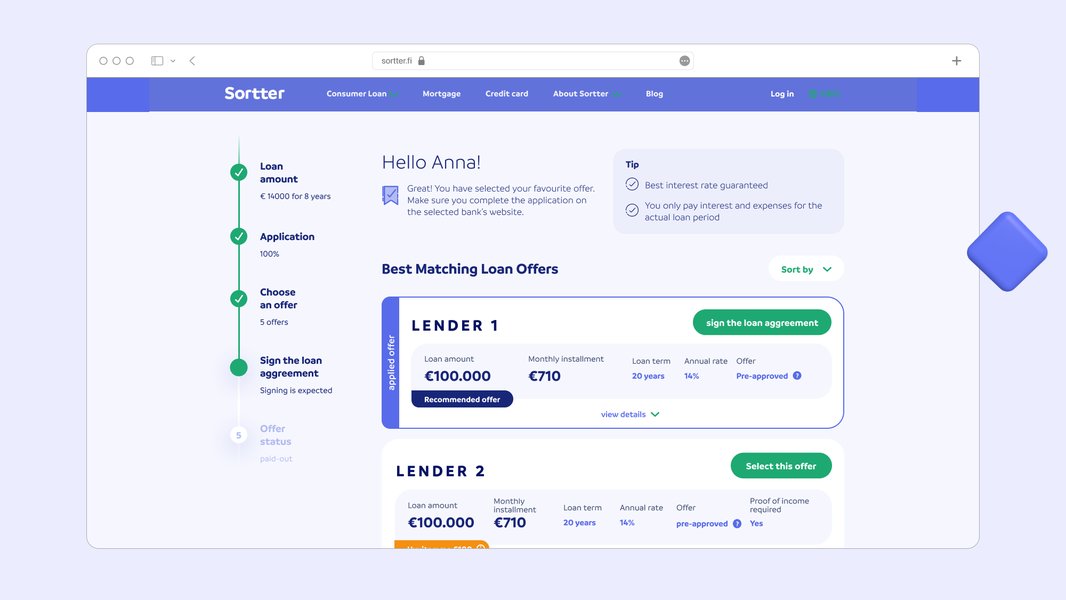
A glimpse into Sortter.fi's platform, where enhanced content can guide users through personalized loan offers.
Detailing the Loan Comparison Journey: Transparency and Methodology
Explaining "Fair Loan Comparison" (Reilu Lainavertailu)
Sortter.fi emphasizes its comprehensive and fair loan comparison. To bolster this for LLMs:
- Elaborate on Principles: Clearly articulate the "reilun lainavertailun periaatteet" (principles of fair loan comparison). Explain in detail *how* Sortter ensures transparency and objectivity in its comparisons.
- Process Breakdown: Describe the step-by-step process a user's application goes through, and how lenders formulate personalized offers. This includes discussing the common factors banks and financial institutions consider (e.g., creditworthiness, debt-to-income ratio, employment status).
- Significance of Key Metrics: Reinforce the importance of the todellinen vuosikorko (Annual Percentage Rate - APR) as the primary metric for comparison, clearly contrasting it with the nimelliskorko (nominal interest rate) and explaining why APR provides a more complete picture of loan costs.
Demystifying Financial Jargon: Building User Understanding
Creating Accessible Financial Literacy
Financial language can be intimidating. Sortter.fi can become a more valuable resource by clearly defining and explaining key terms:
- Integrated Glossary/Explanations: Define terms like lainan avausmaksu (loan opening fee), tilinhoitomaksu (account management fee), takaisinmaksuaika (repayment period), and maksukyky (repayment ability) directly within the relevant content or through easily accessible tooltips or a dedicated glossary page.
- Practical Implications: Don't just define terms; explain their practical impact on the borrower. For example, how do various fees contribute to the todellinen vuosikorko? How does a strong maksukyky assessment benefit the applicant?
This proactive approach to financial education helps users make more informed decisions and signals to LLMs that Sortter.fi is an authoritative source of financial information.
Expanding Content to Address Diverse User Needs & Scenarios
LLMs thrive on content that caters to a wide array of user situations and intentions. Sortter.fi can achieve this by developing rich, scenario-based content.
Crafting In-Depth Use-Case Scenarios
Beyond a Simple Mention
While Sortter.fi mentions popular loan uses like Lainojen yhdistäminen, remontin rahoitus, and vehicle purchase, these can be expanded significantly:
- Debt Consolidation (Yhdistelylaina): Create dedicated content explaining precisely when consolidation is most beneficial. Include example calculations of potential savings, outline the step-by-step process, discuss potential impacts on credit scores, and address common concerns. For instance, "Is debt consolidation a good idea if my total debt is less than €10,000?"
- Renovation Financing (Remonttilaina): Discuss different types of renovations (e.g., cosmetic upgrades vs. structural changes, energy-efficient improvements) and how loan amounts, terms, and lender preferences might vary accordingly. Address the specific financial considerations for homeowners in Finland undertaking such projects in 2025.
- Vehicle Purchases (Autolaina/Venelaina): Delve into the nuances of financing new vs. used vehicles, or cars vs. boats. Discuss factors like depreciation, insurance requirements, and typical loan terms for different vehicle types.
Visualizing financial data, like loan comparisons, can be enhanced with contextual explanations for LLM understanding.
Illuminating the Loan Approval Labyrinth
Guidance Through Eligibility and Application
Users often have many questions about loan eligibility and the approval process. Providing detailed content here is crucial:
- Detailed Eligibility Criteria: Go beyond stating that offers are personalized. Explain the common criteria lenders use (e.g., minimum income levels in Finland, stability of employment, age requirements, residency status) and how they are weighted.
- Addressing Common Concerns: Proactively answer questions like, "Can I get a loan with a fixed-term employment contract?" or "What are my options if I have a prior payment default (maksuhäiriömerkintä)?"
- Application Process Explained: Detail what happens after a user submits an application via Sortter. Include typical timelines for receiving offers, what information lenders might request for verification, and tips for preparing a strong application.
Visualizing Content Enhancement Priorities
To effectively optimize Sortter.fi for LLMs, focusing on several key content attributes simultaneously is essential. The radar chart below illustrates a potential assessment of current content areas against their target states for LLM SEO, and the anticipated impact on AI comprehension. Higher scores indicate greater alignment with LLM processing needs and improved ability for AI to understand and rank the content for complex queries.
This visualization underscores that improvement across all dimensions—from how naturally language flows to the depth of financial explanations and the clarity of user intent—contributes to making Sortter.fi's content more digestible and valuable for advanced AI systems.
Mapping the Path to LLM SEO Excellence
The journey to superior LLM SEO involves interconnected strategies that build upon each other. The mindmap below visualizes the key areas of focus for transforming Sortter.fi's content into a rich, authoritative, and AI-friendly resource. Each branch represents a critical component, from enriching specific content types to enhancing user experience and structural integrity.
for LLM SEO"] id1["Content Enrichment"] id1a["Detailed Loan Explanations
(e.g., Kulutusluotto, Yhdistelylaina)"] id1b["Clear Financial Terminology
(e.g., Todellinen vuosikorko, Nimelliskorko)"] id1c["Rich Use-Case Scenarios
(e.g., Remonttilaina for kitchen vs. general loan)"] id1d["Comparative Analysis & Insights
(Loan types, Lender offerings, Market context)"] id2["User-Centric Approach"] id2a["Natural, Conversational Language"] id2b["Directly Addressing User Intent & Pain Points
(Answering 'why', 'how', 'what if')"] id2c["Enhanced FAQ Sections as Mini-Guides"] id2d["Content Reflecting User Personas & Needs"] id3["Structural & Semantic Enhancements"] id3a["Strategic Internal Linking
(Connecting related concepts and pages)"] id3b["Logical Content Flow & Clear Navigation"] id3c["Consideration of Structured Data (Schema Markup)"] id3d["Incorporating Semantic Keyword Variations & Synonyms"] id4["Building Trust & Authority"] id4a["Incorporating Authentic User Testimonials & Case Studies"] id4b["Transparency in Processes
(e.g., Fair loan comparison principles explained)"] id4c["Highlighting Data Security & Regulatory Compliance (Finnish context)"] id4d["Contextual Information on Lending Partners (Types, Specializations)"] id5["Educational Content Hub (Blog & Guides)"] id5a["In-depth Articles on Financial Planning & Debt Management"] id5b["Comprehensive Guides to Finnish Loan Market & Regulations"] id5c["Explaining Current Economic Trends & Their Impact (e.g., interest rates in 2025)"]
This mindmap illustrates that LLM optimization is not a single task but a holistic strategy. By addressing these interconnected areas, Sortter.fi can create a web of highly relevant and contextually rich content that significantly improves its visibility and utility in AI-driven search environments.
Building Trust and Semantic Richness
Leveraging User Stories and Trust Signals
More Than Just Ratings
While ratings are good, LLMs can process narrative trust signals more effectively:
- Narrative Testimonials: Instead of just star ratings, feature short stories or quotes from users explaining *how* Sortter.fi helped them achieve a specific financial goal or overcome a challenge.
- Explain Trust Factors: Detail what contributes to Sortter's trustworthiness – perhaps its commitment to data security, adherence to Finnish financial regulations (e.g., supervision by the Financial Supervisory Authority - Finanssivalvonta, if applicable), or the transparency of its comparison model.
Powering Up Your Blog and Educational Resources
Becoming a Go-To Financial Hub
Sortter's blog is a prime candidate for LLM SEO enhancement:
- Deep-Dive Articles: Publish comprehensive articles that explore topics in detail. Examples: "A Finn's Guide to Navigating Interest Rate Changes in 2025," "Strategic Debt Management: Beyond Loan Consolidation," or "Understanding Your Credit Report in Finland and How It Affects Loan Applications."
- Answer Complex Questions: Use the blog to address nuanced financial questions that users might type into search engines, e.g., "What are the tax implications of different types of loans in Finland?" or "How can I improve my chances of getting a larger renovation loan?"
- Incorporate Natural Language and Semantic Variations: Write blog content in a natural, conversational style, using synonyms and related terms for financial concepts to improve LLM understanding.
Structuring for Success: Internal Linking and Navigational Clarity
Guiding Users and AI
A well-structured website with logical internal linking helps LLMs understand the relationships between different pieces of content, thereby grasping the overall topical authority of the site.
- Contextual Internal Links: Link relevant pages and blog posts together. For example, a page discussing Yhdistelylaina should link to blog posts about debt management strategies or understanding credit scores.
- Clear Information Hierarchy: Ensure that headings (H1, H2, H3, H4) are used logically to structure content, making it easy for both users and AI to follow the flow of information.
Practical Insights: Optimizing Existing Content
Understanding the theory behind LLM SEO is one part; applying it to existing content is another. The following video offers general strategies for optimizing content, which can be adapted to the specific context of enhancing financial information on Sortter.fi. It highlights the importance of updating and enriching what you already have to meet evolving search engine and user expectations.
This video provides valuable tips on how to approach the optimization of existing website content for better performance.
Key takeaways from such optimization processes often include identifying content gaps, refreshing outdated information (especially crucial in finance with changing rates and regulations as of May 2025), improving clarity, and ensuring the content thoroughly answers the questions users are likely to ask. For Sortter.fi, this means revisiting loan descriptions, financial guides, and comparison explanations to inject more depth, context, and natural language.
Strategic Content Enhancements for Sortter.fi
The table below summarizes key areas for content improvement on Sortter.fi, contrasting a typical current approach with an LLM-optimized strategy, and providing specific examples relevant to the Finnish financial context.
| Area of Improvement | Typical Current Approach (Inferred) | LLM-Optimized Strategy | Example for Sortter.fi |
|---|---|---|---|
| Loan Product Information | Lists loan types (e.g., Kulutusluotto) with basic features. | Detailed narratives covering use cases, pros/cons, influencing factors, target borrower profiles, and comparative benefits against alternatives. | Expanding the Remonttilaina page to detail eligible renovation types, average costs in Finland, potential value increase to property, and comparison with using savings or a line of credit. |
| Financial Terminology Explanation | Uses terms like todellinen vuosikorko assuming user familiarity or with brief definitions. | In-depth, clear explanations of financial terms, their components, practical implications for the borrower, and why they are important in decision-making. | An interactive guide or a detailed article explaining how todellinen vuosikorko is calculated, what fees it includes (e.g., avausmaksu, tilinhoitomaksu), and how it helps compare diverse loan offers accurately. |
| Addressing User Intent | Focus on the transaction: "Compare loans now." | Content comprehensively answers the 'why,' 'how,' 'what if,' and 'what's best for me' questions related to complex financial situations. | A blog post titled: "Navigating Debt Consolidation (Lainojen yhdistäminen): Is It the Right Step for Your 2025 Financial Goals in Finland?" addressing anxieties, processes, and outcomes. |
| Use-Case Specificity | Mentions general uses like "car purchase" or "home renovation." | Detailed scenarios exploring different facets of a use-case, addressing varied user circumstances and needs within that category. | A section on "Financing Your First Car vs. Upgrading Your Family Vehicle: Tailored Loan Insights for Finnish Buyers," discussing different loan structures, insurance considerations, and long-term costs. |
| Content Structure & Internal Linking | Standard website navigation with primary product pages. | Semantic internal linking creating a topical web, guiding users and AI through related concepts; narrative flow within and between pages; use of structured data. | Linking from a Yhdistelylaina page to articles on budgeting techniques, credit score (luottotiedot) improvement, and psychological benefits of debt reduction. |
| Information on Lending Partners | Mentions "over 20 lenders." | Provides general context about the types of lenders (e.g., traditional banks, digital lenders, specialized finance companies), their typical target customer or loan types, without endorsing specific ones. | A general overview: "Understanding the Finnish Lending Landscape: Who Provides Loans Through Sortter?" explaining the diversity of credit providers. |
Frequently Asked Questions (FAQ) for LLM SEO on Sortter.fi
Why is natural language crucial for LLM SEO on a financial website like Sortter.fi?
Natural language helps LLMs understand the content's meaning and intent, much like a human would. For a financial site like Sortter.fi, this means moving beyond jargon and transactional phrases. Using conversational, explanatory language to discuss complex topics like loan terms (e.g., "Mitä tarkoittaa todellinen vuosikorko käytännössä?") makes the information more accessible to users and more accurately interpretable by AI, leading to better matching for complex search queries.
How can Sortter.fi comprehensively cover financial topics without overwhelming users?
The key is structured depth. Sortter.fi can cover topics comprehensively by:
- Using clear headings and subheadings (H2, H3, H4) to break down complex information.
- Employing accordions or "read more" toggles for very detailed explanations.
- Starting with summaries or key takeaways, then offering deeper dives.
- Using visuals like charts and infographics to explain data.
- Linking to dedicated pages or blog posts for highly specific sub-topics.
What's the best way to address user intent for complex queries like "best loan for unexpected home repair in Finland"?
To address such intent, Sortter.fi should create content that directly tackles the scenario. This could be a blog post or a dedicated section within a relevant loan page (e.g., Remonttilaina or Kulutusluotto). The content should:
- Acknowledge the urgency and stress of unexpected repairs.
- Discuss suitable loan options, comparing their pros and cons in this specific context (e.g., speed of approval, flexibility, loan amounts).
- Explain factors to consider, like the size of the repair and current financial situation.
- Provide actionable advice on how to proceed with comparing offers through Sortter.fi.
How does enriching content with context benefit Sortter.fi in search rankings?
LLMs, which power modern search engines, are designed to understand context and relevance deeply. Rich contextual information (e.g., explaining *why* a certain loan is good for a specific situation, discussing current Finnish economic factors affecting loans as of May 2025, providing examples) signals to the AI that Sortter.fi possesses comprehensive knowledge and authority on the topic. This increases the likelihood of ranking for a broader range of complex, long-tail queries and being perceived as a trustworthy source, which are positive ranking factors.
Can providing too much detail be detrimental for LLM processing?
It's not about sheer volume, but relevance and structure. Unstructured, rambling text can be unhelpful. However, well-organized, detailed content that comprehensively covers a topic from multiple angles is highly beneficial for LLMs. The key is to ensure the detail is relevant to the user's potential queries and is presented in a clear, digestible manner. Using semantic HTML (headings, lists, tables) helps LLMs parse and understand the structure and importance of different content pieces. The goal is comprehensive clarity, not just length.
Recommended Next Steps & Further Exploration
To continue enhancing Sortter.fi's content for LLM SEO and user engagement, consider exploring these related areas:
- How can Sortter.fi integrate advanced schema markup to better inform LLMs about its financial products and services?
- What are the best practices for creating hyper-personalized content on Sortter.fi that addresses specific Finnish user financial scenarios in 2025?
- How can Sortter.fi utilize its blog to build topical authority around emerging financial trends in Finland relevant to loan comparison?
- What strategies can Sortter.fi employ to ensure its content remains up-to-date and accurate amidst fluctuating Finnish economic conditions and lending regulations?
References
The insights and recommendations provided are synthesized from best practices in LLM SEO and analyses of financial content strategy. For further reading and to understand the context of Sortter.fi, the following resources were considered:
Last updated May 7, 2025