
Infinite Shape, Finite Space? Unveiling the Volume of Rotated 1/x
Discover the surprising result when the curve y=1/x spins into infinity around the x-axis.
Calculating the volume of a solid formed by rotating a function around an axis is a fundamental concept in calculus, often revealing counterintuitive results. When the function \(y = 1/x\) is rotated around the x-axis over the infinite interval from \(x=1\) to \(x=\infty\), it generates a fascinating shape known as Gabriel's Horn or Torricelli's Trumpet. Let's explore how to find its volume.
Key Insights: The Surprising Calculus of Infinity
- Finite Volume from Infinite Reach: Despite the region under \(y=1/x\) extending infinitely along the x-axis, the volume of the solid generated by its rotation is remarkably finite.
- The Power of the Disk Method: The volume is calculated using the disk method for solids of revolution, which involves integrating the area of infinitesimally thin circular cross-sections.
- Gabriel's Horn Paradox: This solid famously possesses a finite volume (\(\pi\) cubic units) but an infinite surface area, challenging intuition about geometric properties.
Understanding Solids of Revolution and the Disk Method
From 2D Curves to 3D Shapes
A solid of revolution is a three-dimensional figure created by rotating a two-dimensional shape (a region bounded by curves) around a straight line, known as the axis of revolution. In this case, we are rotating the area under the curve \(y = 1/x\), bounded by the x-axis and the vertical line \(x=1\), around the x-axis itself.
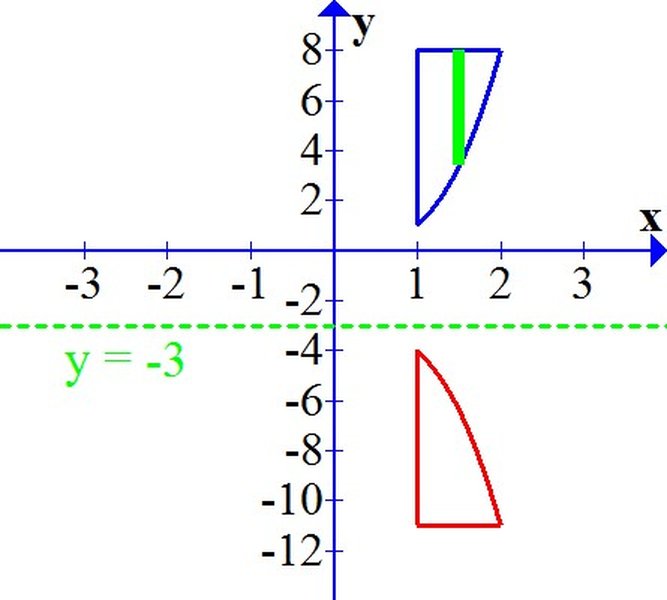
Visualizing the rotation of a region bounded by curves around an axis (y=3 in this example) to form a solid. Our case involves rotating the region under y=1/x around the x-axis from x=1 to infinity.
Slicing with the Disk Method
To calculate the volume of such a solid when rotating around the x-axis, the Disk Method is often employed. Imagine slicing the solid perpendicular to the axis of rotation (the x-axis) into an infinite number of infinitesimally thin disks. Each disk, at a position \(x\), has:
- A radius equal to the function's value at that point, \(r = f(x) = 1/x\).
- An infinitesimally small thickness, \(dx\).
The volume of one such disk (\(dV\)) is the area of its circular face (\(\pi r^2\)) multiplied by its thickness (\(dx\)):
\[ dV = \pi [f(x)]^2 \, dx \]To find the total volume (\(V\)), we sum the volumes of all these disks by integrating over the specified interval, from \(x=a\) to \(x=b\):
\[ V = \int_{a}^{b} \pi [f(x)]^2 \, dx \]Calculating the Volume: Step-by-Step Integration
Setting up the Integral
For our problem, the function is \(f(x) = 1/x\), the axis of rotation is the x-axis, and the interval is from \(x=1\) to \(x=\infty\). Plugging these into the Disk Method formula:
\[ V = \pi \int_{1}^{\infty} \left(\frac{1}{x}\right)^2 \, dx \] \[ V = \pi \int_{1}^{\infty} \frac{1}{x^2} \, dx \]Evaluating the Improper Integral
This is an improper integral because the upper limit of integration is infinity. We evaluate it using a limit:
\[ V = \pi \lim_{t \to \infty} \int_{1}^{t} \frac{1}{x^2} \, dx \]First, find the antiderivative of \(\frac{1}{x^2} = x^{-2}\) using the power rule for integration (\(\int x^n \, dx = \frac{x^{n+1}}{n+1} + C\)):
\[ \int x^{-2} \, dx = \frac{x^{-2+1}}{-2+1} + C = \frac{x^{-1}}{-1} + C = -\frac{1}{x} + C \]Now, evaluate the definite integral from 1 to \(t\):
\[ \int_{1}^{t} \frac{1}{x^2} \, dx = \left[ -\frac{1}{x} \right]_{1}^{t} = \left( -\frac{1}{t} \right) - \left( -\frac{1}{1} \right) = -\frac{1}{t} + 1 = 1 - \frac{1}{t} \]Finally, take the limit as \(t\) approaches infinity:
\[ V = \pi \lim_{t \to \infty} \left( 1 - \frac{1}{t} \right) \]As \(t \to \infty\), the term \(\frac{1}{t}\) approaches 0. Therefore:
\[ V = \pi (1 - 0) = \pi \]The Result: A Finite Volume
The calculation shows that the volume of the solid generated by rotating \(y = 1/x\) around the x-axis from \(x=1\) to infinity is exactly \(\pi\) cubic units.
Gabriel's Horn: The Infinite Paradox
The solid we've calculated the volume for is famously known as Gabriel's Horn or Torricelli's Trumpet. It's renowned for its paradoxical properties:
- Finite Volume: As we calculated, the volume is \(\pi\). You could theoretically fill the horn with \(\pi\) cubic units of paint.
- Infinite Surface Area: Calculating the surface area involves a different integral, \(\int_{1}^{\infty} 2\pi f(x) \sqrt{1 + [f'(x)]^2} \, dx\), which for \(f(x)=1/x\) diverges to infinity. This means you would need an infinite amount of paint to cover its surface!
- Infinite Base Area: The 2D area under the curve \(y=1/x\) from \(x=1\) to \(\infty\), which forms the "base" region before rotation, is also infinite. This is because the integral \(\int_{1}^{\infty} \frac{1}{x} \, dx = [\ln|x|]_{1}^{\infty} = \infty - 0 = \infty\).
Why does this happen? The volume calculation involves integrating \(\frac{1}{x^2}\), while the area calculation involves integrating \(\frac{1}{x}\). The function \(\frac{1}{x^2}\) decreases towards zero much faster than \(\frac{1}{x}\) as \(x\) increases. This faster decrease allows the sum of the volumes of the infinitesimally thin disks to converge to a finite value (\(\pi\)), even though the sum of the areas under the original curve (and the surface area generated) diverges.
Comparing Relevant Integrals
The table below highlights the difference in convergence between the integrals related to the area under the curve and the volume of revolution for \(y=1/x\) from \(x=1\) to \(\infty\).
| Integral | Function Being Integrated | Interval | Convergence | Result | Interpretation |
|---|---|---|---|---|---|
| \(\int_{1}^{\infty} \frac{1}{x} \, dx\) | \(1/x\) | \([1, \infty)\) | Diverges | \(\infty\) | Area under the curve \(y=1/x\) |
| \(\pi \int_{1}^{\infty} \left(\frac{1}{x}\right)^2 \, dx\) | \(\pi/x^2\) | \([1, \infty)\) | Converges | \(\pi\) | Volume of revolution (Disk Method) |
| \( \int_{1}^{\infty} 2\pi \frac{1}{x} \sqrt{1 + \left(-\frac{1}{x^2}\right)^2} \, dx \) | \( \frac{2\pi}{x} \sqrt{1 + \frac{1}{x^4}} \) | \([1, \infty)\) | Diverges | \(\infty\) | Surface area of revolution |
Visualizing the Paradox: Properties Compared
The radar chart below conceptually illustrates the contrasting magnitudes of the area under the curve, the volume of the solid of revolution, and its surface area for \(y = 1/x\) from \(x=1\) to infinity. "High" represents an infinite quantity, while "Low" represents the finite volume.
This chart highlights the core paradox: while the volume is finite (represented conceptually lower), the area under the curve and the surface area of the resulting solid are both infinite (represented conceptually higher).
Conceptual Summary: Mindmap
This mindmap provides a visual overview of the key concepts and steps involved in finding the volume of Gabriel's Horn.
y=1/x rotated around x-axis
(x=1 to infinity)"] id1["Method Used"] id1_1["Disk Method"] id1_1_1["Slice solid into thin disks"] id1_1_2["Disk radius r = f(x) = 1/x"] id1_1_3["Disk volume dV = π * r^2 * dx"] id2["Formula"] id2_1["V = π ∫[f(x)]² dx"] id2_2["V = π ∫(1/x)² dx from 1 to ∞"] id2_3["V = π ∫(1/x²) dx from 1 to ∞"] id3["Calculation"] id3_1["Improper Integral"] id3_1_1["Use limit: lim(t→∞) ∫(1 to t)"] id3_2["Antiderivative of 1/x² is -1/x"] id3_3["Evaluate limit: π * lim(t→∞) [-1/x] from 1 to t"] id3_4["π * lim(t→∞) (-1/t - (-1/1))"] id3_5["π * (0 + 1)"] id4["Result"] id4_1["Volume V = π"] id4_2["Finite Volume"] id5["The Paradox: Gabriel's Horn"] id5_1["Finite Volume (π)"] id5_2["Infinite Surface Area"] id5_3["Infinite Area under y=1/x"] id5_4["Contrast: ∫(1/x²) converges, ∫(1/x) diverges"]
Visual Explanation: Video
For a deeper dive into the calculation involving improper integrals for this specific type of volume of revolution problem, the following video provides a focused explanation:
Video discussing the improper integral for the volume of revolution of 1/x from 1 to infinity.
This video directly addresses the core mathematical step: evaluating the improper integral \(\int_{1}^{\infty} \frac{1}{x^2} dx\), which is crucial for determining the finite volume of Gabriel's Horn. It reinforces the calculation steps shown above.
Frequently Asked Questions (FAQ)
Why is the volume finite when the shape extends to infinity?
The volume is finite because the cross-sectional areas of the disks decrease rapidly enough as \(x\) goes to infinity. The volume calculation depends on the integral of \((1/x)^2 = 1/x^2\). The integral \(\int_{1}^{\infty} \frac{1}{x^2} dx\) converges (equals 1), meaning the sum of the infinitesimally small disk volumes adds up to a finite number (\(\pi \times 1 = \pi\)). Even though the horn is infinitely long, it gets incredibly thin very quickly, squeezing the volume contribution from large \(x\) values towards zero fast enough for the total volume to be finite.
How can the surface area be infinite if the volume is finite?
This is the central paradox of Gabriel's Horn. While the volume integral \(\pi \int (1/x^2) dx\) converges, the surface area integral \(2\pi \int (1/x)\sqrt{1 + (1/x^4)} dx\) behaves more like \(\int (1/x) dx\), which diverges. Intuitively, as the horn stretches out, the contribution to volume (related to radius squared) diminishes faster than the contribution to surface area (related more closely to the radius itself). Think of it like trying to wrap an infinitely long but rapidly thinning thread – the volume it occupies might be small, but its length (analogous to surface area here) is infinite.
What method is used to calculate this volume?
The volume is calculated using the Disk Method for solids of revolution. This method is suitable when rotating a function \(y=f(x)\) around the x-axis. It involves integrating the area of circular disks (\(\pi [f(x)]^2\)) along the axis of rotation (\(dx\)).
What happens if you rotate y=1/x around the y-axis instead?
Rotating \(y=1/x\) (or \(x=1/y\)) around the y-axis from \(x=1\) to \(x=\infty\) (which corresponds to \(y=1\) down to \(y=0\)) requires a different method, typically the Shell Method or rewriting the integral with respect to \(y\) using the Disk Method. If using the Shell Method around the y-axis for the region under \(y=1/x\) from \(x=1\) to \(\infty\), the integral would be \(V = \int_{1}^{\infty} 2\pi x f(x) dx = \int_{1}^{\infty} 2\pi x (1/x) dx = \int_{1}^{\infty} 2\pi dx\). This integral clearly diverges to infinity, meaning the volume generated by rotating this specific region around the y-axis is infinite.
Recommended Reading
- How do you calculate the infinite surface area of Gabriel's Horn?
- When should you use the Disk method versus the Shell method for volumes of revolution?
- What are other examples of convergent and divergent improper integrals in calculus?
- Where are solids of revolution applied in engineering and physics?
References
Last updated May 4, 2025