

Having a BSEE background gives you a significant advantage in tackling Maxwell's equations, even after a 40-year hiatus. Your engineering intuition and foundational understanding will accelerate your learning process. The key to fully grasping these fundamental equations of electromagnetism lies in a robust re-acquaintance with specific mathematical concepts, primarily vector calculus, alongside an understanding of differential equations and linear algebra. This curriculum is meticulously designed to leverage your existing knowledge, streamline your learning, and guide you to a comprehensive understanding within a condensed timeframe.
Key Insights for Your Accelerated Journey
- Vector Calculus is Paramount: The heart of Maxwell's equations lies in vector calculus. Concepts like gradients, divergences, curls, line integrals, surface integrals, and volume integrals are non-negotiable and will be your primary focus.
- Leverage Your BSEE Foundation: Your prior engineering education means you're not starting from scratch. Expect to progress faster than a complete beginner, as many concepts will trigger dormant memories and intuitions.
- Structured and Iterative Learning: This curriculum emphasizes a phased approach, starting with math refreshers and progressively integrating electromagnetic theory. Consistent practice and problem-solving are crucial for cementing understanding.
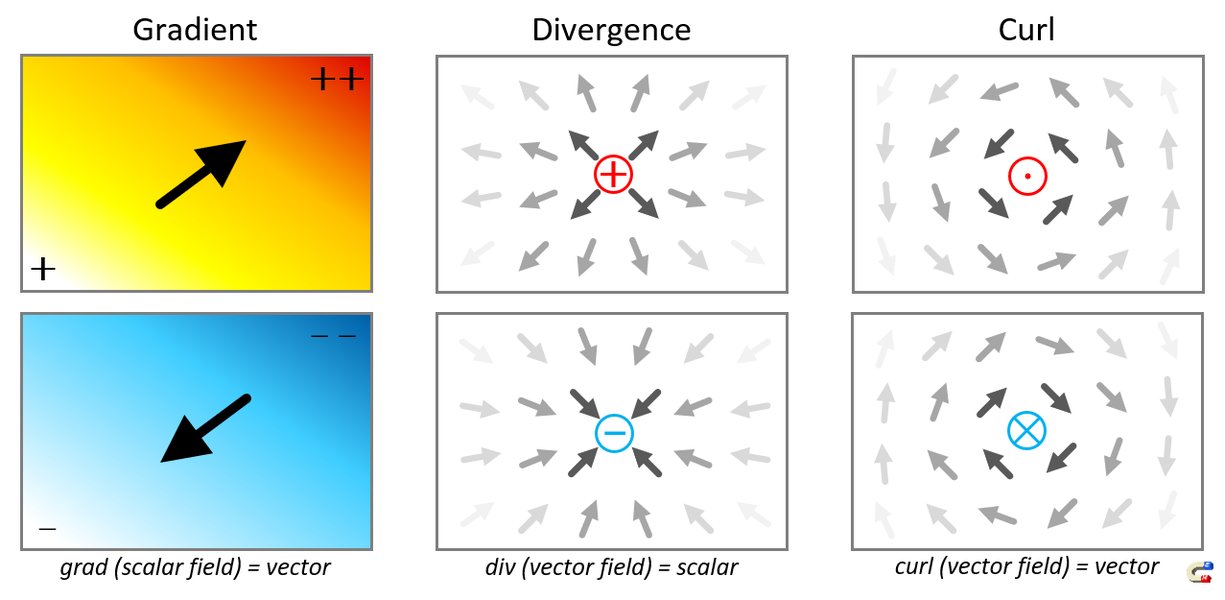
Figure 1: Visualizing the fundamental vector operations: gradient, divergence, and curl. These are critical for interpreting Maxwell's equations.
The Foundational Pillars of Mathematical Mastery
To truly understand Maxwell's equations, a solid grasp of several mathematical domains is indispensable. These form the bedrock upon which the elegant structure of electromagnetism is built. We will systematically revisit and reinforce these areas, focusing on their direct relevance to electromagnetic theory.
Vector Calculus: The Language of Fields
Vector calculus is, without a doubt, the most critical mathematical prerequisite. Maxwell's equations are inherently vector equations, describing how electric and magnetic fields behave in three-dimensional space. Understanding the operators and theorems of vector calculus is not just about computation; it's about intuitively grasping the physical phenomena these equations represent.
Gradients, Divergences, and Curls: Decoding Field Behavior
- Gradient (\(\nabla\phi\)): Describes the rate and direction of the fastest change of a scalar field. In electromagnetism, it helps us understand how potential (a scalar) relates to electric field (a vector).
- Divergence (\(\nabla \cdot \mathbf{E}\)): Measures the "outwardness" or "flux density" of a vector field from a point. For electric fields, it directly relates to the presence of electric charges (Gauss's Law).
- Curl (\(\nabla \times \mathbf{B}\)): Quantifies the "rotation" or "circulation" of a vector field. For magnetic fields, it relates to electric currents and changing electric fields (Ampere-Maxwell Law), and for electric fields, to changing magnetic fields (Faraday's Law).
Line, Surface, and Volume Integrals: Quantifying Field Interactions
Maxwell's equations exist in both differential and integral forms. The integral forms require a strong understanding of how to sum up field quantities over paths, surfaces, and volumes.
- Line Integrals (\(\int \mathbf{F} \cdot d\mathbf{l}\)): Used to calculate work done by a force field along a path, or voltage around a closed loop in Faraday's Law.
- Surface Integrals (\(\iint \mathbf{F} \cdot d\mathbf{S}\)): Essential for calculating flux, such as electric flux through a closed surface (Gauss's Law) or magnetic flux.
- Volume Integrals (\(\iiint \rho \, dV\)): Used to calculate total charge or charge density within a given volume.
Fundamental Theorems: Bridging Differential and Integral Forms
The bridge between the differential and integral forms of Maxwell's equations is forged by integral theorems:
- Divergence Theorem (Gauss's Theorem): Relates the flux of a vector field out of a closed surface to the divergence of the field within the volume enclosed by the surface. This is directly applied in Gauss's laws.
- Stokes' Theorem: Connects the circulation of a vector field around a closed loop to the curl of the field over any surface bounded by that loop. This is critical for understanding Faraday's and Ampere-Maxwell's laws.
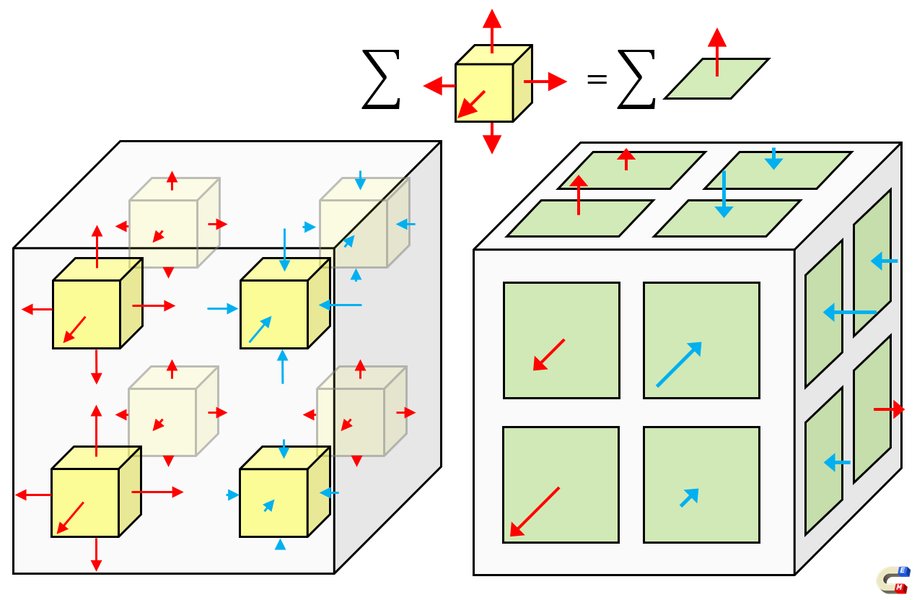
Figure 2: Gauss's Divergence Theorem, illustrating the relationship between flux across a closed surface and the divergence of a vector field within the enclosed volume.
Differential Equations: Dynamics of Electromagnetic Fields
Many phenomena described by Maxwell's equations, particularly time-varying fields and wave propagation, are inherently governed by differential equations. An understanding of Ordinary Differential Equations (ODEs) and an introduction to Partial Differential Equations (PDEs) are beneficial.
- First and Second-Order ODEs: Crucial for understanding circuits and simple resonant systems where fields change over time.
- Partial Differential Equations (PDEs): Maxwell's equations themselves are a set of first-order PDEs. Understanding concepts like the wave equation (which can be derived from Maxwell's) and Poisson's/Laplace's equations (for electrostatic potentials) is key.
Linear Algebra: Structure and Transformations
While not as immediately central as vector calculus, linear algebra provides a powerful framework for understanding vector spaces, transformations, and coordinate systems, which are relevant for advanced topics in electromagnetism and field analysis.
- Vectors and Matrices: Essential for representing fields and applying transformations.
- Eigenvalues and Eigenvectors: Useful in understanding natural modes and properties of systems, though less directly applied in a foundational study of Maxwell's equations.
Your Accelerated Learning Curriculum: Under 6 Months
This curriculum is designed for approximately 10-15 hours per week of dedicated study. With your BSEE background, you may accelerate through some sections faster, potentially completing the core understanding in 3-4 months. The key is consistent engagement and practical application.
Phase 1: Math Foundations Refresher (Weeks 1-4)
This phase is about reactivating your calculus knowledge, specifically targeting the vector calculus concepts essential for electromagnetism.
Week 1: Single-Variable Calculus Review & Vector Basics
Re-familiarize yourself with derivatives and integrals, then dive into the fundamentals of vectors in 2D and 3D. Your goal is to be comfortable with vector addition, subtraction, dot products, and cross products.
- Topics: Limits, Derivatives, Integrals (basic techniques), Scalars, Vectors, Vector addition/subtraction, Dot product, Cross product.
- Resources: Khan Academy Calculus 1 & Multivariable Calculus (Vectors section), Paul's Online Math Notes.
- Milestone: Compute vector operations accurately; understand their geometric interpretations.
Weeks 2-3: Multivariable Calculus: Gradient, Divergence, Curl
This is where the magic begins. Focus intensely on understanding what gradient, divergence, and curl physically represent and how to compute them for various fields.
- Topics: Partial derivatives, Directional derivatives, Gradient (∇φ), Divergence (∇·F), Curl (∇×F), Vector fields.
- Resources: MIT OpenCourseWare 18.02 (Lectures 1-10), "Div, Grad, Curl, and All That" by H. M. Schey (Chapters 1-3 for intuition), 3Blue1Brown "Essence of Multivariable Calculus".
- Milestone: Correctly calculate gradient, divergence, and curl for given scalar and vector fields; articulate their physical meaning (e.g., source for divergence, rotation for curl).
Week 4: Integral Theorems: Line, Surface, Volume
Understand how integrals relate to field quantities and how the fundamental theorems connect these integrals to the differential operators.
- Topics: Line integrals, Surface integrals, Volume integrals, Divergence Theorem (Gauss's Theorem), Stokes' Theorem.
- Resources: MIT OpenCourseWare 18.02 (Lectures 16-22), Khan Academy (Line & Surface Integrals), "Vector Calculus" by Marsden (Chapters 5-6).
- Milestone: Apply integral theorems to simple cases; convert between differential and integral forms of basic field equations.
Phase 2: Introducing Maxwell's Equations (Weeks 5-8)
With your revitalized mathematical toolkit, it's time to integrate these concepts directly into understanding Maxwell's equations.
Weeks 5-6: Gauss's Laws and Faraday's Law
Focus on the first three of Maxwell's equations, understanding their physical meaning and how they are expressed using divergence, curl, and integral forms.
- Topics: Gauss's Law for Electric Fields (\(\nabla \cdot \mathbf{D} = \rho\)), Gauss's Law for Magnetic Fields (\(\nabla \cdot \mathbf{B} = 0\)), Faraday's Law of Induction (\(\nabla \times \mathbf{E} = -\frac{\partial \mathbf{B}}{\partial t}\)). Physical interpretation of each law, differential vs. integral forms.
- Resources: "A Student's Guide to Maxwell's Equations" by Daniel Fleisch (essential for clear explanations), HyperPhysics.
- Milestone: State and explain Gauss's laws and Faraday's law in both differential and integral forms; solve simple problems applying these laws (e.g., electric field of a sphere, induced EMF in a loop).
Weeks 7-8: Ampere-Maxwell Law & Synthesis
Complete the set of Maxwell's equations by tackling the Ampere-Maxwell law, especially the crucial displacement current term, and begin to see how all four equations form a coherent system.
- Topics: Ampere-Maxwell Law (\(\nabla \times \mathbf{H} = \mathbf{J} + \frac{\partial \mathbf{D}}{\partial t}\)), Displacement current, Continuity equation, The complete set of Maxwell's equations in vacuum and material media.
- Resources: MITx 8.02.3x "Electricity & Magnetism: Maxwell's Equations" (Modules 1-3), "Introduction to Electrodynamics" by David J. Griffiths (Chapters 7-9 for depth).
- Milestone: State and explain all four Maxwell's equations; identify the role of each term; understand why the displacement current was necessary.
Phase 3: Applications and Deeper Understanding (Weeks 9-12)
This phase focuses on applying Maxwell's equations, understanding their consequences, and exploring their implications, such as the derivation of electromagnetic waves.
Weeks 9-10: Electromagnetism Theory & Boundary Conditions
Examine the physical implications of Maxwell's equations in various scenarios, including the behavior of fields at interfaces between different materials.
- Topics: Physical interpretation of Maxwell's equations (E from charges, B from currents/changing E), Constitutive relations (\(\mathbf{D} = \epsilon \mathbf{E}\), \(\mathbf{B} = \mu \mathbf{H}\)), Boundary conditions for E and B fields at interfaces, Poynting vector for energy flow.
- Resources: "Introduction to Electrodynamics" by David J. Griffiths (Chapters 2-6), MIT 8.02 lectures (if supplementing with videos).
- Milestone: Solve problems involving boundary conditions; calculate energy flow using the Poynting vector for simple configurations.
Weeks 11-12: Electromagnetic Waves
One of the most profound consequences of Maxwell's equations is the prediction of electromagnetic waves. This section delves into their derivation and properties.
- Topics: Derivation of the wave equation from Maxwell's equations in free space, Plane waves, Speed of light (c), Wave impedance, Introduction to reflection and transmission.
- Resources: "Field and Wave Electromagnetics" by David K. Cheng (Chapters 2-4), MITx 8.02.3x (Modules on waves).
- Milestone: Derive the wave equation from Maxwell's equations; understand the properties of plane waves and the relationship between E and B in a propagating wave.
Figure 4: A mind map illustrating the interconnected topics within the learning curriculum for mastering Maxwell's equations. It categorizes the journey from foundational mathematics through to the applications and deeper insights of electromagnetism.
Phase 4: Consolidation, Advanced Topics, and Problem Solving (Weeks 13-16, Optional for deeper dive)
This phase is for reinforcing your understanding, tackling more complex problems, and exploring numerical or advanced conceptual aspects if time permits or interest arises.
Weeks 13-14: Problem Solving & Intuition Development
Work through numerous problems from textbooks to solidify your understanding. Focus on both analytical solutions and developing strong physical intuition for electromagnetic phenomena.
- Activities: Extensive problem sets from texts like Griffiths or Purcell, cross-referencing mathematical derivations with physical explanations.
- Resources: Textbooks, Physics Stack Exchange (for conceptual questions), MIT OpenCourseWare problem sets.
- Milestone: Confidently solve a wide range of problems involving Maxwell's equations in different contexts (e.g., electrostatics, magnetostatics, time-varying fields).
Weeks 15-16: Introduction to Numerical Methods & Advanced Concepts (Optional)
If you have extra time or a specific interest, briefly explore how Maxwell's equations are solved numerically or delve into more advanced theoretical aspects.
- Topics: Finite-Difference Time-Domain (FDTD) method (conceptual overview), Maxwell's equations in relativistic form (brief exposure), guided waves (waveguides).
- Resources: Forn PDF on Numerical Techniques for Maxwell’s Equations, Feynman Lectures on Physics Vol. II (Chapters 18 and 20 for deep conceptual understanding).
- Milestone: Understand the basic principle of FDTD; appreciate the relativistic invariance of Maxwell's equations.
Essential Resources for Your Journey
A blend of textbooks, online courses, and video lectures will provide a comprehensive learning environment.
| Resource Type | Recommendation | Why It's Useful |
|---|---|---|
| Intuitive Math Text | "Div, Grad, Curl, and All That: An Introduction to Vector Analysis" by H. M. Schey | Excellent for building an intuitive understanding of vector calculus, directly applicable to EM. |
| Maxwell's Guide | "A Student's Guide to Maxwell's Equations" by Daniel Fleisch | Specifically designed to bridge the gap between math and physics, with clear derivations and explanations. |
| Comprehensive EM Text | "Introduction to Electrodynamics" by David J. Griffiths | A standard undergraduate textbook, known for its clear explanations and comprehensive problem sets. |
| Multivariable Calculus Course | MIT OpenCourseWare 18.02 Multivariable Calculus | Free access to lectures, notes, and problem sets from a top university course. |
| Electromagnetism Online Course | MITx Online: Electricity & Magnetism: Maxwell's Equations (8.02.3x) | Structured course focusing on applying vector calculus to Maxwell's equations. |
| Conceptual Videos | 3Blue1Brown "Essence of Calculus" and "Essence of Multivariable Calculus" | Offers powerful visual intuition for complex mathematical concepts. |
| Quick Reference | HyperPhysics: Maxwell's Equations | Concise summaries and conceptual overviews for quick review. |
| Problem Practice | Paul's Online Math Notes (Vector Calculus section) | A rich source of practice problems with solutions. |
Table 1: Key resources for mathematical and electromagnetic studies.
Visualizing Maxwell's Equations: An Introductory Look
Understanding Maxwell's equations goes beyond the mathematical symbols; it involves visualizing the dynamic interplay of electric and magnetic fields. This video serves as an excellent introduction, breaking down the core concepts in an accessible way, which is perfect for reactivating your foundational knowledge before diving deeper into the mathematical rigor.
Video 1: Introduction to Maxwell's Equations, Electric & Magnetic Fields. This video provides an accessible overview of the concepts that underpin Maxwell's equations, offering a visual and intuitive starting point for your relearning journey.
This "Intro to Maxwell's Equations, Electric & Magnetic Fields" video is particularly relevant as it provides a high-level conceptual overview that can help you reconnect with the fundamental ideas before diving into the mathematical details. It touches upon the essence of how electric and magnetic fields are generated and interact, setting the stage for understanding the mathematical formulations you will be mastering.
Frequently Asked Questions
What is the most crucial math topic for Maxwell's equations?
Can I truly learn this in under 6 months with a 40-year gap?
What if I get stuck on a particular concept?
Should I focus on differential or integral forms first?
Are there any practical tools I can use for learning?
Conclusion
Your journey to fully understand Maxwell's equations, even after a significant time away, is an achievable and rewarding endeavor. By systematically refreshing your vector calculus, differential equations, and linear algebra, and then methodically integrating these mathematical tools with the core principles of electromagnetism, you will unlock a deeper appreciation for these profound equations. Your BSEE background provides a strong foundation, making this accelerated curriculum both practical and highly effective. Embrace the challenge, engage with the material consistently, and prepare to reconnect with one of the most elegant theories in physics and engineering.
Recommended Further Exploration
- Advanced applications of Maxwell's equations in modern technology
- History and impact of Maxwell's contributions to electromagnetism
- Introduction to computational electromagnetics and numerical methods
- Relativistic formulation of Maxwell's equations and spacetime