
Unlock Peak Efficiency: Your In-Depth Guide to Modern Self-Storage Software
Discover how these powerful tools revolutionize facility management, from tenant onboarding to automated payments and beyond.
Self-storage software has become an indispensable asset for operators in today's competitive market, transforming how facilities are managed. This guide delves into the intricacies of these sophisticated systems, exploring their operational mechanisms, key features, payment processing capabilities, and the multitude of other benefits they bring to the self-storage industry. As of May 08, 2025, these platforms are more advanced than ever, offering comprehensive solutions to streamline every facet of facility management.
Key Insights at a Glance
- Centralized Operations: Self-storage software acts as a unified hub, bringing together tenant management, unit inventory, billing, access control, and reporting into a single, accessible platform.
- Automation Powerhouse: A primary strength lies in automating routine tasks such as invoicing, payment reminders, online bookings, and even dynamic pricing adjustments, freeing up valuable staff time.
- Enhanced Tenant Experience: Modern software often includes online portals for tenants to manage their accounts, make payments, and reserve units, significantly improving customer convenience and satisfaction.
The Core Mechanism: How Self-Storage Software Works
Digital Transformation for Storage Facilities
Self-storage software fundamentally operates as a specialized property management system (PMS) tailored to the unique needs of the self-storage industry. Its core mechanism revolves around the centralization of data and the automation of processes. Instead of relying on disparate manual systems like paper ledgers or spreadsheets, this software provides a digital infrastructure to handle all aspects of facility operation. It typically employs a robust database to store and manage vast amounts of information, including detailed tenant records, lease agreements, unit availability, occupancy status, payment histories, and maintenance logs. This centralized database ensures that all information is up-to-date and readily accessible to authorized personnel, fostering consistency and reducing the likelihood of errors associated with manual data entry.
Most contemporary self-storage software solutions are cloud-based. This architectural choice offers significant advantages, including remote accessibility, meaning managers can oversee operations from virtually anywhere with an internet connection, using desktops, tablets, or smartphones. Cloud hosting also facilitates automatic software updates, ensuring the system remains current with the latest features and security patches without requiring manual intervention from the facility staff. Furthermore, data backup and disaster recovery are typically managed by the provider, enhancing data security and business continuity. The software integrates various modules—such as tenant management, billing, access control, and reporting—into a cohesive system. Algorithms within the software automate workflows, such as sending out rent reminders, processing recurring payments, flagging delinquent accounts, and managing gate access based on payment status. This interconnectedness allows for a seamless flow of information and automated actions, which significantly enhances operational efficiency.
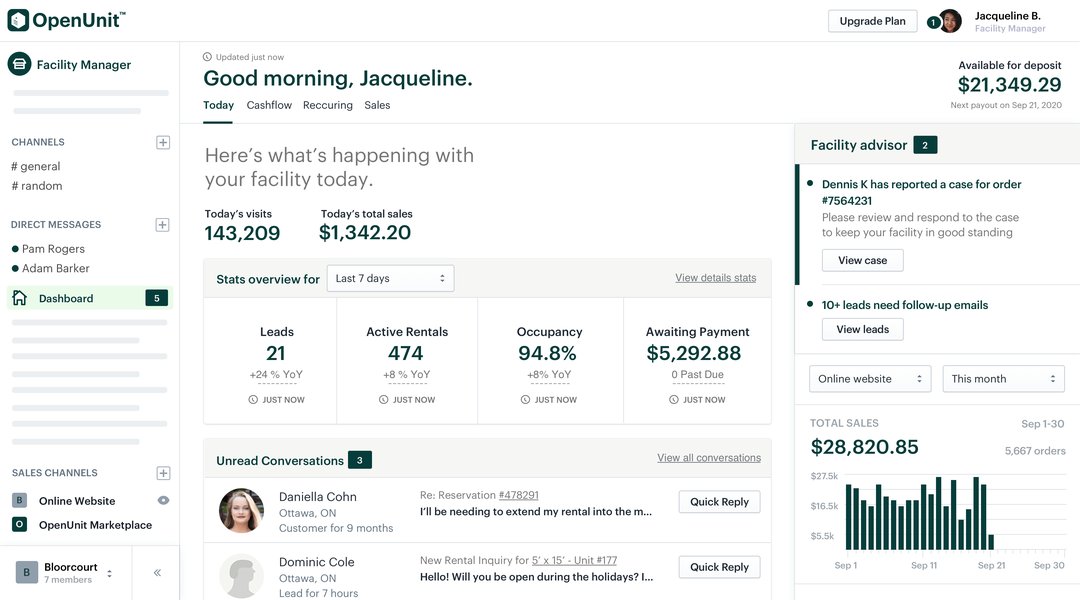
An example of a modern self-storage software dashboard, showcasing key operational metrics and navigation options.
Unpacking the Major Features
Modern self-storage software is equipped with a diverse array of features designed to address every conceivable aspect of facility management, thereby optimizing operations and elevating the tenant experience.
Comprehensive Tenant and Unit Management
At the heart of any self-storage software is its tenant management module. This allows for the meticulous recording and organization of all tenant-related information, including contact details, lease agreements, communication logs, and payment histories. Unit management capabilities are equally crucial, providing an up-to-date inventory of all storage units, their sizes, types, rental rates, and current availability status. Many systems feature interactive site maps that offer a visual representation of the facility, allowing managers to quickly identify vacant units, assign spaces, or schedule maintenance for specific units. This centralized database of tenant and unit information is critical for efficient day-to-day operations, enabling staff to quickly access records and respond to inquiries.
Seamless Online Rentals and Bookings
A significant feature is the ability to facilitate online rentals and reservations. Prospective tenants can browse available units, compare sizes and prices, complete rental agreements, and make initial payments directly through the facility's website or a dedicated online portal, often 24/7. This not only offers immense convenience to customers, allowing them to secure a unit without needing to visit the facility in person or call during business hours, but also streamlines the onboarding process for facility managers and can significantly boost occupancy rates by capturing leads at any time.
Automated Payment Systems
Streamlining Financial Transactions
Automated payment processing is a cornerstone feature that dramatically reduces administrative burdens and improves cash flow. The software typically integrates with various secure payment gateways to accept a multitude of payment methods, including credit/debit cards, ACH bank transfers, and sometimes even mobile wallets. Tenants can often set up recurring auto-payments, ensuring timely rent collection and minimizing late payments. The system automates the entire billing cycle, from generating and sending invoices to processing payments and issuing receipts. For overdue accounts, the software can automatically send reminders and apply pre-defined late fees according to the facility's policies.
Integrated Access Control
Many self-storage software platforms offer integration with electronic gate systems, keypads, and smart locks. This allows for automated access control based on a tenant's payment status. For instance, if a tenant is up-to-date with their payments, their unique access code will grant them entry. If an account becomes delinquent, access can be automatically restricted until the balance is settled. This feature enhances security by providing a detailed log of who enters and exits the facility and when, while also automating a critical aspect of collections.
Robust Reporting and Analytics
Self-storage software provides powerful reporting and analytics tools, offering valuable insights into key performance indicators (KPIs). Managers can generate reports on occupancy rates, revenue trends, delinquency rates, average rental duration, tenant demographics, and marketing effectiveness. These data-driven insights are invaluable for informed decision-making, helping operators identify areas for improvement, optimize pricing strategies, and understand their customer base better. Some advanced systems even offer predictive analytics to forecast demand.
Dynamic Pricing and Revenue Management
More sophisticated software solutions incorporate dynamic pricing capabilities. These tools analyze factors such as unit availability, local market conditions, competitor pricing, and historical demand patterns to recommend or automatically adjust rental rates. The goal is to maximize revenue by charging optimal prices—potentially increasing rates during peak demand and offering promotions during slower periods. This proactive approach to pricing can significantly impact a facility's profitability.
Maintenance Management
To ensure the facility remains in good condition, many software platforms include modules for tracking maintenance requests and scheduling work orders. Staff can log issues, such as a broken door latch or a light needing replacement, assign tasks to maintenance personnel or external vendors, track progress, and maintain a history of repairs. Some systems allow for photo or video attachments to better document issues. This organized approach to maintenance helps prolong the life of facility assets and ensures a safe and pleasant environment for tenants.
Inside the Payment Process: Secure and Automated
The payment process within self-storage software is meticulously designed for efficiency, security, and tenant convenience. As mentioned, automation is key. The software typically handles recurring billing by automatically generating invoices on scheduled dates and, if authorized by the tenant, processing payments using stored payment information. This automation drastically reduces the manual labor involved in sending out paper invoices, tracking payments, and making collection calls. It ensures a consistent and predictable revenue stream for the facility.
Security is paramount in payment processing. Reputable self-storage software providers ensure their payment modules are PCI (Payment Card Industry Data Security Standard) compliant. This means they adhere to strict security protocols to protect sensitive financial data, such as credit card numbers, during transmission and storage. Transactions are typically processed through secure, encrypted payment gateways, minimizing the risk of data breaches. Tenants benefit from multiple payment options, often including an online tenant portal where they can view their balance, make one-time payments, update their payment methods, and enroll in autopay. This self-service capability not only empowers tenants but also reduces the workload on facility staff. In the event of failed payments or delinquencies, the system can automatically trigger a series_of actions, such as sending payment reminders via email or SMS, applying late fees as per the lease agreement, and, if integrated, restricting gate access.
Visualizing Software Priorities: A Comparative Radar Chart
When selecting self-storage software, facility operators often weigh various factors. The radar chart below offers a visual comparison of hypothetical software solutions based on common evaluation criteria. This is an illustrative example to show how different platforms might excel in different areas. "Solution Alpha" might be a robust, feature-rich platform, while "Solution Beta" could be more focused on user-friendliness and affordability, and "Solution Gamma" might offer strong scalability for multi-facility operators.
This chart helps illustrate that the "best" software depends on a facility's specific needs and priorities. For instance, a large enterprise with multiple locations (Solution Alpha) might prioritize scalability and a comprehensive feature set, while a smaller, single-site operator (Solution Beta) might value ease of use and affordability more highly. A growing business (Solution Gamma) might seek a balance of scalability and strong customer support.
Beyond the Basics: Additional Valuable Functionalities
Beyond core operational features, modern self-storage software often incorporates a suite of additional tools that contribute significantly to business growth, operational refinement, and an enhanced customer journey.
Marketing and Website Integration
Many software solutions offer integrations with marketing tools or even provide built-in marketing functionalities. This can include tools for managing online listings, email marketing campaigns, and search engine optimization (SEO) for the facility's website. Some providers also offer website design services or templates, enabling facilities to create professional, mobile-responsive websites that are directly integrated with the software's online booking and payment systems. This creates a seamless experience from initial online search to unit rental.
Multi-Facility Management
For operators with multiple storage locations, the ability to manage all facilities from a single software instance is a major advantage. This centralized oversight allows for standardized reporting, consistent operational procedures across all sites, and easier allocation of resources. Managers can typically switch between facility views within the software, compare performance metrics, and implement changes company-wide from one dashboard.
Customer Relationship Management (CRM) Tools
Basic CRM functionalities are often embedded to help manage interactions with current and prospective tenants. This can include tracking leads, logging communications (calls, emails), and setting follow-up reminders. More advanced CRM features might enable targeted marketing campaigns based on tenant behavior or rental history, helping to improve customer retention and upsell opportunities.
Enhanced Data Security and Compliance
Given the sensitive nature of tenant and financial data, robust security features are non-negotiable. Reputable software providers implement multi-layered security measures, including data encryption (both in transit and at rest), regular security audits, role-based access control (ensuring staff only access information relevant to their roles), and compliance with data privacy regulations (like GDPR or CCPA, depending on the jurisdiction). Secure data backup and recovery protocols are also standard.
Mobile Applications
Increasingly, self-storage software vendors offer mobile apps for both facility managers and tenants. Manager apps allow for on-the-go access to key operational data, performing tasks like unit inspections, processing payments, or managing gate access from a smartphone or tablet. Tenant apps can provide convenient access to their accounts, allow them to make payments, receive notifications, or even digitally access their units if smart lock technology is in place.
Mapping the Ecosystem: Self-Storage Software Components
The mindmap below illustrates the interconnected components and functionalities that constitute a comprehensive self-storage software solution. It showcases how various modules work together to streamline operations and enhance user experience for both facility managers and tenants.
This visual representation highlights how a central software system branches out to cover diverse operational areas, from managing individual tenant accounts and physical units to implementing sophisticated pricing strategies and ensuring facility security.
A Quick Guide to Self-Storage Software
The following video provides a concise overview of what self-storage software entails and how it can benefit facility operations. It touches upon some of the core functionalities and the importance of such systems in managing day-to-day tasks efficiently.
This video serves as a good starting point for understanding the fundamental role of software in the self-storage industry. It emphasizes the shift from manual processes to automated, digitally managed operations, highlighting the time-saving and efficiency gains that such software can bring to a facility of any size.
Feature Comparison: A Snapshot
To further understand the practical applications, the table below summarizes some common features found in self-storage software and their direct benefits to facility operators and tenants. This provides a quick reference to the value proposition of these systems.
| Feature | Description | Benefit to Operator | Benefit to Tenant |
|---|---|---|---|
| Tenant Portal | Secure online account access for tenants. | Reduces staff workload for account inquiries and payments. | Convenient self-service for payments, account updates, and communication. |
| Automated Billing | System-generated invoices and payment reminders. | Ensures timely billing, improves cash flow, reduces manual effort. | Clear and timely notifications regarding rent due. |
| Online Unit Reservation | Allows prospective tenants to book units online. | Captures leads 24/7, streamlines move-in process, increases occupancy. | Ability to rent a unit anytime, anywhere, without visiting the office. |
| Gate Access Integration | Software controls access based on tenant status. | Enhances security, automates delinquency management (access denial). | Secure and reliable access to their stored belongings. |
| Reporting Suite | Generates reports on occupancy, financials, etc. | Provides actionable insights for business decisions and strategy. | (Indirect) Leads to better managed and potentially more competitive facilities. |
| Maintenance Tracking | Logs and manages facility repair and upkeep tasks. | Ensures facility is well-maintained, prolongs asset life, improves safety. | A clean, secure, and well-maintained storage environment. |
Frequently Asked Questions (FAQ)
What is the primary purpose of self-storage software?
The primary purpose of self-storage software is to streamline and automate the operational management of self-storage facilities. This includes managing tenant information, unit inventory, billing and payments, access control, reporting, and often marketing and communication, all from a centralized platform.
Is self-storage software typically cloud-based or installed locally?
Most modern self-storage software solutions are cloud-based (SaaS - Software as a Service). This offers benefits like remote access, automatic updates, data backup by the provider, and often lower upfront costs compared to locally installed systems. However, some legacy or specialized systems might still offer on-premise installations.
How does self-storage software handle payments securely?
Reputable self-storage software ensures payment security by integrating with PCI-compliant payment gateways. This means they adhere to strict industry standards for handling sensitive credit card information, using encryption and other security measures to protect financial data during transactions and storage.
Can self-storage software integrate with other tools like accounting software or gate systems?
Yes, many self-storage software platforms are designed to integrate with a variety of third-party systems. Common integrations include accounting software (like QuickBooks), electronic gate access systems, security camera systems, and sometimes marketing platforms or call center services.
What kind of reporting can I expect from self-storage software?
Self-storage software typically offers a comprehensive suite of reports, including financial reports (revenue, expenses, delinquency), occupancy reports (unit availability, move-ins/move-outs, average length of stay), operational reports (maintenance logs, access logs), and marketing reports (lead sources, conversion rates). These reports help managers make data-driven decisions.
Recommended Further Exploration
- How does dynamic pricing in self-storage software maximize revenue for facilities?
- What are the key security features to look for when choosing self-storage management software?
- In what ways can self-storage software assist with marketing efforts and attracting new tenants?
- What is the role of mobile applications in modern self-storage software suites for both managers and tenants?
References
Last updated May 8, 2025