
Unlocking the Quantum Realm: Inside the Ultra-Cold World of Superconducting Computers
Explore the intricate circuits and cryogenic challenges defining the future of computation.
Superconducting quantum computers represent a cutting-edge approach to harnessing quantum mechanics for computation. By utilizing the unique properties of superconducting materials cooled to near absolute zero, these machines aim to solve problems currently intractable for even the most powerful classical supercomputers. This exploration delves deep into the principles, components, operation, challenges, and potential of this rapidly advancing technology.
Key Insights into Superconducting Quantum Computing
- Josephson Junctions are Crucial: These tiny components, consisting of two superconductors separated by an insulator, provide the necessary non-linearity to create distinct energy levels, allowing superconducting circuits to behave like artificial atoms (qubits).
- Cryogenics are Essential but Challenging: Qubits must operate at extremely low temperatures (milliKelvin range) to maintain superconductivity and minimize thermal noise, requiring complex and expensive dilution refrigerators.
- Decoherence is the Main Enemy: Maintaining the fragile quantum states (superposition and entanglement) against environmental noise (decoherence) is the primary obstacle to building large-scale, fault-tolerant quantum computers. Coherence times are constantly improving but remain a key research focus.
What Are Superconducting Quantum Computers?
Harnessing Zero Resistance for Quantum Power
Superconducting quantum computing is a prominent paradigm that uses electronic circuits fabricated from superconducting materials, such as niobium or aluminum, to create quantum bits (qubits). When cooled to temperatures just fractions of a degree above absolute zero (typically below 20 milliKelvin), these materials exhibit superconductivity – the complete loss of electrical resistance and the expulsion of magnetic fields. This unique state allows electrical currents to flow indefinitely without energy loss, creating a stable environment for delicate quantum states.
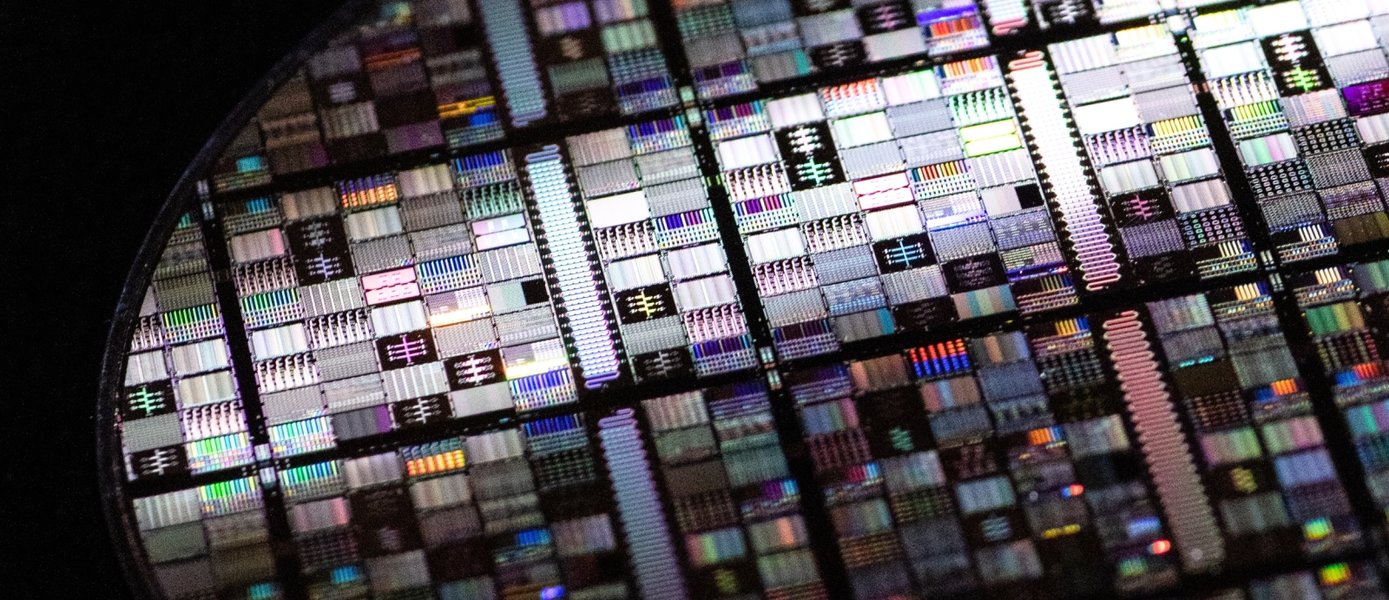
A cryogenic probe station used in superconducting qubit research and fabrication.
At its core, a superconducting qubit is an artificial atom or quantum dot implemented as a microfabricated circuit. The quantum information is encoded in its quantum states, typically the ground state (representing \(|0\rangle\)) and the first excited state (representing \(|1\rangle\)). To function effectively as a qubit, the energy levels must be distinct and controllable.
The Role of Josephson Junctions
A critical component enabling qubit functionality is the Josephson junction. This device consists of two superconducting electrodes separated by a very thin insulating barrier. Cooper pairs (paired electrons responsible for superconductivity) can tunnel across this barrier, a quantum mechanical effect. Crucially, the Josephson junction acts as a non-linear, dissipationless inductor. This non-linearity is essential because it makes the energy levels of the superconducting circuit anharmonic, meaning the spacing between consecutive energy levels is not constant. This allows researchers to isolate the two lowest energy states (\(|0\rangle\) and \(|1\rangle\)) and use them as the qubit states, addressing them precisely with microwave pulses without accidentally exciting higher energy levels.
The Building Blocks: Qubit Types and Architectures
Designing the Quantum Core
Several designs for superconducting qubits have been developed, each with its own advantages and disadvantages regarding coherence time, sensitivity to noise, ease of fabrication, and control.
Common Superconducting Qubit Types:
- Charge Qubits (e.g., Cooper Pair Box): These qubits encode information based on the number of Cooper pairs that have tunneled onto a small superconducting island connected to a reservoir via a Josephson junction. While relatively simple, they are highly sensitive to charge noise (fluctuations in background electric charges), limiting their coherence times.
- Flux Qubits: Information is encoded in the direction of supercurrent flowing in a superconducting loop interrupted by one or more Josephson junctions. The state depends on the magnetic flux threading the loop. They are generally less sensitive to charge noise but more susceptible to magnetic flux noise.
- Phase Qubits: These utilize the phase difference across a current-biased Josephson junction as the quantum variable. They were among the earliest types but have largely been superseded due to relatively short coherence times.
- Transmon Qubits: An evolution of the charge qubit, the Transmon (Transmission Line Shunted Plasma Oscillation Qubit) significantly reduces sensitivity to charge noise by increasing the ratio of Josephson energy (\(E_J\)) to charging energy (\(E_C\)). This is achieved by shunting the Josephson junction with a large capacitor. Transmons are currently the most widely used type due to their longer coherence times (tens to hundreds of microseconds) and relative ease of control and coupling.
- Fluxonium Qubits: These qubits use a Josephson junction shunted by a large "superinductor" (an array of Josephson junctions or a long superconducting wire). They offer protection against both charge and flux noise and can achieve very long coherence times, although they can be more complex to control.
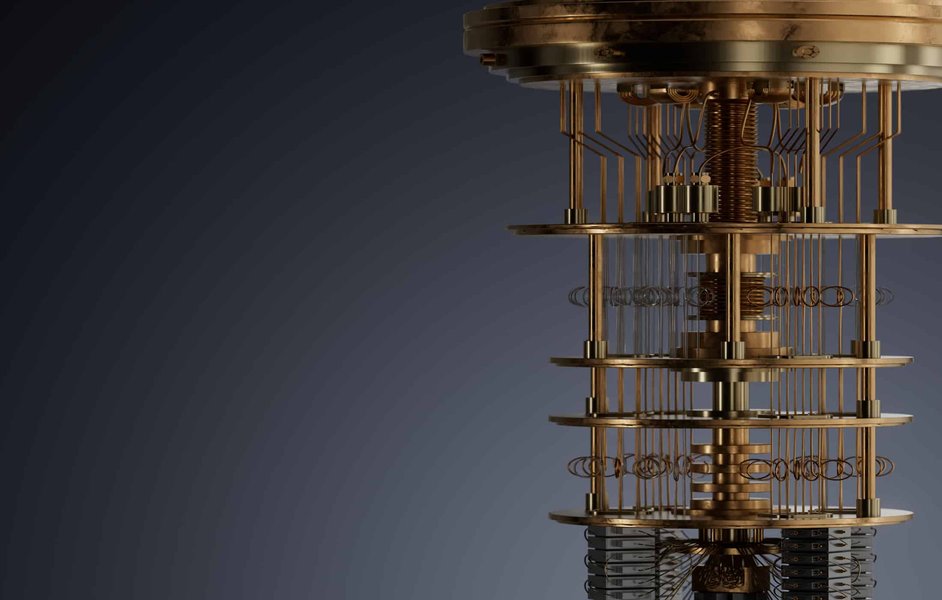
Illustration showing the basic structure of a Transmon superconducting qubit.
Circuit Quantum Electrodynamics (cQED)
Most modern superconducting quantum processors utilize the framework of circuit Quantum Electrodynamics (cQED). In this architecture, qubits are coupled to microwave resonators (cavities). These resonators serve multiple purposes:
- Readout: The state of the qubit affects the resonant frequency of the coupled cavity. By probing the cavity with a weak microwave signal, one can infer the qubit's state (\(|0\rangle\) or \(|1\rangle\)) non-destructively. This is known as dispersive readout.
- Coupling: Resonators can act as a "quantum bus" to mediate interactions between different qubits, enabling the two-qubit gates necessary for entanglement and complex algorithms.
- Protection: The cavity environment can help protect the qubit from certain types of environmental noise.
How Superconducting Quantum Computers Operate
Control, Measurement, and the Cryogenic Environment
Operating a superconducting quantum computer involves precise control and measurement sequences performed within an extreme cryogenic environment.
Control with Microwave Pulses
Qubit states are manipulated using carefully shaped microwave pulses applied to the qubit itself or its associated control lines.
- Single-Qubit Gates: Applying a microwave pulse at the qubit's transition frequency (typically in the GHz range) induces Rabi oscillations, rotating the qubit state on the Bloch sphere. The duration and phase of the pulse determine the specific quantum gate (e.g., X, Y, Hadamard gates).
- Two-Qubit Gates: Entangling gates (e.g., CNOT, CZ, iSWAP) are typically realized by temporarily tuning the qubits into resonance with each other or via a coupling element like a shared resonator or a tunable coupler. This interaction allows the state of one qubit to influence the state of the other. Techniques like cross-resonance gates or parametric modulation using flux tuning are common. The Hamiltonian for a driven qubit can be represented, in the rotating frame, as: \[ H_{\text{drive}} = \frac{\hbar}{2} \Omega(t)(\sigma_x \cos(\phi) - \sigma_y \sin(\phi)) \] where \(\Omega(t)\) is the Rabi frequency (amplitude of the drive) and \(\phi\) is the phase of the drive, controlling the axis of rotation on the Bloch sphere. \(\sigma_x\) and \(\sigma_y\) are Pauli matrices.
Readout and Measurement
As mentioned, dispersive readout via coupled resonators is the standard technique. A microwave tone probes the resonator, and the phase and amplitude of the reflected or transmitted signal depend on the qubit's state (\(|0\rangle\) or \(|1\rangle\)), which slightly shifts the resonator's frequency. This signal is very weak and must be amplified by near quantum-limited amplifiers (like Josephson Parametric Amplifiers - JPAs) operating at cryogenic temperatures before being processed by room-temperature electronics.
The Need for Extreme Cold
Superconductivity only occurs below a critical temperature (\(T_c\)), which for materials like aluminum is around 1.2 Kelvin. However, to minimize thermal noise that can cause decoherence, superconducting qubits must be operated at much lower temperatures, typically around 15-20 milliKelvin (mK). This is achieved using complex dilution refrigerators, which employ multiple cooling stages using mixtures of Helium isotopes (\({}^3\text{He}\) and \({}^4\text{He}\)). This cryogenic infrastructure is bulky, expensive, and requires careful engineering for wiring, thermal anchoring, and magnetic shielding.
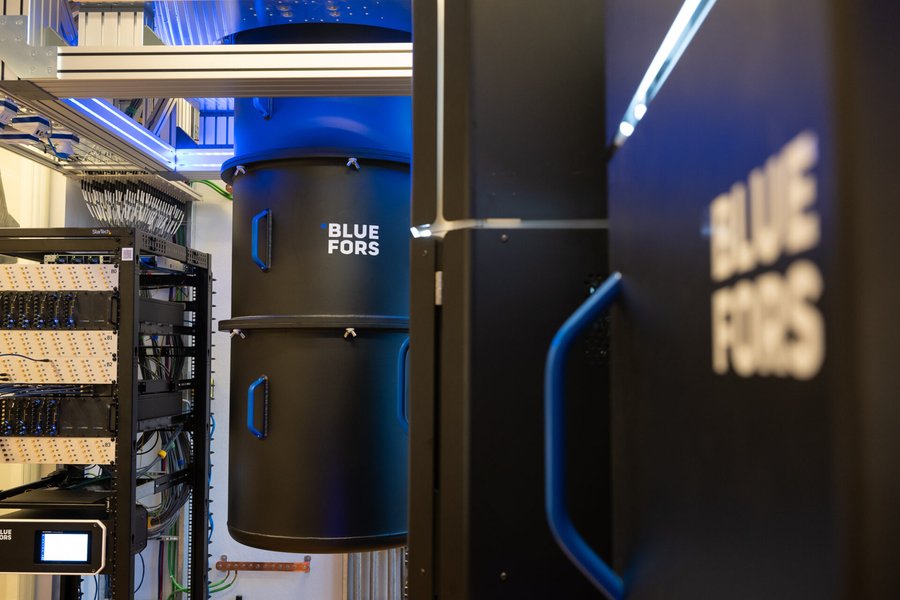
The complex internal structure of a dilution refrigerator housing superconducting quantum circuits.
Comparing Superconducting Qubit Types
A Balancing Act of Properties
Different superconducting qubit designs offer trade-offs between various desirable properties. The radar chart below provides a qualitative comparison of some key characteristics for common qubit types. Higher values generally indicate better performance or easier implementation in that category (note: this is a simplified representation; actual performance depends heavily on specific design and fabrication details).
This chart highlights why the Transmon qubit is currently favored: it strikes a good balance, particularly excelling in charge noise immunity and control fidelity compared to earlier designs like the charge qubit, while being simpler to fabricate and couple than more noise-resilient but complex designs like Fluxonium.
Mapping the Concepts of Superconducting Quantum Computing
Visualizing the Interconnected Ideas
To better understand the relationships between the core components and concepts in superconducting quantum computing, the following mind map provides a visual overview. It connects the foundational principles of superconductivity and quantum mechanics to the specific hardware elements, operational procedures, inherent challenges, and ultimate applications of this technology.
(Zero Resistance)"] id1b["Quantum Mechanics
(Superposition, Entanglement)"] id1c["Quantized Energy Levels"] id2["Key Hardware"] id2a["Superconducting Qubits
(Artificial Atoms)"] id2a1["Types"] id2a1a["Transmon"] id2a1b["Flux Qubit"] id2a1c["Charge Qubit"] id2a1d["Phase Qubit"] id2a1e["Fluxonium"] id2b["Josephson Junctions
(Non-linearity)"] id2c["Microwave Resonators
(cQED Architecture)"] id2d["Cryogenic System
(Dilution Refrigerator)"] id3["Operation"] id3a["Initialization"] id3b["Control (Microwave Pulses)"] id3b1["Single-Qubit Gates"] id3b2["Two-Qubit Gates"] id3c["Readout (Dispersive Measurement)"] id3d["Circuit QED Interaction"] id4["Major Challenges"] id4a["Decoherence
(Noise Sensitivity)"] id4b["Scalability
(Crosstalk, Connectivity)"] id4c["Error Correction
(Fidelity Limits)"] id4d["Cryogenic Complexity & Cost"] id4e["Fabrication Uniformity"] id5["Applications & Potential"] id5a["Cryptography
(Shor's Algorithm)"] id5b["Materials Science & Chemistry
(Simulation)"] id5c["Artificial Intelligence
(Machine Learning)"] id5d["Optimization Problems"] id5e["Fundamental Science"]
This mind map illustrates how the fundamental physics enables the creation of specialized hardware like qubits and Josephson junctions. These components are operated within a cQED framework using microwave control and require sophisticated cryogenic systems. While facing significant challenges like decoherence and scalability, the potential applications across various scientific and industrial domains drive intense research and development.
Major Hurdles and Ongoing Solutions
Navigating the Path to Fault Tolerance
Despite significant progress, building large-scale, fault-tolerant superconducting quantum computers faces substantial challenges.
Decoherence and Noise
Quantum states are incredibly fragile. Interactions with the surrounding environment (thermal fluctuations, electromagnetic noise, material defects) cause qubits to lose their quantum properties (superposition and entanglement) over time – a process called decoherence. Key metrics are the energy relaxation time (\(T_1\)) and the dephasing time (\(T_2\)). Extending coherence times is paramount. Research focuses on:
- Materials Science: Improving the quality of superconducting films and insulating layers to reduce defects and loss.
- Qubit Design: Developing qubit geometries less susceptible to specific noise sources (e.g., Transmon's reduced charge sensitivity).
- Environmental Shielding: Enhanced magnetic shielding and cryogenic filtering to isolate qubits.
- Surface Treatments: Techniques like chemical etching to remove surface contaminants that contribute to noise, as explored by Berkeley Lab.
Scalability and Crosstalk
Increasing the number of qubits on a chip introduces new problems. As qubits are placed closer together, unwanted interactions (crosstalk) can occur, leading to errors. Efficiently wiring and controlling thousands or millions of qubits while maintaining high fidelity and connectivity is a major engineering challenge. Solutions include:
- Advanced Chip Architectures: Optimizing qubit layout and connectivity (e.g., heavy-hex lattices).
- 3D Integration: Stacking chip layers for qubits and control wiring to manage density.
- Improved Couplers: Designing tunable couplers that can be switched on/off precisely to control interactions.
- Frequency Allocation: Carefully assigning operating frequencies to qubits and resonators to minimize interference.
Gate Fidelity and Error Correction
Current quantum gates are not perfect; they have small error rates. For complex algorithms requiring many gates, these errors accumulate, corrupting the result. Achieving "fault tolerance" requires implementing quantum error correction (QEC) codes. These codes use many physical qubits to encode one logical qubit, allowing errors to be detected and corrected. However, QEC requires extremely low physical error rates (typically below 0.1%) and significant qubit overhead. Current research focuses on:
- Improving Gate Fidelities: Refining control pulses and calibration techniques. State-of-the-art single-qubit gates achieve fidelities >99.9%, and two-qubit gates >99%.
- Developing Efficient QEC Codes: Designing codes like the surface code that are well-suited to the nearest-neighbor interactions common in superconducting architectures.
- Error Mitigation: Techniques used in the current NISQ (Noisy Intermediate-Scale Quantum) era to reduce the impact of errors without full QEC.
Cryogenic Infrastructure
As mentioned, the need for milliKelvin temperatures requires large, power-hungry dilution refrigerators. Scaling up the number of qubits also increases the heat load and the complexity of wiring and signal routing into and out of the cryogenic environment. Innovations are needed in cryo-electronics and packaging.
Summary of Challenges and Mitigation Approaches
The following table summarizes the key challenges facing superconducting quantum computing and the primary strategies being pursued to overcome them:
| Challenge | Description | Mitigation Strategies |
|---|---|---|
| Decoherence | Loss of quantum state information due to environmental noise (thermal, electromagnetic, material defects). Limits computation time. | Improved materials, optimized qubit designs (e.g., Transmon, Fluxonium), better shielding, Purcell filters, surface treatments, operation at mK temperatures. |
| Scalability & Connectivity | Difficulty in increasing qubit count while maintaining control, connectivity, and low crosstalk. | Advanced chip layouts (2D/3D integration), optimized wiring, tunable couplers, frequency allocation management, modular architectures. |
| Gate Fidelity & Errors | Imperfections in quantum gate operations leading to computational errors. | Pulse shaping optimization, calibration techniques, quantum error correction codes (e.g., surface code), error mitigation techniques. |
| Readout Errors | Inaccuracies in measuring the final state of the qubits. | Quantum-limited amplifiers (JPAs), improved resonator design, advanced signal processing. |
| Fabrication Variance | Small inconsistencies during manufacturing leading to variations in qubit properties (e.g., frequency). | Improved lithography and etching processes, laser annealing for frequency tuning, robust qubit designs. |
| Cryogenic Complexity | Need for expensive, large, and complex dilution refrigerators and associated infrastructure. | Development of cryo-CMOS control electronics, improved thermal management, potential for higher-temperature superconductors (long-term goal). |
Recent Advancements and Future Directions
Pushing the Boundaries of Quantum Computation
The field of superconducting quantum computing is progressing rapidly, driven by academic research and significant industrial investment.
Scaling Qubit Numbers
Companies and research groups are continuously increasing the number of qubits in their processors. As of early 2025, systems with several hundred qubits have been announced or demonstrated, such as Fujitsu and RIKEN's 256-qubit hybrid system and processors from Google and IBM exceeding the 100-qubit mark. These advancements focus not just on quantity but also on quality – improving coherence times, gate fidelities, and connectivity within these larger systems.
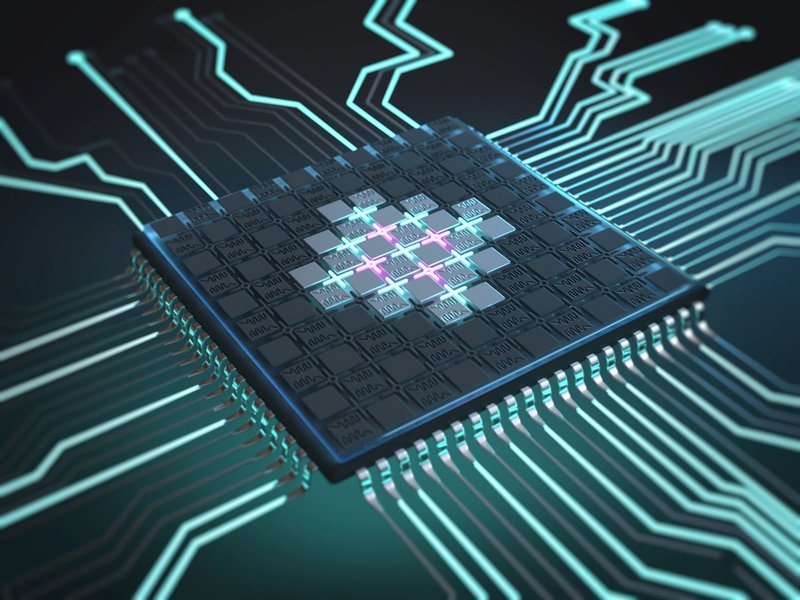
Artistic visualization of a multi-qubit superconducting processor chip.
Towards Fault Tolerance
Significant theoretical and experimental work is underway to implement quantum error correction. Research groups, like those at MIT, are making progress in demonstrating the fundamental components needed for fault-tolerant architectures, such as improved qubit interactions and demonstrations of basic error correction protocols on small numbers of qubits. New qubit designs aiming for inherent noise protection are also being explored.
Manufacturing and Engineering
The field is shifting towards "quantum engineering," integrating principles from materials science, electrical engineering, and computer science. Advances include using standard semiconductor manufacturing processes (e.g., CMOS fabrication on 300-mm wafers) to improve yield and uniformity, potentially lowering costs and accelerating development.
Hybrid Approaches
Many near-term applications involve hybrid quantum-classical algorithms, where a quantum processor works in tandem with classical computers. Optimizing this interface and developing algorithms suited for current NISQ devices is an active area of research.
Exploring Superconducting Qubits Visually
The following video provides an accessible overview of how superconducting circuits, particularly Transmons, are used to build quantum computers, covering concepts like circuit QED and control mechanisms.
This video explains the basics of superconducting circuits like the transmon used by IBM, discusses circuit QED, and provides context on how these physical systems function as qubits, complementing the technical details discussed here.
Potential Applications
Revolutionizing Science and Industry
If large-scale, fault-tolerant superconducting quantum computers can be realized, they promise to revolutionize numerous fields:
- Cryptography: Shor's algorithm could break widely used encryption schemes like RSA. Quantum computers could also enable new forms of secure communication (Quantum Key Distribution).
- Materials Science and Chemistry: Simulating the behavior of molecules and materials at the quantum level could lead to the discovery of new catalysts, drugs, and materials with desired properties (e.g., high-temperature superconductors, efficient solar cells).
- Artificial Intelligence and Machine Learning: Quantum algorithms could accelerate certain machine learning tasks, potentially leading to breakthroughs in AI.
- Optimization: Solving complex optimization problems in logistics, finance, and manufacturing that are intractable for classical computers.
- Fundamental Science: Simulating quantum systems could deepen our understanding of physics, from particle physics to cosmology.
While still in development, the potential impact drives the intense global effort to build functional superconducting quantum computers.
Frequently Asked Questions (FAQ)
What makes a circuit "superconducting"?
A circuit becomes superconducting when it's made from specific materials (like aluminum or niobium) and cooled below their critical temperature (typically near absolute zero). In this state, the material loses all electrical resistance, allowing current to flow without energy loss. This property is crucial for maintaining delicate quantum states in qubits.
Why are Josephson junctions so important?
Josephson junctions provide the essential non-linearity required for superconducting qubits. A simple superconducting circuit (like an LC oscillator) has evenly spaced energy levels, making it hard to isolate just two levels for a qubit. The non-linear inductance of the Josephson junction creates anharmonicity – uneven spacing between energy levels. This allows precise targeting of the lowest two states (\(|0\rangle\) and \(|1\rangle\)) with microwave pulses, forming a controllable qubit.
What is the difference between T1 and T2 coherence times?
\(T_1\) (Energy Relaxation Time): This measures how long a qubit in the excited state (\(|1\rangle\)) takes to decay back to the ground state (\(|0\rangle\)) by losing energy to its environment.
\(T_2\) (Dephasing Time): This measures how long a qubit can maintain a specific phase relationship in a superposition state (e.g., \((|0\rangle + |1\rangle)/\sqrt{2}\)). Dephasing is caused by fluctuations in the qubit's frequency and is usually faster than energy relaxation (\(T_2 \le 2T_1\)). Both times limit the duration of quantum computations.
Are superconducting quantum computers the only type?
No, superconducting qubits are one of the leading platforms, but several other promising approaches exist. These include trapped ions, photonic quantum computers, neutral atoms, topological qubits, and silicon-based spin qubits. Each platform has its own strengths and weaknesses regarding qubit stability, scalability, connectivity, and operating requirements.
Recommended Further Exploration
- How do Josephson junctions create anharmonicity in superconducting qubits?
- What are the latest advancements in quantum error correction for superconducting systems?
- Compare superconducting qubits with trapped ion quantum computers.
- Explain the role of circuit QED in qubit readout and coupling.
References
Last updated April 30, 2025